Last updated October 26, 2026
Summary
- Flyer distribution is legal in most of the US, but your city, county, and state set the rules, so check them first
- Never put flyers in or on a mailbox: federal law (18 U.S.C. 1725) and USPS rules reserve it for mail with postage
- Some cities require a permit or license for commercial handouts, and private property needs the owner's permission
- Respect posted "No Soliciting" signs, and don't leave flyers on parked cars where local rules prohibit it
- Door hangers and Hand-to-Hand distribution reach people legally on the street and at the door, and EDDM is the legal route into the mailbox
Last updated: October 2026
Distributing flyers in your neighborhood is a simple way to boost local visibility, promote your business, or spread the word about an event. Offline marketing like flyer distribution puts a physical message in front of the people who live and work near you.
But is it legal to put flyers around? Mostly, yes. The rules are set by your city, county, and state, plus one federal rule about mailboxes, so it's worth knowing them before your first drop.
In this guide, we'll walk you through how to distribute flyers legally while making sure your message reaches the right people. It's general guidance, not legal advice, so check your local ordinance before you launch.
What is flyer distribution?
Flyer distribution is a marketing method that involves handing out printed promotional materials, such as flyers or leaflets, directly to potential customers. Businesses use it to build brand awareness, promote special offers, or announce events.
Flyering is a long-standing form of offline marketing. Compared with online marketing methods, which can oversaturate people with messages, flyers let you put your message directly in front of the customers you want to reach.
The information on your flyer encourages the reader to take action, whether that's buying something, placing an order, or attending an event.
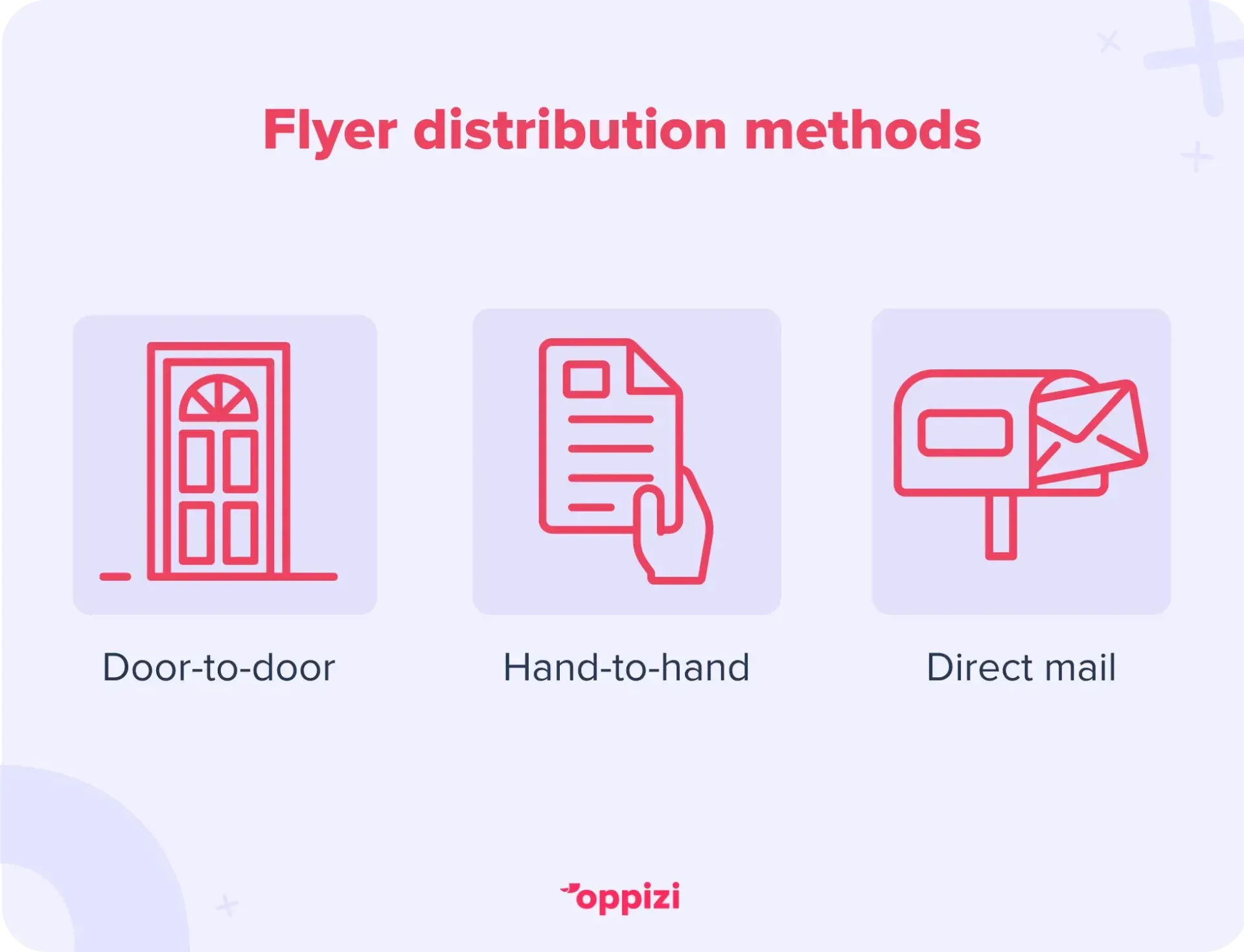
To get there, you need a plan for how you'll deliver your flyers and a check that the method is legal where you're working. There are three main methods:
Where can you legally distribute flyers?
In many places, as long as you know the rules for each. These are the most common locations in the US and what to watch for at each:
- Public sidewalks and pedestrian areas: Handing flyers to willing passersby on a public sidewalk is generally permitted. Keep walkways clear, don't block entrances, and check whether your city requires a permit for commercial distribution.
- Residential doorsteps and door handles: Leaving a flyer at a front door or looped over a door handle is legal in most areas, provided no "No Soliciting" or "No Trespassing" sign is posted. Don't tape flyers to doors without permission, as some cities treat this as unauthorized posting.
- Apartment buildings and gated communities: Lobbies, common areas, and locked entrances need management permission. Always ask before entering a secured building or complex.
- Community bulletin boards: Libraries, coffee shops, laundromats, gyms, and community centers often have boards for flyers. Ask staff before posting and follow any size or removal rules.
- Farmers markets and community events: Distributing at local events is usually allowed, but check with the organizer first. Some require vendor registration or limit handouts to approved zones.
- Cars and vehicles: Avoid placing flyers on parked cars. Many cities restrict leaving unsolicited material on vehicles, and violations can bring fines.
- Utility poles, trees, and street signs: Many cities prohibit posting on public fixtures and remove what's posted, sometimes with a fine. Use approved posting surfaces.
- Mailboxes: Never. Only mail with postage may go in or on a mailbox. More on that below.
One important note: rules vary by city and state. A method that's fine in one city can need a permit, or be banned in certain zones, in the next. When in doubt, check your city's municipal code or work with a distribution partner that plans around local rules. If you're choosing locations for reach rather than legality, see the best places to distribute flyers.
Do you need permission to distribute flyers?
Whether you're distributing flyers yourself or hiring an agency, you might wonder about the legal side of things.
In most cases, you don't need explicit permission to distribute flyers in public spaces, but there are regulations to consider. Rules vary by location, and local laws may require a permit, especially in certain cities or high-traffic areas.
Leaving flyers on private property, such as at businesses, without permission is prohibited in some cities, and placing them in mailboxes is prohibited everywhere in the US under federal law. To avoid fines or penalties, check with local authorities in the area you're targeting.
So before we look at how to hand out flyers effectively, let's review the rules that apply in the United States.
Legal considerations for flyer distribution
Distributing flyers is a practical way to promote your business, but it's essential to understand how to do it legally to avoid fines or penalties. Laws vary widely by location, so learn the rules where you're operating.
In the US, many cities and counties regulate "handbill" distribution, especially in public places like sidewalks, streets, or parks, and some require a license or permit for commercial distribution. States can set rules too. Florida, for example, added section 501.062 to its statutes, effective July 1, 2026: a person may not engage in commercial solicitation at a home that displays a qualifying "No Commercial Solicitation" sign. A first violation is a noncriminal violation with a fine of up to $500, and a second or later violation is a second-degree misdemeanor (Fla. Stat. 501.062).
While getting a permit usually isn't complicated, it can add to your campaign costs. If you're unsure about local rules, working with a flyer distribution company can simplify the process, as it'll handle the logistics and plan around local requirements.
How to distribute flyers legally: 8 essential tips
To make your flyer distribution campaign both effective and legally compliant, follow these eight tips:
1. Check local regulations
Research the rules governing flyer distribution in your area. Some cities require permits for public distribution, while others have designated zones where flyering is prohibited. For commercial campaigns in particular, check whether your city requires a solicitation license before you begin.
2. Obtain necessary permissions
Always ask before distributing flyers on private property, at businesses, or on vehicles. Ignoring "No Solicitation" or "No Trespassing" signs can result in fines or legal action. For public spaces, contact local authorities to find out whether a permit is required.
3. Use approved distribution methods
- Door-to-Door: Deliver flyers to homes, but never in or on mailboxes. Federal law reserves the mailbox for mail with postage.
- Hand-to-Hand: Hand flyers directly to people in public areas, with a permit where one is required.
- Direct mail: Use addressed direct mail or Every Door Direct Mail (EDDM) to reach mailboxes legally through the USPS.
4. Respect restricted areas
Avoid distributing flyers in restricted zones such as schools, hospitals, and government buildings unless you have explicit permission. Many of these sites have their own rules to maintain order and privacy.
5. Avoid littering
Distribute flyers responsibly to prevent littering. Flyers dropped on sidewalks, parking lots, or public spaces can lead to fines and damage your brand's reputation. Consider adding a note on your flyers encouraging recipients to recycle them.
6. Time your campaign appropriately
Distribute flyers at times that are convenient and non-disruptive for your audience. For residential neighborhoods, mid-mornings or early evenings are often ideal, while in business districts, lunchtime tends to work best.
7. Comply with advertising standards
Make sure your flyer content follows advertising standards. Avoid misleading claims, offensive content, or inappropriate imagery, as these can lead to legal disputes or complaints.
8. Partner with professional distributors
Hiring a reputable flyer distribution company can simplify the process and help with compliance. These companies are often familiar with local regulations and can handle permitting, route planning, and distribution logistics on your behalf.
Can you put flyers in mailboxes?
No. Under federal law, it's an offense to knowingly deposit mailable matter "on which no postage has been paid" in any letter box approved by the Postal Service, with intent to avoid paying postage, and each offense carries a fine (18 U.S.C. 1725). The Supreme Court upheld the rule against a First Amendment challenge in 1981 (U.S. Postal Service v. Council of Greenburgh Civic Associations).
USPS rules go further than the inside of the box. No part of a mail receptacle may be used for matter without postage, "including items or matter placed upon, supported by, attached to, hung from, or inserted into a mail receptacle" (USPS DMM 508.3.1.3). So no flyers tucked behind the flag or rubber-banded to the box either. If you want to reach the mailbox, send it as mail. USPS Every Door Direct Mail (EDDM) lets you target entire ZIP Codes or carrier routes without a mailing list, and EDDM Retail doesn't need a mailing permit. For the full rule set, see our USPS EDDM requirements guide.
Is it legal to put flyers on doors?
Yes. Leaving a flyer at a residential front door is legal in most of the United States. What matters is how you leave it and what the property signals about solicitation.
- Door handles and doorknobs: Looping a flyer or door hanger over a handle is the standard Door-to-Door method and is generally legal without the resident's prior consent. See door hangers vs flyers for when each format fits.
- Taping flyers to doors: Some cities treat sticking promotional material to a door as unauthorized posting. Use door hangers or leave flyers loose instead.
- "No Soliciting" and "No Trespassing" signs: These signs can legally restrict your ability to approach a property or leave material. Respect them. Ignoring a posted sign can lead to fines or trespass complaints, and in Florida a qualifying sign is backed by state law.
- Apartment buildings: Building management controls access to common areas, corridors, and unit doors. Get written permission from property management before distributing inside a multi-unit building.
- Gated communities and HOAs: These need access permission from the management company or HOA board. Don't enter restricted areas without authorization.
The one firm rule across all 50 states: never place flyers in or on a mailbox.
How to distribute legally
Flyer marketing works best when it's done within legal guidelines. Each distribution method has its own rules, so understand what's allowed in your area before launching a campaign.
Door-to-door distribution
Door-to-Door flyering is a widely used distribution method for local marketing.
In the US, permits generally can't be required for non-commercial flyers like political, religious, or community messages: the Supreme Court struck down a permit rule for door-to-door advocacy and handbill distribution in Watchtower Bible & Tract Society v. Village of Stratton (2002). Commercial campaigns are treated differently, and some cities require a permit or license for them. Research local regulations before you begin.
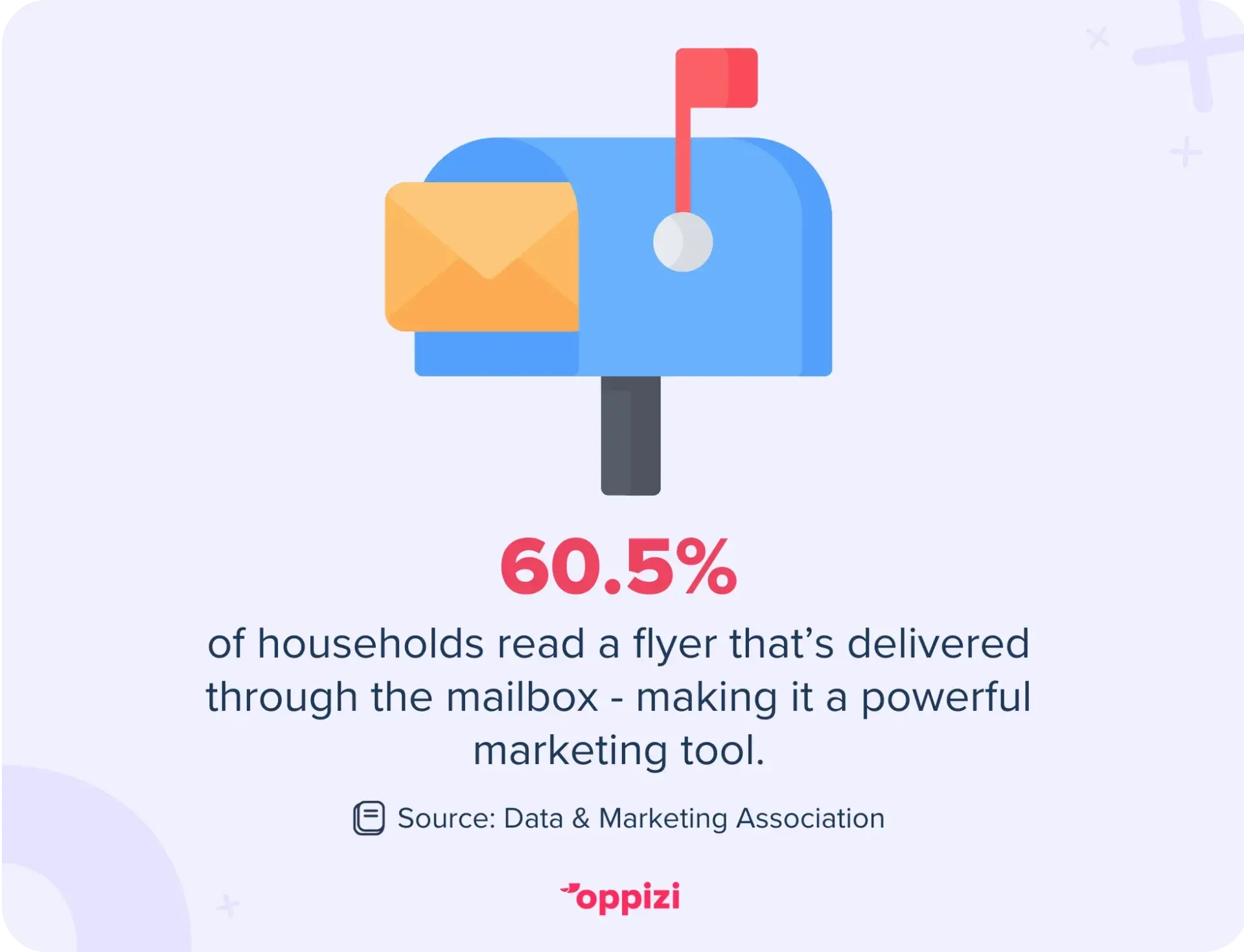
You must also respect any "No Solicitation" or "No Trespassing" signs. Ignoring them can lead to fines. And under federal law, flyers can't go inside mailboxes unless they're mailed through the US Postal Service with postage.
Hand-to-hand flyering
Distributing flyers by hand in public places, like sidewalks, events, or business districts, puts your message directly in front of foot traffic. Local laws may require permits or set rules about where and how you can distribute materials.
You'll also need permission from property owners to flyer on private premises like parking lots or building entrances. Get that approval in writing to protect yourself.
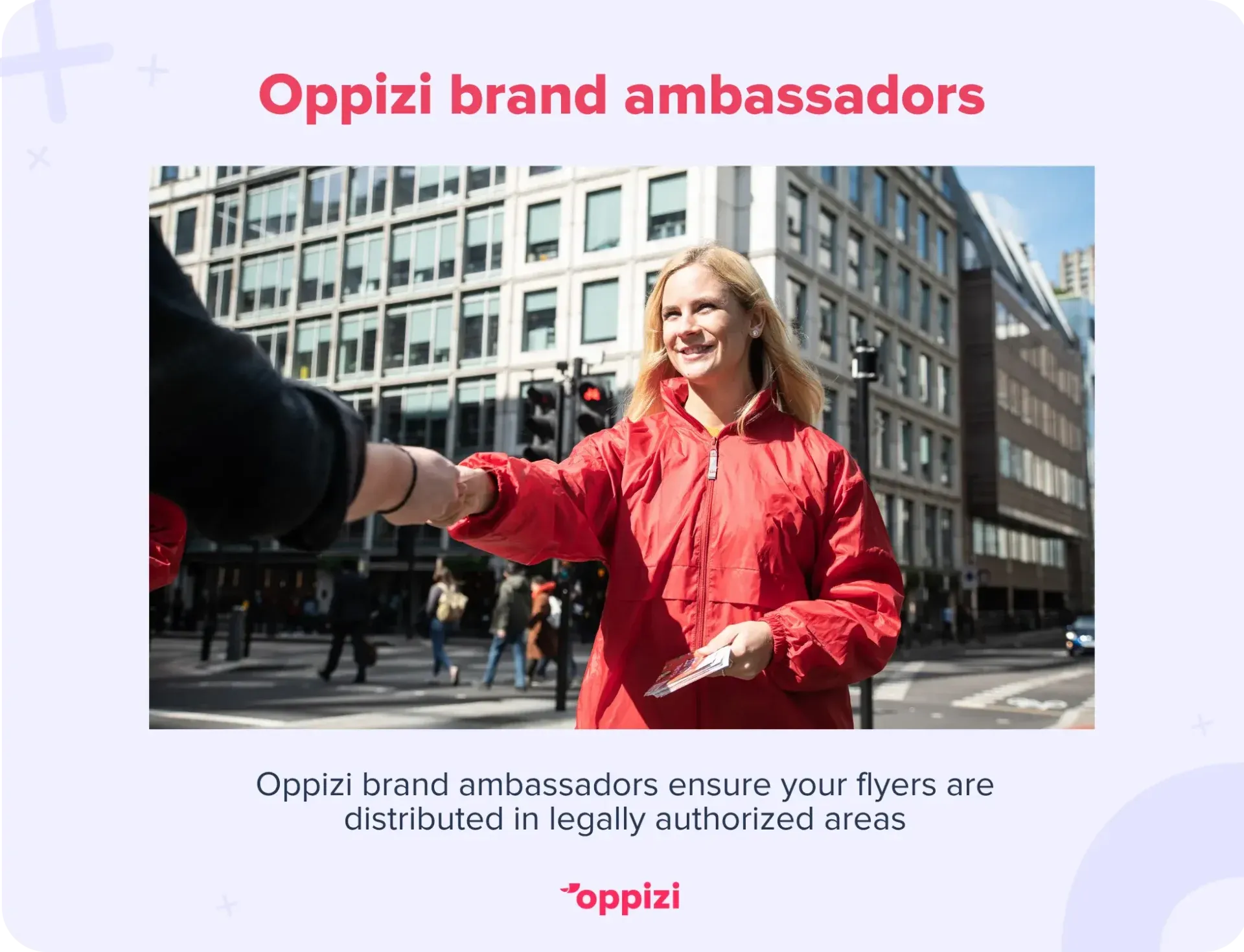
To simplify things, many businesses choose to work with a flyer distribution service like Oppizi, whose Brand Ambassadors plan each mission around local rules.
How to target specific neighborhoods for flyering
Flyering lets you put your message in a specific place, down to the street. Targeting the right neighborhoods rather than distributing broadly makes every mission count.
Choose neighborhoods by audience fit, not just geography
Before planning routes, define who you want to reach. Families, renters, homeowners, students, and young professionals cluster in different parts of a city. Match the neighborhood to your offer: a home services campaign should prioritize owner-occupied streets, and a student promotion should focus on areas near universities and rental housing.
Narrow the map to streets and blocks
Once you have your neighborhoods, work at the street level. Apartment clusters and mixed-use corridors near retail suit Hand-to-Hand campaigns; single-family residential streets suit Door-to-Door drops. Oppizi OS ranks suburbs and streets based on household density, geography, and campaign goals, so you're not guessing which blocks to cover. Every mission comes with GPS tracking, app check-ins, geotagged photo proof, and real-time reporting, so you can see which streets were covered.
Start with a pilot, then scale
Test two or three neighborhoods before committing to a full city rollout. Give each area its own promo code or landing page so you can compare results, then expand into the strongest zones on your next run. For the full method, see how to target specific demographics with flyers and how to measure flyer ROI.
Flyer distribution companies and legal compliance
One of the easiest ways to stay on the right side of the law is to partner with a professional flyer distribution company. Good distributors understand local US regulations, including where permits are required for public distribution and how to avoid trespassing, solicitation, and littering violations.
If your flyer's call to action collects personal information, such as a sign-up form, make sure you handle that data under the privacy laws that apply to your business, such as California's CCPA.
Partnering with a professional flyer distribution company helps keep these details handled, minimizing risk for your business.
How do I choose the right flyer distribution company?
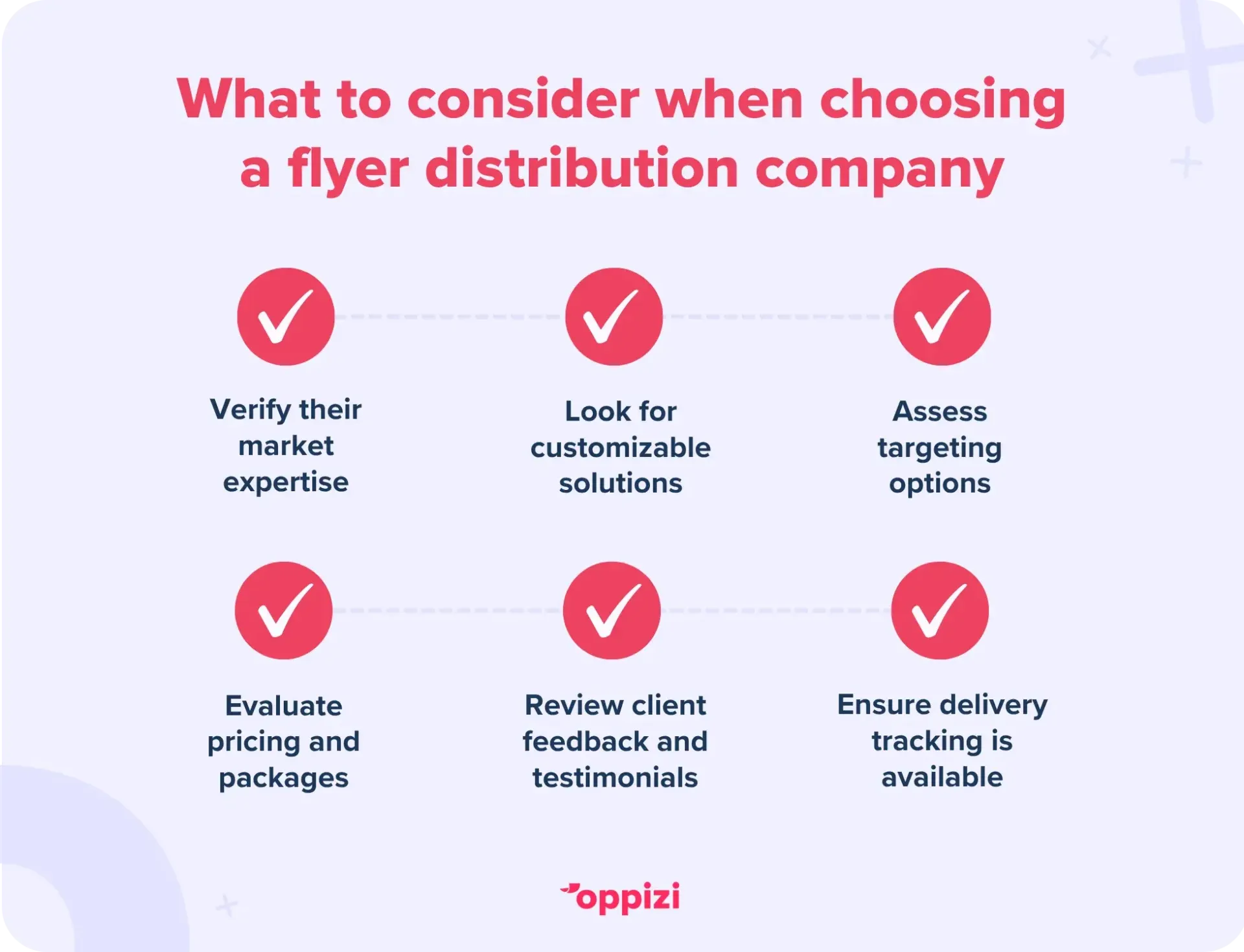
If you're hiring a flyer distribution company, here are the key things to look for:
Expertise
Choose a company with a strong track record. Look for reviews and testimonials from similar businesses. An experienced company will be better equipped to handle logistics and potential challenges, and to distribute your flyers legally.
Volume
Know how many flyers you want to distribute and whether the company can handle that volume. Some charge more for small batches, so check for volume-related pricing or hidden fees.
Flyer size
Common US flyer sizes include 8.5 x 11 inches and 5.5 x 8.5 inches. If you need a different flyer size, confirm the company can accommodate it.
Process and compliance
When you're comparing companies, pay close attention to their processes. You'll want to understand two things:
- Do they have the relevant permissions to distribute your flyers legally using the channel you've selected?
- What process is in place to make sure their teams deliver the flyers as promised, such as GPS tracking and photo proof?
Collection
Find out whether they'll collect the flyers from you or you'll need to deliver them. This can affect your decision depending on time or location.
Reviews
Check Google reviews, testimonials on their site, and third-party platforms to get a sense of their reputation.
Social media
Scan their social media accounts for public feedback. Look out for negative comments or poor customer interactions.
Connections
If you want flyers placed in local businesses, choose a company with strong local ties, since placements depend on those relationships.
Cost
Understand the full cost upfront. Ask about collection fees, permit charges, and whether pricing changes with volume. For example, a low per-unit rate might only apply to high-volume orders.
Take your flyer distribution to the next level
Flyer distribution remains a practical form of marketing in the digital age. It can help you stand out with a local audience, as long as your campaigns are run legally and measured properly.
At Oppizi, our Brand Ambassadors run Hand-to-Hand and Door-to-Door missions planned around local rules, with GPS tracking, app check-ins, geotagged photo proof, and real-time reporting. Whether you're targeting a specific neighborhood, piloting a new market, or scaling across multiple cities, we've got you covered.
Create a flyering campaign with Oppizi today and see what professional flyer distribution can do.
Frequently asked questions
- How do you distribute flyers legally in the United States?
Flyer distribution laws vary by city and state, but generally you need permission to distribute on private property or in restricted areas. Public spaces often allow distribution if you don't obstruct traffic or litter. Some cities require permits for busy areas or commercial door-to-door distribution, and mailboxes are off-limits everywhere, so check local regulations first.
- Where can I legally distribute flyers?
Legal locations include public sidewalks, residential doorsteps, community bulletin boards at libraries and coffee shops, farmers markets and events with organizer permission, and private businesses with owner approval. Avoid mailboxes, utility poles, parked cars, and gated communities or apartment buildings without management permission. Rules vary by city, so verify local ordinances before launching a campaign.
- Is it legal to put flyers on doors?
Yes. Leaving a flyer at a residential front door or looped over a door handle is legal in most of the US, provided no "No Soliciting" or "No Trespassing" sign is posted. Don't tape flyers to doors, as some cities treat this as unauthorized posting. Apartment buildings and gated communities need management permission, and mailboxes are always off-limits.
- Can you put flyers in mailboxes?
No. Federal law (18 U.S.C. 1725) prohibits depositing unstamped mailable matter in a mailbox approved by the Postal Service, and USPS rules extend that to anything placed on, attached to, or hung from the box. A flyer can only reach a mailbox as mail with postage, for example through Every Door Direct Mail (EDDM).
- Can you target specific neighborhoods for flyering?
Yes. Choose neighborhoods based on your target audience's profile, then narrow distribution to specific streets or blocks. Give each zone its own promo code or landing page so you can see which neighborhoods respond best, then scale into your strongest areas. Oppizi OS supports suburb and street-level selection guided by household density and campaign goals.
- What are the most effective flyering methods?
Hand-to-Hand distribution reaches foot traffic in busy public places, and Door-to-Door distribution reaches homes in targeted residential streets. Both work best with a clear audience, a clear call to action, and a trackable element like a promo code, so you can measure results by location. Direct mail through EDDM covers the mailbox legally.
- How do you hand out flyers door to door?
To distribute flyers door to door legally and efficiently, plan your streets, leave flyers at the door or on the handle rather than in the mailbox, and skip homes with "No Soliciting" signs. Services like Oppizi run Door-to-Door missions with trained Brand Ambassadors who follow local regulations on every route.
- How long does it take to hand out 1,000 flyers?
With one to two of Oppizi's three-hour missions, 1,000 flyers can usually be distributed, depending on the area and method. Our Brand Ambassadors work through planned routes to cover your targeted streets, and every mission is tracked with GPS, app check-ins, and geotagged photo proof, so you can see where your flyers went.
- Is it legal to distribute flyers in public places?
Yes, in most cases. Handing flyers to willing passersby on public sidewalks is generally permitted, but follow local regulations: some cities require permits for commercial distribution or high-traffic locations, and some areas are restricted. Keep walkways and entrances clear, don't litter, and ask organizers or owners before distributing at events or on private property.
- What are the best times to hand out flyers?
The best time to hand out flyers depends on your audience. For residential neighborhoods, mid-mornings or early evenings are often ideal. In business districts, lunchtime tends to work best. Near events, distribute as people arrive. Whatever the timing, choose moments that are convenient and non-disruptive for the people you're trying to reach.
- Can businesses outsource flyer distribution?
Yes. Businesses can partner with flyer distribution experts like Oppizi, which handles end-to-end flyer distribution, including route planning, Brand Ambassador management, and campaign tracking. Missions are planned around local rules and reported with GPS tracking, app check-ins, geotagged photo proof, and real-time reporting, so you can measure results.