Last updated October 15, 2026
Summary
- Direct mail's main advantages are tangibility, precise targeting, personalization, measurability, and a long life in the home
- Its main disadvantages are cost, lead time, environmental impact, and the risk of being treated as junk mail
- Cold addressed mail averages a 1% response rate and 2.1x the campaign cost in revenue, per the UK-measured JICMAIL tracker
- Oppizi runs addressed direct mail, EDDM, inserts, and flyering from one platform, with campaign tracking and no monthly platform fee
- Direct mail is worth it when targeting, creative, and measurement are planned in from the start
Last updated: October 2026
Direct mail marketing can be a powerful way to connect with your audience and promote your business. However, like any strategy, it comes with its own set of challenges. In this article, we'll explain what direct mail advertising entails and dive into its advantages and disadvantages, helping you decide if it's the right approach for your business.
What is direct mail marketing?
Direct mail marketing is a traditional form of offline marketing that involves sending physical promotional materials directly to a recipient's mailbox. Unlike digital marketing, which relies on emails or online ads, direct mail marketing uses tangible items to engage customers.
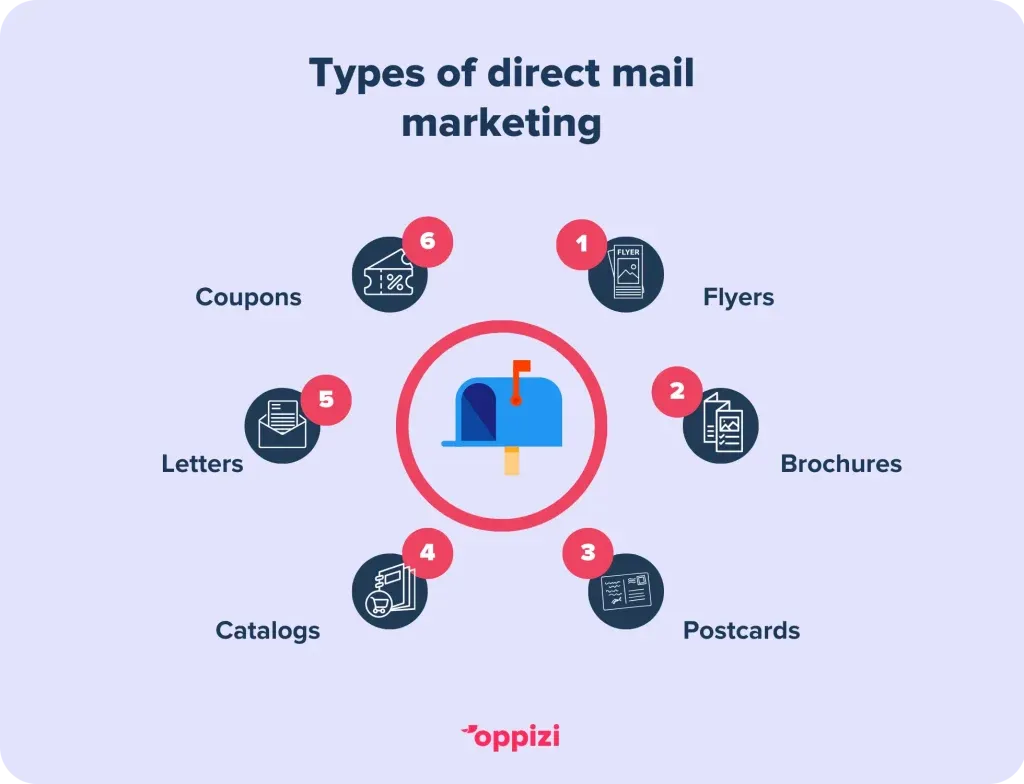
These materials can take many forms, including:
- Advertisements: Flyers, brochures, or postcards that highlight special offers, new products, or events.
- Catalogs: Comprehensive collections of products or services, often used by retailers or specialty companies.
- Personalized letters: Customized messages aimed at building a direct connection with the recipient.
- Coupons and discount codes: Incentives to encourage purchases or visits.
What are the advantages of direct mail marketing?
The main advantages of direct mail are that it's tangible, targeted, personal, and measurable, and it stays in the home far longer than a digital ad stays on screen. It often reaches people that crowded digital channels miss, filling the gaps left by digital methods. Here are a few reasons why businesses should consider using direct mail advertising:
Direct mail marketing can boost brand retention
Direct mail can improve brand awareness as it keeps your brand top of mind for both existing and potential customers. Sending postcards, flyers, or personalized letters serves as a tangible reminder of your offerings in a crowded market, where retaining customer loyalty is increasingly challenging.
Direct mail is personal and highly targeted
Direct mail campaigns can be precisely tailored to target specific demographics, locations, or purchase behaviors. A named, relevant piece in the mailbox reads as a message to one household rather than an ad to everyone, which makes it an effective tool for engaging the right audience.
Direct mail is tangible and interactive
Physical pieces of mail offer a sense of tangibility and interactivity that digital channels often lack. People are more likely to take notice of a piece of mail that physically lands on their doorstep than an email that gets lost in their spam folder.
Direct mail is long-lasting
Unlike digital ads, which can disappear or become outdated very quickly, physical mail can stay visible for weeks after it's sent. Royal Mail's UK research, The Private Life of Mail (2015), found that advertising mail is kept in a household for an average of 17 days. That gives a single campaign multiple chances to be seen.
Direct mailing is targeted
Direct mail allows businesses to precisely target specific audiences based on demographics, location, and past behaviors, so the message reaches the households most likely to be interested.
Direct mail is personalized
With modern printing techniques, direct mail can be customized with individual names and tailored messages, creating a more personal experience for recipients.
Direct mailing is less competitive
While digital marketing is saturated with ads, direct mail stands out as a tangible piece of content, facing less competition in the mailbox than in the feed.
How does direct mail's response compare with email?
On raw response, email is ahead, and on return, mail makes its case. Cold addressed mail averages a 1% response rate and door drops 0.3%, per the UK-measured JICMAIL Response Rate Tracker, which measured 4,939 campaigns through matchback and tracking codes rather than by survey. Email marketing posted a 2.3% unique click rate in 2024, per the DMA Email Benchmarking Report 2025. JICMAIL puts cold mail at 2.1 times the campaign cost in revenue, rising to 2.7 times above 100,000 pieces.
Direct mail marketing can generate leads
Many consumers who respond to direct mail are willing to share their contact information, which turns a campaign into a lead generation channel. Offering incentives, such as free giveaways or discounts, can further encourage recipients to provide their details, which businesses can use for future marketing initiatives.
Direct mail marketing does not require explicit GDPR consent
In the US, the CAN-SPAM Act covers commercial email, not postal mail. In the UK, the ICO confirms that postal marketing isn't covered by the PECR electronic marketing rules and can rely on legitimate interests rather than consent, provided you meet that basis's requirements. It's still good practice to honor opt-out requests and handle mailing data responsibly.
Direct mailing can be measured
Direct mail campaigns can be tracked through unique codes, URLs, or response cards, providing measurable insights into campaign performance and ROI.
What are the disadvantages of direct mail marketing?
The main disadvantages of direct mail advertising are cost, lead time, environmental impact, and the risk of being ignored. Printing and postage add up, campaigns take longer to deploy and deliver, and mail sent without targeting or creative care ends up in the recycling bin instead of on the fridge. Here's what to plan for:
Can be time-consuming
Creating, printing, and sending direct mail requires significant time and planning compared to digital campaigns, which can be deployed instantly. While it's true that you can send out mail and have it delivered quickly, it can take some time for the recipient to receive the mail and open it.
Depending on the mailing list's size and the mail service's speed, it can take several days or even weeks for the entire mailing to be delivered. This longer lead time can delay reaching potential customers or responding to market trends.
Can be expensive depending on the provider
Direct mail can be expensive to produce and distribute because of postage, printing, and other associated costs. Depending on the size of a mailing list and the frequency with which mail pieces are sent out, businesses may find the cost of direct mail marketing to be prohibitive. Pricing varies widely by provider: with Oppizi, addressed direct mail runs $0.54 to $0.65 per piece with data included, and there's no monthly platform fee.
There are environmental concerns
The production and distribution of physical mail may raise sustainability issues, and some direct mail initiatives may hurt a company's image among environmentally conscious consumers. Tight targeting cuts wasted print, and choosing a provider that invests in climate action helps: Oppizi funds climate projects through Ecologi.
Could be perceived as junk mail
Some people may ignore or discard direct mail pieces without even reading them, especially if they appear overly commercial or don't apply to their interests. Direct mail could also be perceived as intrusive or annoying, especially if it's sent out too frequently.
Is direct mail worth it?
For most businesses trying to reach customers in a defined area, yes, as long as targeting, creative, and measurement are planned in from the start. Direct mail offers unique advantages, including targeted outreach, tangible engagement, and effective lead generation. However, it's important to recognize its constraints and to approach it in a sustainable and targeted way.
That's where a platform like Oppizi helps. Oppizi runs addressed direct mail, EDDM, inserts, and flyering from one platform, so you can plan, launch, and track campaigns in one place, while supporting sustainability through climate projects.
Ready to put your brand in the mailbox? Launch your direct mail campaign with Oppizi in just minutes.
Frequently asked questions
- What are the advantages of direct mail?
Direct mail is tangible, targeted, and personal, and it stays in the home longer than a digital ad stays on screen. Campaigns can be tracked with unique codes and URLs, so results report like any other channel. Oppizi runs addressed direct mail, EDDM, inserts, and flyering from one platform, with campaign tracking built in.
- What are the disadvantages of direct mail advertising?
The main drawbacks are cost, lead time, environmental impact, and the risk of being treated as junk mail. Printing and postage add up, and campaigns can take days or weeks to land. Tight targeting, relevant offers, and a provider that invests in climate projects reduce each of these tradeoffs.
- Is direct mail worth it?
For most businesses targeting customers in a defined area, yes. Per the UK-measured JICMAIL Response Rate Tracker, cold addressed mail returns 2.1 times the campaign cost in revenue on average, rising to 2.7 times above 100,000 pieces. Results vary by offer, list, and creative, so track every campaign from the start.
- Does direct mail get a higher response rate than email?
Not on raw response. Cold addressed mail averages a 1% response rate per the UK-measured JICMAIL tracker, while email's unique click rate was 2.3% in 2024 per the DMA. Direct mail's case rests on return and durability: JICMAIL puts cold mail at 2.1 times the campaign cost in revenue.
- How much does direct mail cost?
Cost depends on format, volume, and provider, with printing, postage, and data making up most of it. With Oppizi, addressed direct mail runs $0.54 to $0.65 per piece with data included, EDDM costs about $0.45 per piece all-in, and there's no monthly platform fee on either.