Last updated October 14, 2026
Summary
- Direct mail for ABM is addressed mail sent to named people at target accounts agreed with sales, personalized to each account or segment
- The best direct mail for ABM matches the account's value: gifts or content packages for strategic accounts, letters and event invitations for clusters, and postcards for the wider list
- Tier accounts one-to-one, one-to-few, and one-to-many, and set budget per account against each tier's deal value
- Every send needs a named sales owner and a follow-up commitment, or the mail goes nowhere
- Measure accounts engaged, meetings booked, and pipeline influenced, since per-piece response rate is a weak yardstick at ABM volumes
Last updated: October 2026
Your emails are getting filtered, your LinkedIn ads are blending into the scroll, and you're still expected to reach a buying committee whose members never check the same inbox. The mailbox on their desk is a lot less crowded.
Direct mail for ABM puts a physical piece in front of the specific people you've already decided you want to win. This guide covers the best formats for account-based mail and how to design the program around them: building the account list, tiering accounts and budget, sequencing mail with sales, and measuring at the account level rather than the piece level.
What is direct mail for ABM?
Direct mail for ABM is addressed mail sent to named people at a defined list of target accounts, personalized to each account or segment, and timed to support a sales sequence. Instead of mailing every business in a ZIP Code, you're sending a printed piece to the VP of Operations at a company your sales team has already agreed is a fit.
Three things make it account-based rather than just B2B mail: the list is a set of target accounts chosen by marketing and sales together, the message speaks to that account's situation or the recipient's role, and every send has a named owner who follows it up.
What is the best direct mail for ABM?
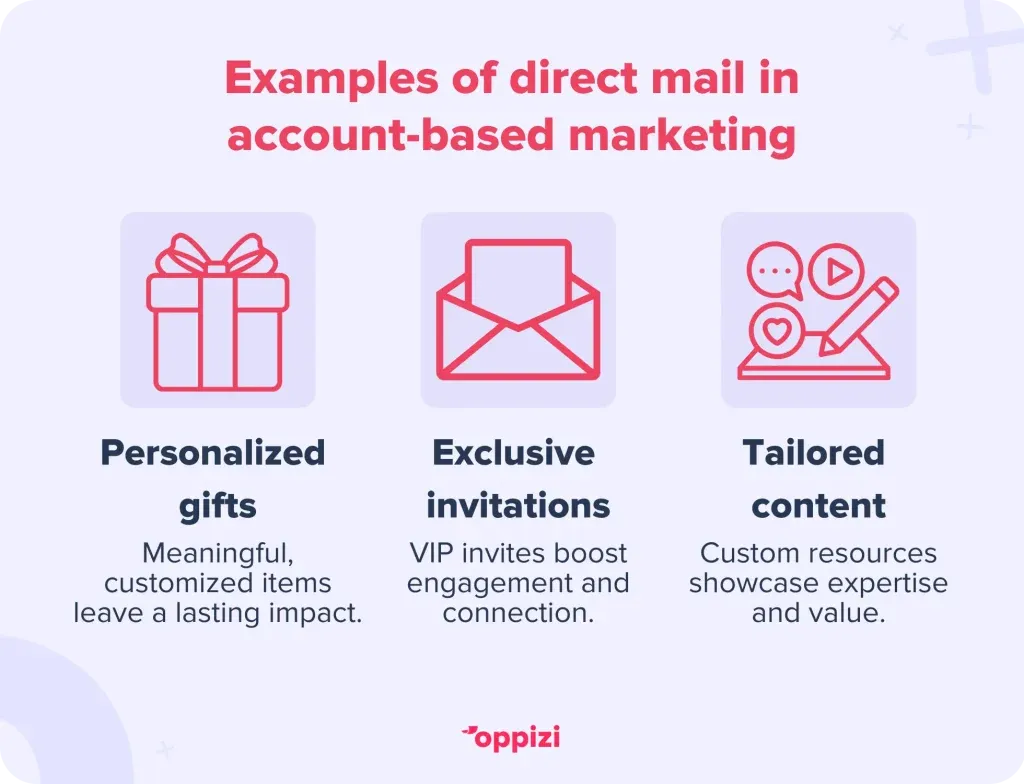
The best direct mail for ABM is the format that matches what the account is worth to you: a relevant gift or content package for your most strategic accounts, a personalized letter or a printed event invitation for clusters of similar accounts, and a personalized postcard for the wider target list. Whatever the format, it should show you know something specific about the account.
Gifts and content packages for your most strategic accounts
A boxed mailer containing something genuinely useful stands out on a desk: a book tied to the account's problem, a kit for a workshop you want to run with them, or a tailored content package such as a short industry report or a relevant customer story. Reserve it for the accounts where one deal covers the cost, and plan for longer production lead times. For ideas, see these B2B direct mail examples.
Personalized letters for named decision-makers
A personalized letter in an envelope, signed by a named person, still reads as the most deliberate thing in a business mailbox. It gives you room to reference the account's situation, and it travels well inside a company when someone passes it to a colleague. A short handwritten note on top adds a personal touch. Add one tailored insert rather than a stack of collateral.
Event invitations for clusters of accounts
A printed invitation to a roundtable, a dinner, or a workshop gives decision-makers a reason to reply and gives your rep a reason to call. It works well for clusters of accounts in the same industry, where one event can bring several target accounts into the same room.
Postcards and self-mailers for the wider list
Postcards have no envelope to open, so the message lands in a glance. They're the right format when a signal fires and speed matters more than depth. Use variable fields to swap in the recipient's name, company, industry, and a relevant offer or invitation.
Personalization should reflect something you actually know about the account. A first name merged into a generic template doesn't make it account-based.
How is account-based mail different from general B2B direct mail?
Account-based mail is a program built around a short list of accounts, while general B2B direct mail is any mail aimed at businesses, including broad prospecting, event invites, and customer retention. The difference shows up in four places:
- The list. General B2B mail starts from a segment. ABM starts from accounts sales has named, then maps the people inside them.
- The unit of success. General B2B mail counts responses. ABM counts accounts engaged, meetings booked, and pipeline moved.
- The handoff. In ABM, mail rarely closes anything on its own. It opens a conversation that a named rep is ready to have.
- The budget logic. ABM spends unevenly on purpose, with the most per account where a single deal justifies it.
If you want the broader picture of formats, services, and B2B use cases, start with the B2B guide. This article is about running mail inside an ABM program.
How do you build a target account list for direct mail?
You build it by agreeing the accounts with sales first, then mapping the buying committee inside each one, then validating every address before anything prints. A great mail piece sent to the wrong person, or the right person at an office they left last year, is wasted spend.
Agree account fit and intent with sales
Start with fit: industry, company size, geography, and the problems your product solves. Then layer in intent: website visits from the account, content downloads, event attendance, and conversations already in your CRM. Accounts that score high on both go to the top of the list. Accounts already in late-stage deals or recently closed-lost usually come off it, because a surprise mailer can cut across a live negotiation.
Map the buying committee
ABM mail works best when it reaches more than one person at the same account. For each account, list the economic buyer, the day-to-day champion, and anyone likely to block the deal. Then decide who gets what: the executive might receive a letter from your CEO, while the practitioner gets a practical guide to their specific problem.
Validate addresses before you print
B2B contact data decays fast. People change roles, offices move, and hybrid teams may not be at the address on file. Confirm business addresses through your data provider or your sales team, and run address verification against postal data before every send. If you plan to mail a home address, only do it when the contact has given it to you for that purpose.
Building lists from scratch is its own job. Our guide to targeted mailing lists covers sourcing and segmenting them.
How should you tier accounts and budget for ABM mail?
Tier accounts by deal value and how much personalization each deserves, then set budget per account rather than per piece. Most ABM programs use three tiers, and the point of tiering is to spend unevenly on purpose.
| Tier | Who it covers | Personalization | Who owns the follow-up | What success looks like |
|---|---|---|---|---|
| One-to-one | A small set of strategic accounts | Built for one account and one contact | The named account executive | A meeting with a senior buyer |
| One-to-few | Clusters of similar accounts | By industry, role, or shared problem | The account team for each cluster | Pipeline created or accelerated |
| One-to-many | A wider list of target accounts | Variable fields on a shared template | SDRs, triggered by signals | Accounts engaged and handed to sales |
For one-to-one accounts, a single closed deal can justify a high cost per account. For one-to-many, keep cost per piece low and let volume and timing do the work. Oppizi's addressed direct mail runs $0.54 to $0.65 per piece with data included and no monthly platform fee, which makes the one-to-few and one-to-many tiers practical to run at scale.
Set the budget as a cost per target account, then check it against the deal value of that tier. That's the comparison that tells you whether a format is worth it.
How do you sequence direct mail with sales outreach?
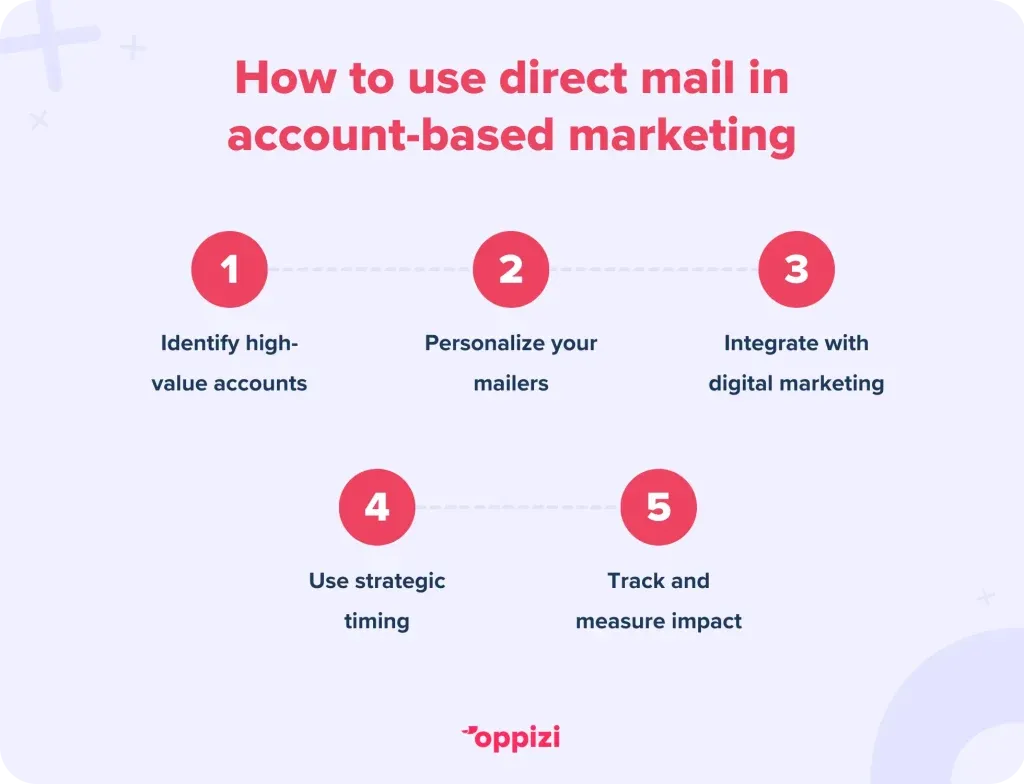
You sequence it by treating the mail piece as one scheduled step in a sales cadence, with a named owner and a follow-up commitment agreed before anything ships. The program design matters more than the exact days.
- Agree the list and the owner. Marketing and sales confirm which accounts and contacts receive mail, and which rep follows up on each one.
- Warm the account first. A LinkedIn touch or a relevant email before the mail lands means the piece arrives from a name the recipient has seen.
- Send the mail with one clear next step. Ask for one thing: a meeting, a workshop slot, or a visit to a page built for that account.
- Follow up once the piece has had time to land. The rep calls or emails within a couple of business days of expected arrival and references the piece directly.
- Send a second touch to accounts that stay quiet. A different format or angle, a few weeks later, often reaches a different member of the committee.
- Log every touch. Record sends and responses against the account in your CRM so the next play builds on what happened.
The one rule that holds across every tier: no mail goes out without a follow-up commitment from sales. Mail that arrives with nobody ready to call is the most common way ABM budget disappears.
Which triggers should fire an account-based mail send?
The best triggers are signals that an account is already paying attention: intent spikes, pipeline stage changes, and customer lifecycle moments. Programmatic direct mail lets these fire automatically instead of waiting for a monthly batch.
- Intent and engagement. A target account visits your pricing page more than once, or several contacts from it download the same guide.
- Pipeline stage changes. A first meeting is booked, a proposal goes out, a deal goes quiet for longer than your normal cycle, or a decision is close and needs a final push.
- Customer lifecycle. Onboarding, a renewal window, or an expansion conversation. ABM mail isn't only for acquisition.
On Oppizi, sends can be triggered automatically through the Braze integration, Shopify, or a custom integration, and account lists exported from your CRM can be imported through SFTP. Oppizi then handles printing, mailing, and tracking.
How do you measure direct mail in an ABM program?
You measure it at the account level: which target accounts engaged, how many meetings the mail helped book, and how much pipeline moved after a send. Response rate per piece is a weak yardstick at ABM volumes, where a few hundred pieces can produce a handful of very valuable conversations.
For context, cold addressed mail averages a 1.0% response rate and returns 2.1 times its campaign cost in revenue, per the JICMAIL Response Rate Tracker, which measured 4,939 UK campaigns. That's UK-measured data across volume programs, so read it as a reference point for mail in general, not a target for a 200-account ABM play.
The metrics that matter more for ABM:
- Accounts engaged. Target accounts showing new activity after a send, such as site visits, replies, or a new contact joining the conversation.
- Meetings booked. Meetings with mailed accounts, and the cost per meeting for each tier.
- Pipeline influenced. Opportunities created or advanced at accounts that received mail before the stage change.
- Tracked responses. Unique URLs, account-specific landing pages, and promo codes tie individual responses back to the send.
Oppizi tracks each campaign from distribution through to response in Oppizi OS, so mail performance sits next to the rest of your account data rather than in a separate spreadsheet.
What mistakes should B2B teams avoid with ABM direct mail?
The most common mistakes are sending mail nobody follows up, mailing bad addresses, and choosing swag over relevance. Each one wastes the budget that makes ABM mail worth doing.
- Mail as a standalone channel. A piece that arrives without digital context or a sales follow-up is a nice surprise that goes nowhere.
- Stale contact data. Validate addresses before every campaign, not once a year.
- Swag without a point. A branded mug says nothing about the recipient's problem. A relevant brief or a useful book does.
- One message for the whole committee. The CFO and the practitioner care about different things. Write to each.
- Judging a tier on the wrong metric. A one-to-one package that books one meeting with a strategic account can be the best spend in the program.
Ready to put mail into your ABM program?
Account-based mail works when the list is agreed with sales, the format matches the tier, and every send has someone ready to follow it up. The rest is execution, and that's the part we handle.
Oppizi runs addressed direct mail with personalization, triggers, and tracking from one platform, with no monthly platform fee. Create your Oppizi account and plan your first account-based mail send.
Frequently asked questions
- What is the best direct mail for ABM?
The best direct mail for ABM matches the account's value. Send a gift or tailored content package to your most strategic accounts, a personalized letter or event invitation to clusters of similar accounts, and a postcard to the wider target list. Every piece should reference something specific about the account and have a named rep ready to follow up.
- How much should I budget per account for ABM direct mail?
Budget per account depends on the tier. Strategic one-to-one accounts can justify a high cost per account because a single deal covers it, while one-to-many sends should stay low per piece. Set a cost per target account for each tier, compare it with that tier's deal value, then test, measure meetings booked, and scale what works.
- Should ABM direct mail go to an office or a home address?
Send ABM mail to a validated business address by default. Hybrid work means some contacts are rarely in the office, so confirm the address with your data provider or sales team before printing. Only mail a home address when the contact has shared it with you for that purpose, and log that consent alongside the contact.
- How long does it take for ABM direct mail to influence pipeline?
Early signals, such as site visits from target accounts, replies, and booked meetings, usually show within weeks of delivery. Pipeline influence takes longer because B2B deals move slowly, so track mailed accounts through sales stages for at least a full quarter before judging the program, and compare each tier against its own goal.
- How do you measure direct mail in an ABM program?
Measure at the account level rather than per piece. Track which target accounts engaged after a send, how many meetings the mail helped book, and how much pipeline moved at mailed accounts. Unique URLs, account-specific landing pages, and promo codes tie individual responses back to the send, so mail sits alongside your other account data.
- Can ABM direct mail be triggered automatically?
Yes. Programmatic direct mail fires a send when a signal is met, such as a pricing page visit, a stage change, or a renewal window. On Oppizi, sends can be triggered through the Braze integration, Shopify, or a custom integration, and Oppizi then handles printing, mailing, and tracking without manual list pulls for each wave.