Coverage down to the walk
Build your delivery area from postal codes and letter-carrier walks on a map, with household and business counts in view before you commit.
Put your printed piece in every mailbox on the Canada Post routes you choose, homes and businesses alike. Printing, distribution and tracking sit in one place.
Pick your routes, set your volume, and widen the footprint when the numbers tell you to.
Build your delivery area from postal codes and letter-carrier walks on a map, with household and business counts in view before you commit.
Describe the audience you want in front of and our agents propose the Canada Post routes that match the attributes you set.
Buying coverage means there is no mailing list to source or licence, and printing and distribution sit inside the one quoted price.
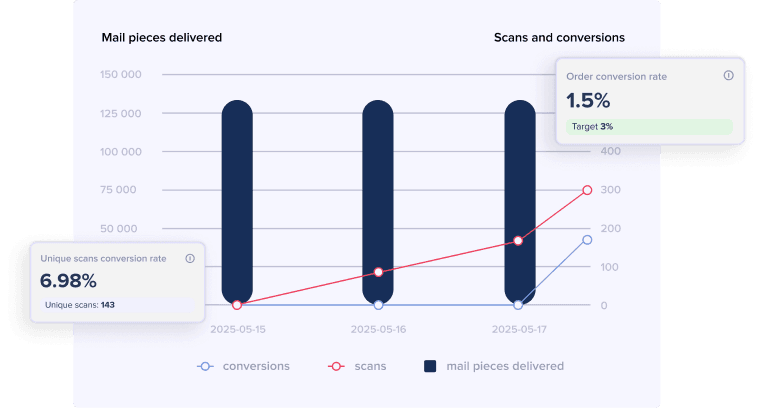
Follow distribution progress and campaign response in the same place, at no extra cost.
Neighbourhood Mail is bought by geography. The unit you select is the Canada Post letter-carrier walk, not the individual household, which is what makes it the quickest way to put one message in front of everyone in an area.
Start from the first three characters of the postal code and narrow from there, so coverage follows the catchment rather than a city boundary.
Select the individual routes inside an area to concentrate spend on the streets that matter and leave out the ones that do not.
Coverage can be residential mailboxes, business addresses, or a mix of the two, set when you build the campaign.
Canada Post selection data narrows a route list by the characteristics of the households on it, without you ever holding a name or an address.
Routes, volume, artwork and reporting all sit in one system, so covering a province takes the same handful of steps as covering one neighbourhood.
Start in one catchment, then widen the footprint as demand grows.

Tell every household and business in the catchment that you have opened, street by street.

Get a time-limited offer in front of a whole area without building an audience list first.

Stay visible across the same routes to keep foot traffic and enquiries coming.











Still deciding? Our Canadian team is happy to walk through it with you.
Neighbourhood Mail is Canada Post's unaddressed service: your printed piece goes to every mailbox on the letter-carrier walks you choose, with no names and no mailing list. It suits work where the area defines the audience — opening a new location, entering a city for the first time, or an offer aimed at everyone in a catchment. Canada Post called the product Unaddressed Admail until 2016.
Cost turns on the routes you cover, the volume and the format printed, so campaigns are quoted rather than priced off a rate card. Tell our Canadian team the areas and the volume you have in mind and you get back a costed plan with printing and distribution included, and no separate data or list fees.
Oppizi OS includes a map-based selector where you build coverage from postal codes, individual carrier walks or a radius around your location, with household and business counts shown as you go. If you would rather start from the audience, describe it and the platform proposes the routes that match.
The JICMAIL Response Rate Tracker puts the response rate for unaddressed door drops at 0.3%. That figure is measured in the United Kingdom, so treat it as a reference point rather than a Canadian benchmark — Canada Post publishes recall, trust and engagement research rather than response rates. Repeating a drop over the same routes lifts the number, and the offer and the creative move it further than the channel does.
Use Neighbourhood Mail when geography defines the audience and you want everyone in an area to see the same message. Use Addressed Direct Mail when you are mailing named households picked out of your own data, third-party demographics or B2B records. Both run from the same platform, so a coverage drop and a customer mailing can sit in one plan.
Yes. Coverage can be residential mailboxes, business addresses, or both. A trade offer can go to the businesses in an industrial pocket while a consumer offer covers the surrounding homes, and you set that mix when you build the campaign.
Every piece can carry a QR code, a unique URL, a promo code or a tracked phone number, and the scans and redemptions land in your Oppizi OS dashboard next to the distribution record. That is what turns a coverage drop into a channel you can report on.
Oppizi has distributed more than 14 million pieces across Canada over 12+ years and tracked more than 740,000 conversions here, for brands including Uber Eats, DoorDash and HelloFresh. Every piece is measured in Oppizi OS through QR codes, unique URLs and promo codes.
Canada Post delivery across the routes you choose, and every response attributed in Oppizi OS.