Last updated 30 September 2026
Understanding what direct mail is and how it drives measurable performance is increasingly top of mind for marketers evaluating channel mix and budget allocation in an increasingly crowded and volatile digital environment.
The crux of the matter is that direct mail can easily become a lever for growth for established brands and small businesses alike. It all comes down to making the most out of its potential. This guide offers a comprehensive and evidence-based exploration of direct mail marketing: how it works, why it performs, where it fits strategically, and how to execute it with confidence.
What is direct mail marketing?
Direct mail is a precision marketing channel that uses professionally produced print assets such as letters, postcards, brochures, catalogues, dimensional mailers to deliver highly targeted messages to specific audiences via postal services or private carriers.
Historically, direct mail meant mass-mailed catalogues, sales letters, and coupon packs sent to broad postal lists. Today, it has evolved into a data-driven, technology-enabled channel. Modern direct mail integrates sophisticated targeting, real-time tracking, and efficient digital integration to help businesses generate leads, increase sales, and strengthen customer relationships.
Successful direct mail campaigns are built on enduring principles:
- Precise audience targeting
- Accurate delivery
- A strong value proposition
When these fundamentals are paired with modern marketing technology, like CRM-driven segmentation, automated workflows, address verification tools, attribution modeling, direct mail becomes a powerful, integrated channel. It’s this combination of factors that turns direct mail into a competitive advantage for teams that use it strategically.
What are the benefits of using direct mail?
The numerous advantages of direct mail make it one of the most effective offline channels available. Here’s why it works:
Visibility in a crowded ecosystem
Direct mail provides enduring visibility amplified by a low competition environment. Physical mailboxes receive dramatically fewer commercial pieces; thus, a postcard stands out the minute the mailbox is open — a stark contrast to the hundreds of messages vying for attention online.
Direct mail can make a lasting impression. Studies show that consumers spend an average of 17 days interacting with or seeing a mail piece. Physical mailers often remain visible in homes or offices, on desks, refrigerators, or counters, providing repeated exposure that reinforces brand awareness and increases the likelihood of conversion.

According to research from MIT Sloan, almost 80% of people reported that their online experience was oversaturated with digital ads and noted that postcards, brochures, and catalogues stood out because they were so different from the flood of digital promotions.
This high visibility of direct mail can lead to increased sales, with the majority of consumers reporting having taken an action after receiving direct mail.
Precise efficient targeting
The decline of third-party cookies, increasing restrictions around data collection, and heightened consumer skepticism are reshaping digital targeting. Direct mail, which is built on first-party and permission-based data, avoids many of these disruptions. Each mail piece is delivered to a verified household or individual and postal addresses provide a stable, reliable foundation for audience targeting.
At the same time, direct mail allows marketers to reach specific audiences with exceptional precision. Using demographic insights, purchase behavior, or geographic markers, brands can tailor campaigns to the households most likely to respond — whether that’s a particular neighborhood, lapsed customers, high-value segments, or prospects who fit a certain profile.
Built-in trust and brand authenticity
Direct mail conveys trust and authenticity to a much higher degree compared to other channels. Many offline marketing statistics back up this claim. In surveys conducted by Marketing Sherpa, 76% of Americans reported trusting mail more than digital ads when making purchase decisions.
Its tangible, personal nature contributes to this perception: 71% of consumers say print catalogues and magazines feel more authentic than digital campaigns, which points to a sense of intentionality and care that digital channels often lack. And millennials, more than any other age group, believe that mail brings a sense of daily discovery and look forward to seeing what deals or coupons are being offered.
High accountability through measurement and optimization
Although it was historically perceived as a channel that was difficult to track, modern direct mail now operates with the same performance rigor as digital channels:
- QR codes, unique URLs, and promo codes create deterministic attribution.
- Addressable mail can be triggered programmatically.
- Lift studies and match-back analysis offer statistically reliable measurement.
This allows marketers to test creative, optimize frequency, and build repeatable, scalable direct mail campaigns grounded in data.
Easy creative adaptation from existing digital assets
Most marketing teams already have a steady pipeline of digital assets, like performance ads, landing page visuals, product imagery, brand messaging, and promotional offers. These elements can be quickly adapted into high-impact mail formats with minimal effort.
Compared to branching into an entirely new channel like TV, radio, or OOH where production costs, timelines, and creative development cycles start at zero, direct mail allows marketers to repurpose what already works and enter a new channel quickly, cheaply, and with minimized risk.
Natural fit into omnichannel strategies
In omnichannel experiments, direct mail consistently shows its ability to amplify digital performance. When integrated properly (e.g., triggered by digital signals or paired with retargeting), it becomes a valuable asset in the overall marketing mix.
The neuroscience behind direct mail
One of direct mail’s most powerful advantages is the one digital media can’t replicate: touch. The tactile nature of print slows people down, increases processing time, and makes the content feel more intentional and trustworthy. Understanding why and how our brains respond this way is key to appreciating the impact of physical media and, subsequently, getting better results with direct mail.
Physical media enhances memory and recall
A landmark study by the U.S. Postal Service Office of Inspector General and Temple University found that people processed digital ads more quickly, but they lingered longer on physical ones. Print pieces also generated stronger emotional reactions and were remembered more clearly. They required 21% less cognitive load to process, meaning that the message in a printed piece feels more intuitive and easier to grasp. The same study revealed that people subconsciously assign more value and desire towards products and services they encounter in a physical format.
Touch leads to a sense of ownership
Beyond emotional impact and memory, touch plays a powerful role in shaping how people value what they encounter. Psychologists call this the endowment effect.
A study published in the Journal of Consumer Research found that merely touching an object results in an increase in perceived ownership of that object. When that happens, we assign more value to the object. Direct mail taps directly into these psychological mechanisms. A printed mailer is physically handled as opposed to just being seen, creating an instant, subconscious sense of ownership. That tactile interaction makes the piece feel more personal and relevant.
Object permanence
Another unique strength of direct mail is its connection to the psychological principle of object permanence, which is the idea that physical objects continue to exist even when they’re out of sight. A well-designed mailer or catalog remains in the recipient’s environment, allowing for repeated exposure over time. Even if it’s initially set aside, it can be rediscovered days or weeks later, keeping the brand and message top of mind.
Tech’s influence on direct mail
Direct mail works because it has evolved with the times. It’s not the spray and pray tactic of the past. Far from it. Advances in marketing technology have transformed direct mail by enabling automation, deeper personalization, and end-to-end tracking.
Direct mail automation
Direct mail automation uses real-time signals and integrated data to deliver mail at the most meaningful point in the customer journey. For example, when someone abandons a shopping cart or repeatedly views a product online, you can design a programmatic mailing campaign to automatically send print pieces in response to that specific consumer behavior.
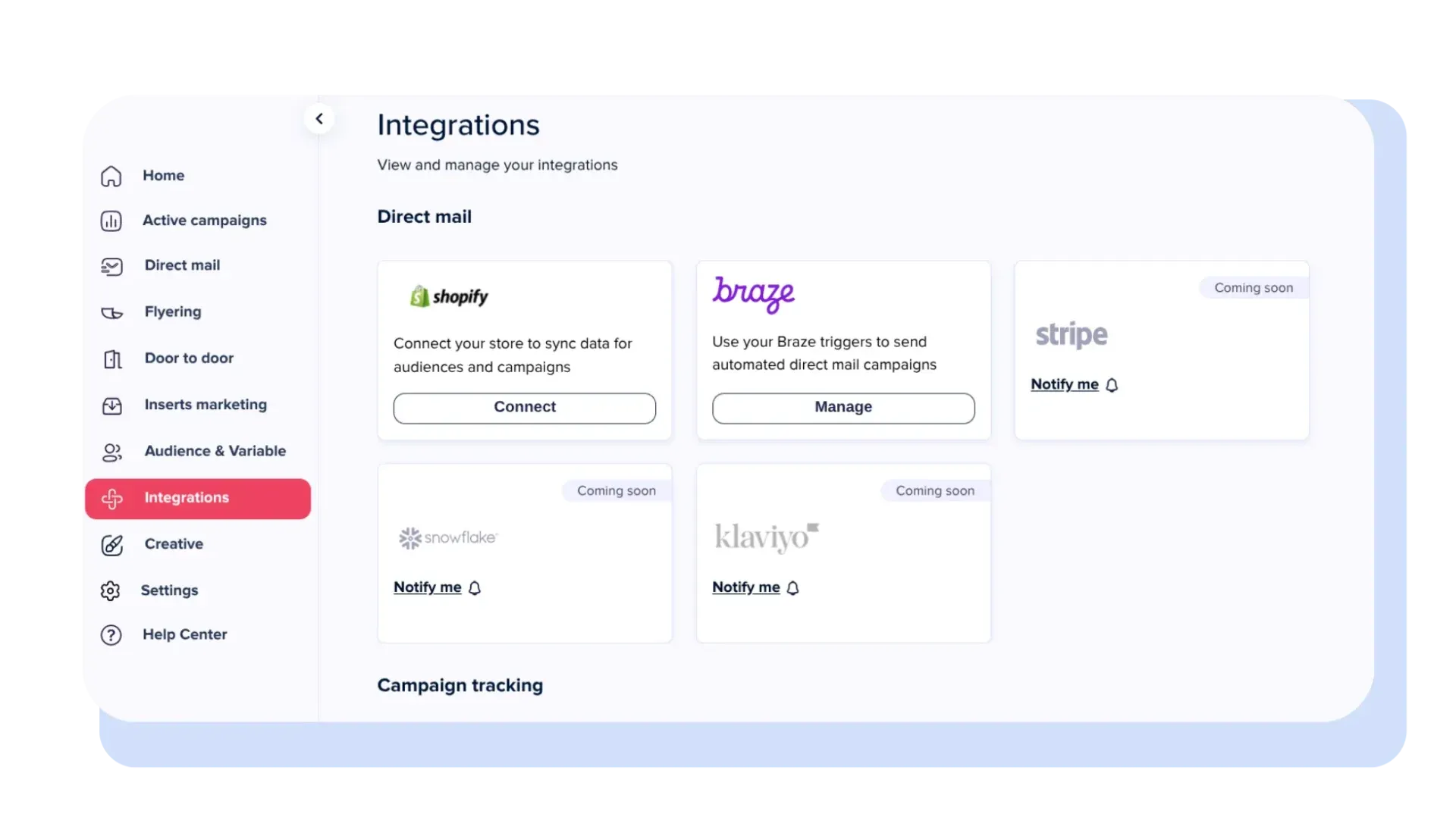
Integrations, such as Shopify, HubSpot, Salesforce, Marketo, allow customer, product, and lifecycle data to sync automatically with a direct mail platform. This makes it possible to build and update segmented audiences in real time, trigger mailings based on customer behavior or lifecycle stage, streamline processes, and close the loop with attribution and performance analytics.
Direct mail personalization
Dull, generic mailers are more likely to be dismissed as junk, whereas customized pieces convey an upscale feel and strengthen brand loyalty.
Variable-data printing takes mail personalization even further, customizing each mailer with unique images, copy, or offers based on a recipient’s browsing or purchase history. And by embedding QR codes or personalized URLs, these assets connect recipients directly to product videos, e-commerce pages, or event registrations, while capturing real-time data on engagement.
Direct mail measurement and tracking
There are a number of metrics that are used to measure the success of your direct mail marketing campaign.
- Delivery and response time
- Conversion rate
- Cost per acquisition
- Customer lifetime value
The foundation is unique identifiers embedded directly into each mailed piece: QR codes, unique URLs, custom landing pages, or unique promo codes. These elements allow marketers to attribute actions that consumers take: website visits, form completions, coupon redemptions, purchases. With these in place, direct mail becomes a trackable source of traffic and conversions.
Types of direct mail
Direct mail today encompasses a diverse set of formats. Each of them serves a different strategic purpose:
- Postcards are ideal for acquisition, reactivation, or promotional campaigns where the goal is rapid engagement.
- Letters and envelopes are particularly effective for high-consideration products, subscription services, or B2B engagement.
- Multi-page catalogues and brochures provide deep engagement opportunities, particularly for product-rich portfolios, cross-selling, or high-LTV customers.
- Self-mailers blend the accessibility of postcards with additional space for storytelling or layered messaging. They are a versatile option for mid-funnel nurturing.
- Dimensional and premium mailers are typically reserved for high-value account-based marketing (ABM), VIP customers, or loyalty campaigns.
- Printed newsletters are used as a long-form engagement tool, building thought leadership, loyalty, and nurturing relationships over time.
The key consideration for modern marketers is that format choice should be strategically aligned with objectives rather than selected arbitrarily.
Direct mail use cases for modern marketers
Direct mail marketing can be used for acquisition, retention, or reactivation purposes.
Acquisition and demand generation
Direct mail serves as a reliable acquisition lever, particularly in markets where digital saturation drives up CPMs and lowers attention quality. Marketers can use postcards, letters, and self-mailers to introduce product benefits or promote enticing offers to prospective customers.
Customer retention, loyalty, and reactivation
Loyalty programs, subscription businesses, and membership-based organizations rely on physical mail to reinforce ongoing relationships. It routinely outperforms digital-only efforts in reactivation campaigns for lapsed customers or in subscription contexts.
Cross-selling and upselling
By analyzing purchase history and browsing behavior, marketers can deliver offers tailored to individual customers, improving uptake of complementary products or higher-tier services.
Event marketing and community activation
Direct mail excels at driving attendance and engagement for events, whether that’s a product launch, webinar, conference, or in-store experience. By combining mail with digital registration tracking, marketers can gain insights into response patterns, optimizing follow-ups and improving attendance rates.
Market entry, expansion, and brand awareness
When brands enter new markets or launch new products, direct mail provides a dependable way to establish presence quickly. This is especially valuable for DTC brands expanding into specific cities, B2B companies targeting clusters of relevant industries, or regulated-sector marketers (financial services, healthcare) who require compliant channels not dependent on third-party cookies.
Account-based marketing (ABM) and high-value pipeline acceleration
Dimensional mailers, premium kits, and personalized packages create high-impact moments with stakeholders. When combined with synchronized outreach from SDRs and targeted digital retargeting, direct mail becomes a deal-accelerating instrument in ABM campaigns.
What industries benefit most from direct mail?
Direct mail’s tactile, personalized, and tech-enabled qualities make it effective across a wide range of industries, particularly where building trust, awareness, or repeat engagement is key. Some examples include, but are not limited to:
- Mobility and transportation brands — car-sharing services or e-bike networks.
- Food and beverage companies — meal-kit subscriptions and grocery delivery services.
- Real estate agents and agencies
- Health and wellness businesses — gyms, specialty studios, and wellness programs.
- Healthcare services — specialty clinics, dental practices, broader health networks.
- Financial services - banks, fintechs, and credit providers
- Insurance providers — auto, home, or life insurers
- Education providers — universities, online learning platforms, and professional training institutions
- B2B and professional services firms – consultancies, SaaS companies, agencies
- Nonprofits and cultural institutions — charities, museums, performing arts theaters.
- Travel and hospitality brands — hotel, resorts, travel operators.
Successful direct mail campaign ideas
Here are some practical ways in which direct mail could be used as an effective marketing tactic:
- A local agent sends postcards showing recently sold homes and their prices. The card invites homeowners to get a free home evaluation to see what their property might be worth.
- A café mails menus with their best dishes and a “buy one, get one free” coupon for new customers. A QR code makes it easy to book a table online.
- A community theater sends out invitations for an upcoming play, highlighting the event date, performers, and offering a discount for early bird tickets.
- A wellness company mails a sample — like a scented candle or tea — along with a postcard offering a discount on the first subscription box.
- A gardening store sends postcards with spring planting tips and a 15% discount. They include a beginner’s checklist to encourage visits and purchases.
- A fitness brand introduces a new smartwatch with postcards. They showcase the design, features, and include a QR code for pre-orders with an exclusive discount for the first 100 buyers.
How to send direct mail
Building an effective direct mail campaign should be a disciplined, data-led process for it to provide best results. Here’s a step-by-step breakdown:
Build your mailing list
Start by defining exactly who you want to reach. Use your customer database, acquire targeted lists, or capture leads from your website. Segment your audience by relevant criteria such as demographics, geography, purchase behavior, or interests.
Set objectives
Articulate the primary objective of your campaign and assign it deterministic metrics to measure success (QR scans, unique URL visits, code redemption, sign ups) before creative development begins. Potential goals could include reactivation of dormant customers or new customer acquisition.
Choose the right direct mail format
Format is a performance variable just as much as it is an aesthetic decision. For example, you should consider postcards for lower-cost, broad retargeting or self-mailers for storytelling and visual products.
Design your mail piece
Your mailer should be clear, visually appealing, and aligned with your brand. Make sure you have a single dominant message, and a clear, immediate call-to-action. And remember, good direct mail design increases engagement, memorability, and the likelihood of conversion.
Integrate digital components for tracking
Every modern direct mail campaign should include digital connectors. Some examples include QR codes, unique URLs, or custom landing pages.
Manage production and logistics
Operational excellence has a direct impact on performance. Beyond just printing and mailing, production planning encompasses timing, quality control, fulfillment, and delivery reliability. Some organizations may handle production internally. However, there’s also the option of partnering with a dedicated direct mail provider which streamlines the entire workflow.
Measure and track
Direct mail shouldn’t be a ‘send it and forget it’ type of channel. Campaigns need to be measurable, testable, and continuously refined for best results.
How direct mail fits into an omnichannel strategy
There’s an abundance of channels that marketers use to promote their services. Websites, email, social media, text messages, direct mail are all strong contenders, but the smartest play is to make them work together. That’s what omnichannel marketing is all about.
Direct mail can act as both a trigger and a reinforcer in the overarching strategy. According to a survey published in MIT Sloan, when asked about brand discovery and retention, roughly 4 in 5 participants said that they were far more likely to research a brand online or visit a store after receiving a printed piece. Thus, a seamless loop where online and offline behaviors feed into each other is created.
Here’s how direct mail integrates with digital channels to create a unified customer experience.
Direct mail and websites
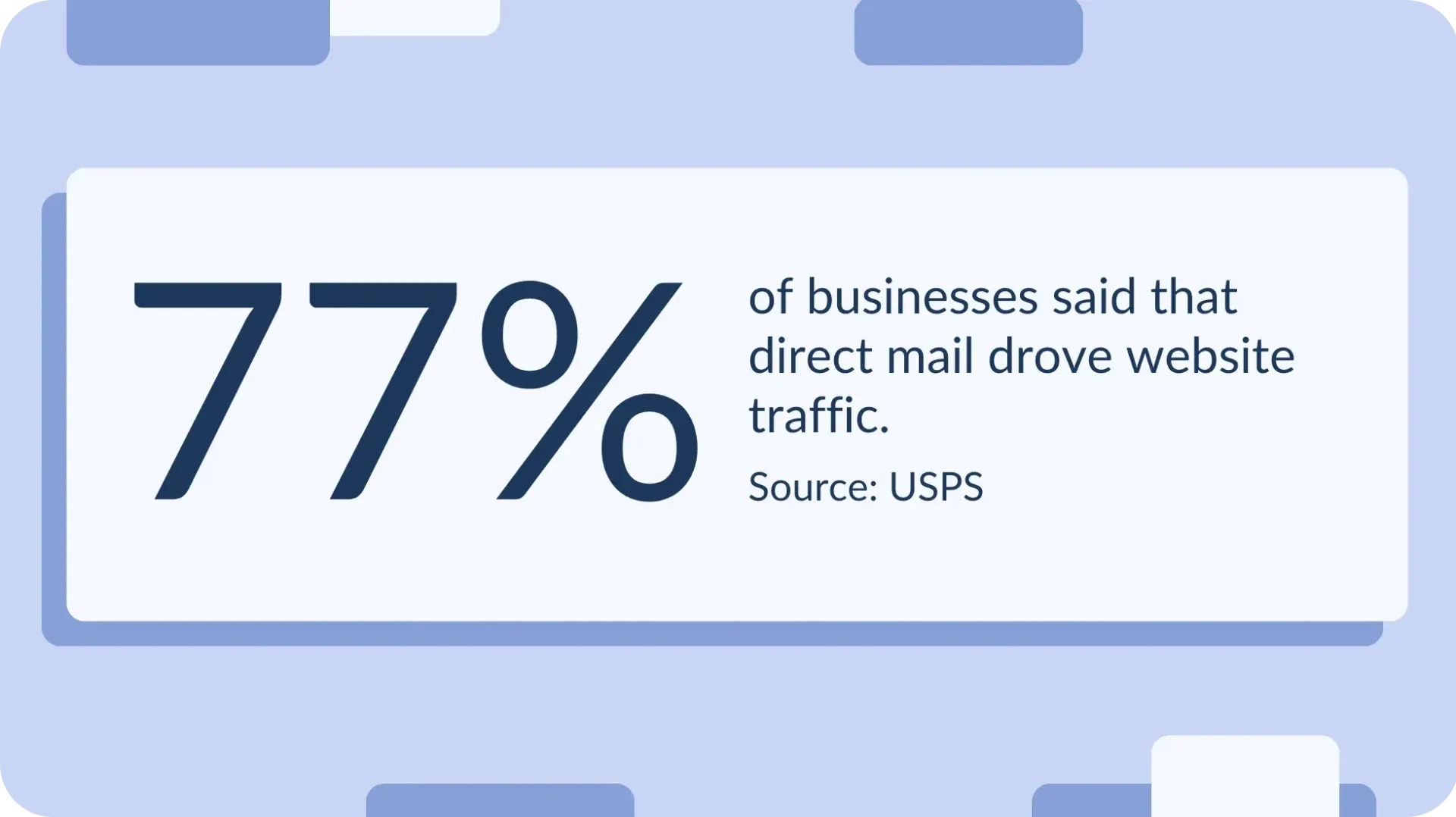
Mailers can be used to complement websites. So much so that 77% of businesses said that direct mailers drove website traffic. Through personalized URLs or QR codes, customers can easily go from physical mail to online sites.
Direct mail and email
By pairing direct mail and email marketing campaigns, businesses can reinforce their message across multiple touchpoints. For example, you could announce a new product or service by mail, and then offer a limited time discount via email.
Direct mail and social media
The sender is informed when mailpieces reach their target audience. Subsequently, you can trigger a highly targeted paid social media ad campaign to target the same audience group that directly relates to the mailpieces and the customers who received them.
How much does direct mail cost?
The cost of a direct mail campaign is shaped by several factors: audience size, format complexity, printing specifications, postage class, design, and the level of personalization required.
Larger volumes reduce the cost per piece, while premium formats, heavier stock, or variable-data printing increase production expenses. Postage can be a large cost driver. The quality of your mailing list and design costs should also be taken into account.
On average, advertisers spend between $0.30 to $1 or more per piece for a campaign. Marketers consistently find the cost worth the investment. In fact, 84% of marketers say direct mail offers the highest ROI of any channel.
Common mistakes and best practices in direct mail marketing
Despite being one of the most controllable and measurable channels in marketing, direct mail campaigns sometimes underperform for reasons that are entirely preventable.
What not to do in direct mail marketing
These are some mistakes to avoid in order to take advantage of the channel’s full potential:
- Don’t lead with a weak or unclear offer. A strong offer is concrete, timely, and aligned with audience needs, whether that’s financial savings (discounts, free upgrades), convenience (free delivery, priority access), experiential value (VIP previews, early access), or risk reduction (free trials, guarantees). Without this, response rates inevitably fall flat.
- Don’t use direct mail as a standalone tactic. Using offline and online in tandem can generate stronger results than using them separately.
And how to get it right
It’s not difficult to make direct mail work for you. Here’s some tips and tricks to achieve that:
- Keep messaging single-minded. Focus on delivering one core idea, not several competing ones. A clear headline, a focused benefit, a strong offer, and a frictionless CTA consistently outperform cluttered pieces.
- Prioritize tactile and visual impact. Format, design, and finish influence whether your piece gets noticed. Physicality is one of the medium’s superpowers. Use it deliberately.
- Engineer attribution from the start. Use trackable URLs, unique landing pages, individualized promo codes, QR codes tied to UTM parameters, or matchback analysis. Modern direct mail thrives on measurement and attribution turns it from a cost center into a performance engine.
- Measure rigorously. If you can’t measure direct mail, you can’t manage it, and you certainly can’t scale it. Once your campaign launches with proper tracking in place, you should monitor engagement as it happens.
Using direct mail strategically
The question for modern marketing professionals is no longer whether direct mail belongs in the marketing mix. Direct mail data settles that debate. Instead, it’s all about how to orchestrate it with the precision, measurement, and creative discipline it deserves. Or better yet, how to find the right partner who’s going to make that process effortless and ensure you get the best results by using direct mail.
Oppizi can be that trusted partner.
With over 10 years of experience in offline marketing, we can help scale your direct mail marketing efforts. Every campaign is tracked in real time through our analytics dashboard that features 14 actionable KPIs. This level of visibility transforms direct mail into a high-accountability channel fit to deliver results for your business. Are you ready to see what direct mail can do for the growth of your business? Get started with Oppizi today.