Last updated 30 September 2026
Digital marketing has led the marketing mix for years, but in 2026, even the most sophisticated digital campaigns are starting to hit a ceiling. Clicks and impressions can only take you so far; and to break through, businesses are rediscovering the power of offline marketing.
Offline and online marketing aren’t competitors. In fact, when they’re combined in one omnichannel marketing strategy, these tactics help top businesses expand their reach, build genuine trust, and drive sustainable growth. These channels complement and reinforce each other, and this synergy is the foundation of an expert marketing strategy.
In this article, we’ll take a look at how offline and online marketing work together in practice: what integration really means, why it outperforms single channel strategies, and what kind of results companies can expect when they implement strategies that draw on the strengths of both of these approaches.
Understanding digital and offline channels today
Paid social and search, display ads, content and SEO, email, landing pages, and analytics are the backbone of digital marketing. They enable real-time optimization, granular audience segmentation, experimentation, and continuous performance feedback loops.
Yet the model is under a growing strain. Acquisition costs continue to rise. Marginal returns are harder to sustain and tech stacks become more complex and fragile. On top of that, audiences grow increasingly selective and resistant to these forms of advertising.
Offline marketing, long viewed as difficult to track, measure, or scale, has quietly evolved alongside digital channels. Today, tools such as direct mail, flyering, and insert media are powered by rich data and modern marketing technology, enabling precise targeting—whether by geography, behavior, or customer lifecycle.
Campaigns can be easily automated, and measurement (when the right infrastructure is in place) is systematic and comprehensive. And they do so while preserving the advantages that digital still struggles to replicate: physical presence, sensory engagement, sustained attention. Thus, channel diversification becomes a strategic necessity.
Not every company may be able to start with a fully developed omnichannel model. What matters is taking deliberate first steps toward combining channels and progressively increasing their level of integration as capabilities, data, and processes mature.
Why an integrated approach is no longer optional
Modern offline channels are not legacy tactics kept alive by habit or out of nostalgia. Nor are digital channels going away any time soon. Here are some advantages of combining advertising tactics:
Broader audience reach
A growing share of prospects actively avoids digital advertising through ad blockers or privacy settings. According to a GWI report, 4 in 10 of the online population are blocking ads. Others are technically reachable but practically unavailable: oversaturated with impressions, they mentally filter out most paid placements. Certain demographics, such as older audiences or lower-frequency internet users remain consistently underrepresented in digital-first strategies.
Offline marketing opens the door to these new, untapped markets.
They operate outside algorithmic filters, bidding wars, and platform gatekeepers. Instead of competing for milliseconds of attention in crowded feeds, these methods place brand messages directly into the physical environments people already inhabit: their homes, neighborhoods, commutes, and everyday routines.
Direct mail, flyering, and inserts make it possible to access households and individuals who are difficult to reach online, while also increasing frequency and visibility among digitally accessible audiences.
Stronger memorability through physical presence
Physical formats are processed differently than digital ones. A flyer picked up from a real person on the street or a piece of direct mail opened at home creates longer exposure, with consumers spending an average of 17 days interacting with or seeing a mail piece.
Research on the science behind direct mail also shows that physical marketing assets require 21% less cognitive effort to process and produce stronger memory encoding. In practice, this means messages are absorbed more intuitively, remembered for longer, and far more likely to resurface when consumers later are faced with a purchasing decision.
Plus, offline channels operate in a different attention economy than digital ads. A mailbox, a lobby, or a doorstep has far fewer competing messages than a social feed or a search results page. This scarcity dramatically increases the probability of being noticed, processed, and remembered.
Increased perceived brand value and credibility
Physical marketing amplifies a brand’s digital presence by anchoring it in the real world and adding a layer of trust and credibility. According to MarketingSherpa, formats such as print ads, TV spots, mailers, catalogs, and outdoor advertising consistently rank among the most trusted advertising channels, underscoring the enduring power of physical media.
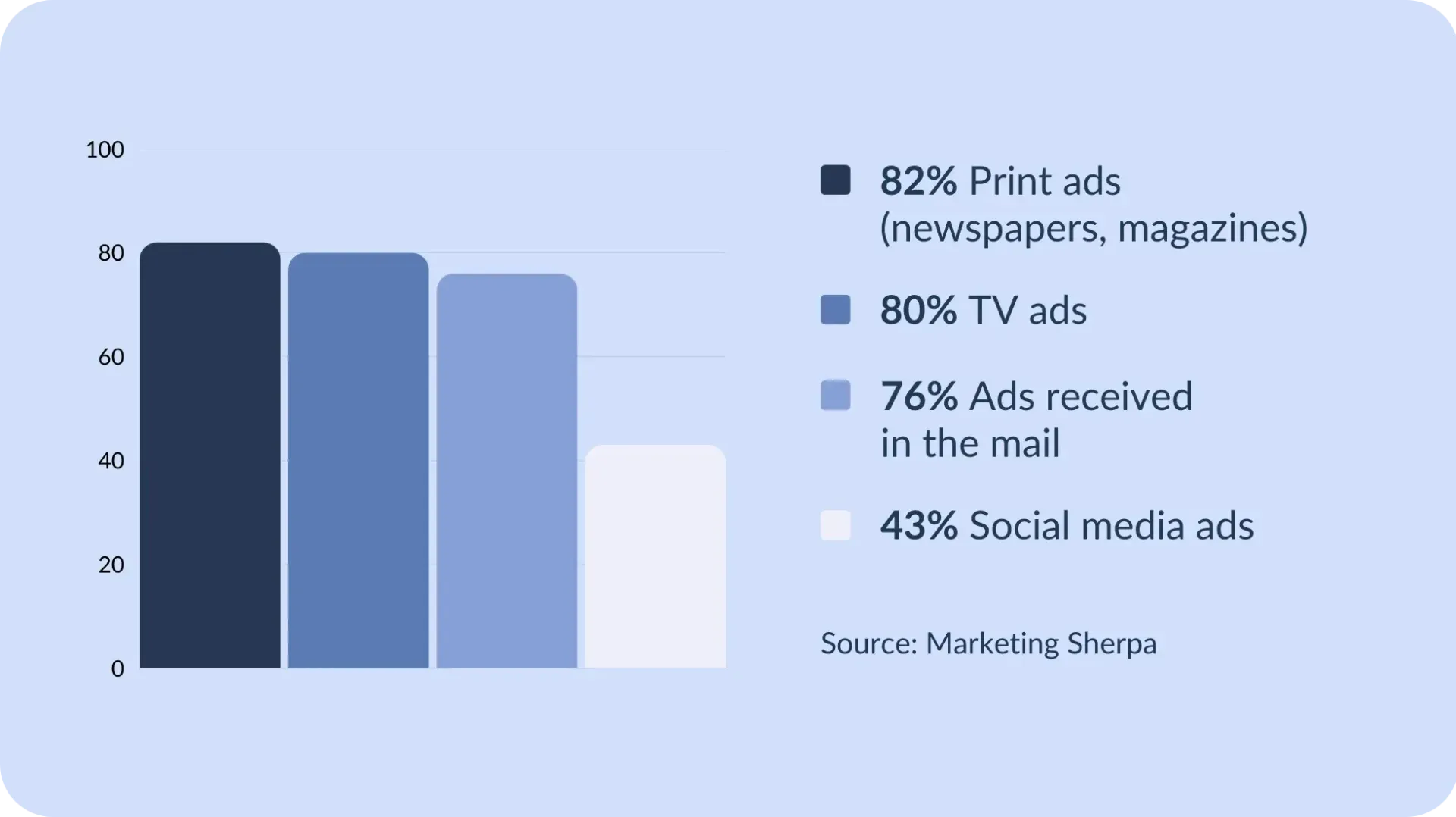
This is why premium and established brands continue to invest in catalogs, flyers, and direct mail: tangible materials communicate trust and legitimacy. Giving, receiving, and interacting with physical objects remains a deep and intuitive part of human experience, one that builds confidence and reinforces value between brand and consumer.
When prospects later encounter the same brand online, they are more likely to recognize it, trust it, and engage with it. In integrated campaigns, offline channels often do the trust-building, while digital channels capture and convert the demand.
Reinforced campaign messages
When the same campaign message appears both online and offline, recall and recognition increase significantly. Offline exposure makes digital impressions more familiar, more credible, and easier to process. Instead of competing for attention, digital ads benefit from prior recognition.
This dynamic reflects the long-standing Marketing Rule of 7: the idea that prospects need multiple exposures to a message before it truly registers and drives action. Integrated campaigns simply reach those meaningful repetitions faster and more reliably.
Better targeting through location and context
Digital targeting is powerful, but it is not always precise in ways that matter most to physical behavior: where people live, work, commute, and shop. Offline channels add a layer of real-world accuracy by allowing brands to target based on geography, neighborhoods, foot traffic patterns, and local context. Platforms like Oppizi provide the data, orchestration technology, and distribution intelligence required to execute precise offline targeting reliably and at scale.
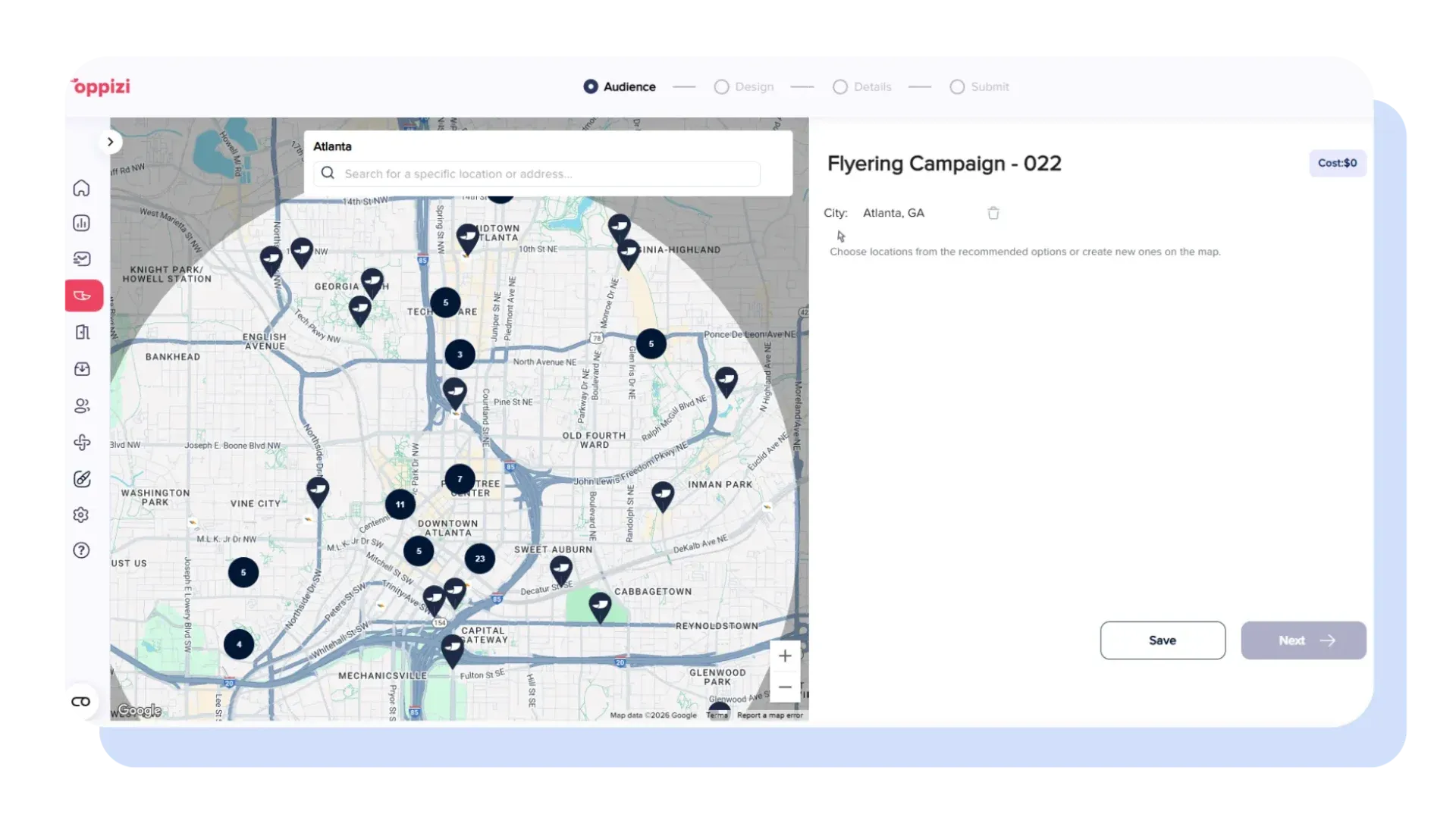
This enables highly relevant campaigns, such as promoting a service only within its delivery radius, launching in specific postcodes, or supporting store openings at street level. When combined with digital retargeting and CRM data, offline targeting becomes even more effective, introducing the brand in the physical environment and continuing the conversation online with tailored messaging. The result is less wasted spend and stronger campaign alignment.
Better measurability through integrated attribution
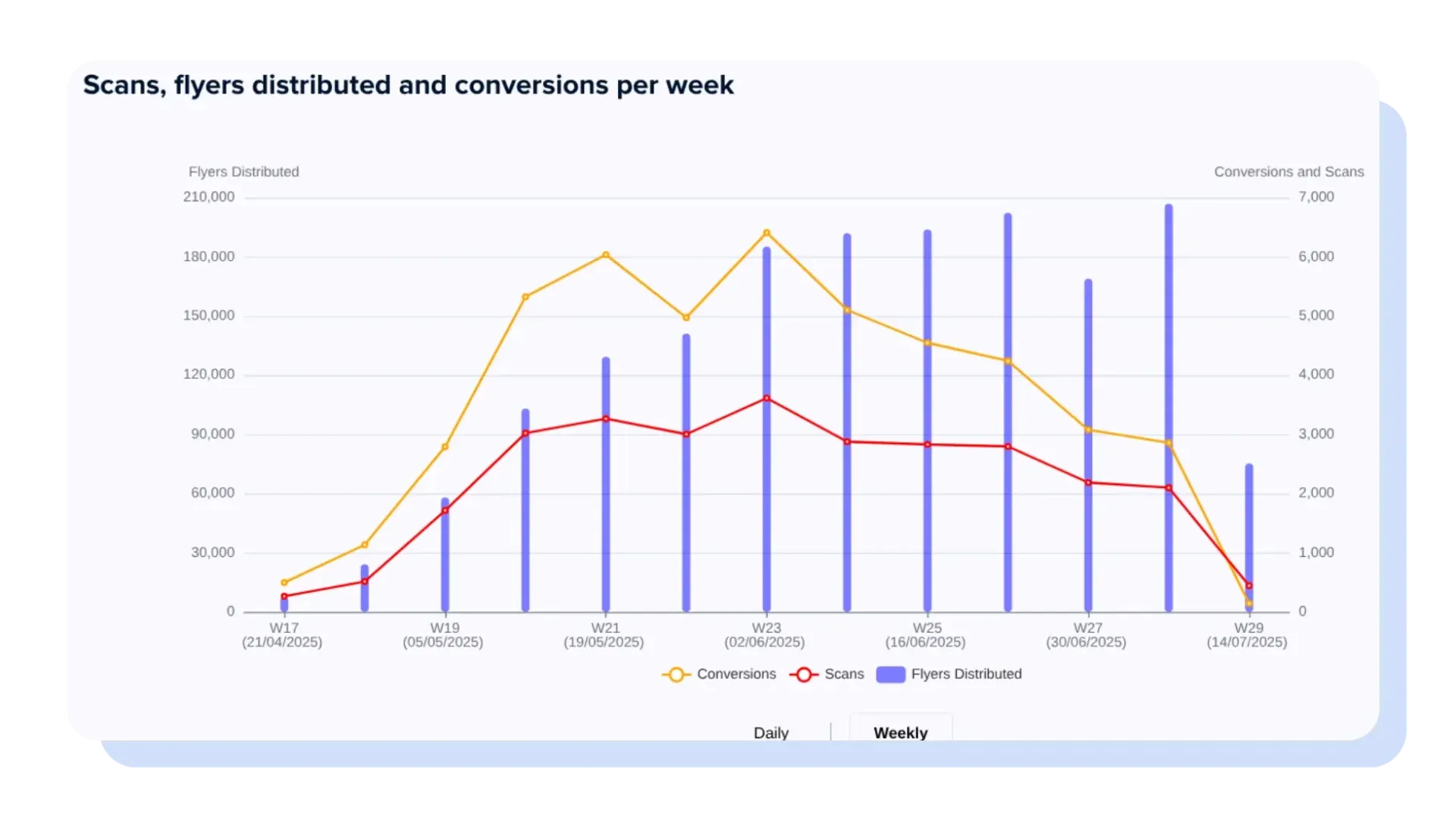
When integrated with digital channels, physical campaigns can be tracked, optimized, and attributed with the same performance mindset as online media.
QR codes, custom URLs, promo codes, and lift analysis make it possible to connect offline exposure to online behavior, from website visits and app installs to sign-ups and purchases. This allows marketers to measure incremental impact, compare channel performance, and optimize campaigns in real time. In an integrated setup, offline expands visibility.
How online and offline tactics complement each other across key channels
Offline tactics like direct mail, flyering, and inserts are especially powerful in unified contexts because they sit at the intersection of physical reach and digital activation. Here are the most common and effective integration use cases:
Offline → online activation
In campaigns where physical materials act as the first touchpoint, digital channels can complete the journey. Each plays a distinct role in creating a connected, end-to-end experience. For example:
- Flyers guide recipients to landing pages or app downloads through QR codes
- Direct mail pieces use custom URLs to deliver tailored offers which can be accessed on the website or in the app
- Package inserts introduce customers to relevant products within your catalog which they can access online
These examples are particularly effective for awareness and acquisition, where offline captures attention and digital handles conversion and measurement.
Online → offline reinforcement
The flow also works in the opposite direction. Digital data increasingly shapes where and how offline campaigns are deployed. Brands use website behavior, CRM insights, or past campaign performance to decide which neighborhoods receive flyers or which customers receive direct mail. Instead of blanket distribution, offline becomes selectively deployed based on real user signals.
For example, through e-commerce integrations such as Oppizi’s Shopify integration, brands can trigger direct mail based on specific customer actions: abandoning a cart, completing a first purchase, or browsing certain product categories. A customer who hesitated at checkout might receive a reminder offer at home, while an existing buyer could receive a tailored cross-sell recommendation via mail.
Advances in personalization and automation technology make this even more powerful, enabling brands to customize content, offers, and visuals at scale.
Synchronized messaging across channels
Consistency multiplies impact. When brands deliver the same tone, values, and core message across channels, from email and social to websites and physical touchpoints, they reduce confusion and accelerate recognition. Offer alignment is just as critical. A promotion advertised in a flyer should match what customers see online or in-store. Mistakes or discrepancies will break trust and undermine the entire campaign.
These are some ways you can achieve synchronicity across channels:
- Launching a paid social campaign and a flyer drop with the same value proposition and creative theme
- Reinforcing limited-time digital offers through direct mail reminders as well as through email.
- Using inserts to support major digital product launches or feature announcements.
How combining digital and real-world tactics improves performance and ROI
When marketing teams use offline and digital together, they often see performance improvements across every key metric, from engagement to conversion and long-term value. Coordinated omnichannel campaigns outperform siloed efforts.
Greater engagement and higher conversion
Campaigns that use three or more channels show dramatically better outcomes than single-channel efforts. Omnichannel campaigns deliver engagement rates nearly three times higher than single-channel campaigns. Moreover, they often see up to 250% higher purchase rates, proving that diverse, coordinated touchpoints prime prospects for conversion far more effectively than digital alone.
Improved customer retention and lifetime value
Integrating channels effectively leads to relationship building over time. Research shows that omnichannel or integrated customers tend to stick around longer and spend more, because their experience feels seamless and valuable across interactions.
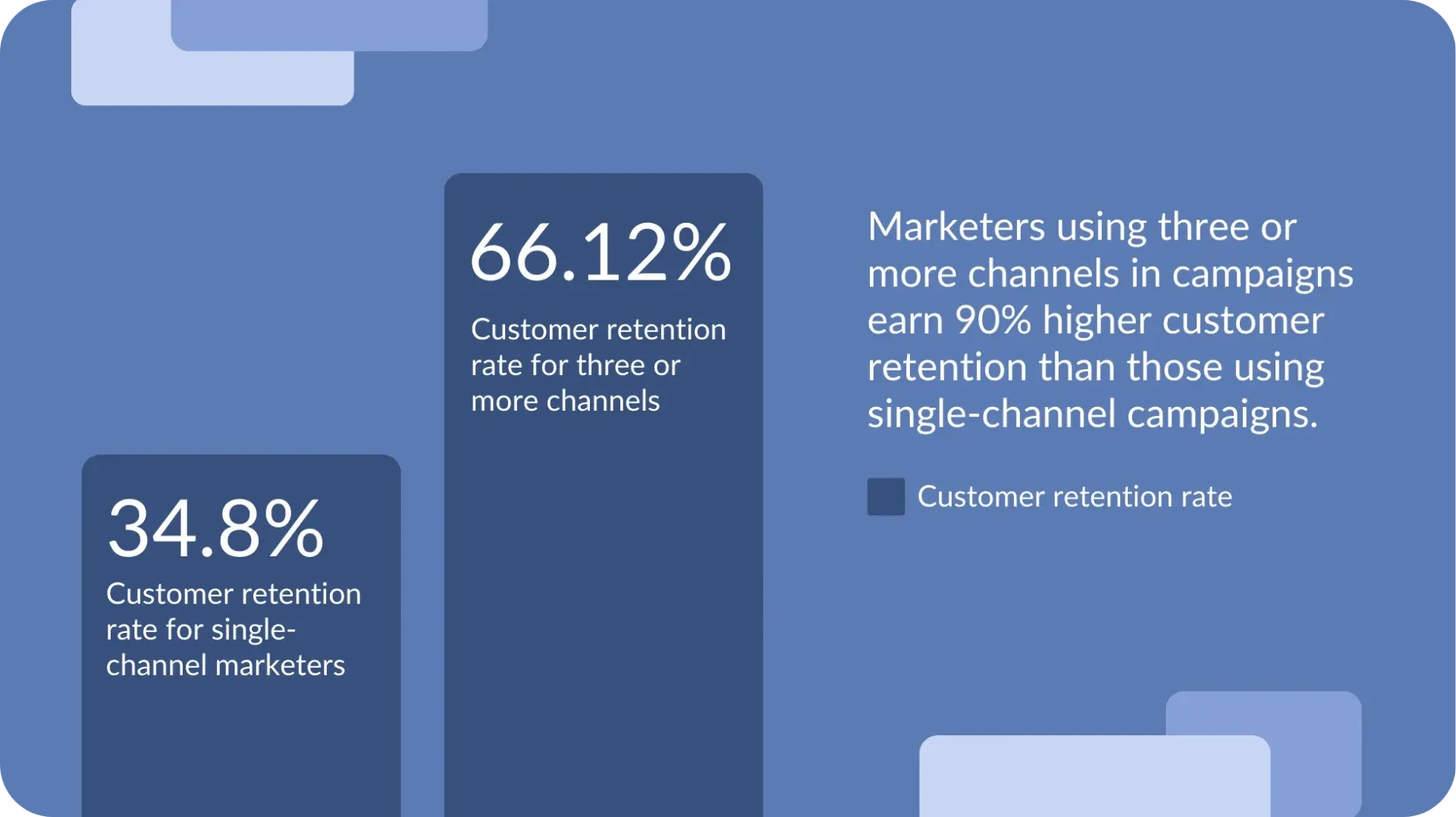
Brands that integrate multiple channels see customer retention rates jump from 35% to 66%. That is a 90% higher retention rate for omnichannel campaigns and proof that consistent presence across environments builds loyalty that neither offline nor online can achieve in isolation.
Higher customer spend
Multichannel engagement not only drives more purchases but also increases the value of each transaction. Average order value for customers exposed to integrated experiences tends to be around 13% higher.
Together, these numbers prove once again that offline and digital amplify each other’s impact when deployed in a unified strategy.
Streamlines experiences, happier customers
Customers today have grown to expect seamless experiences across touchpoints. According to BusinessDashers, roughly 73% of buyers anticipate a unified journey that effortlessly bridges online, offline, mobile, sales, and support interactions. When brands deliver that level of cohesion, satisfaction measurably improves, with integrated omnichannel experiences leading to up to a 20% increase in customer satisfaction compared with disjointed approaches
Richer, data-driven insights
Integrating offline and digital channels unlocks better data, clearer patterns, and smarter decision-making. When brands activate multiple channels and track how audiences respond across them, they gain a more complete picture of what actually drives engagement and conversion.
By combining offline signals such as QR code scans, promo code redemptions, or geographic lift with digital data like searches, clicks, and conversions, businesses get deeper insights into preferences, timing, and purchase triggers. The result is a feedback loop where every campaign improves the next one and an environment where offline and digital together become a force for growth.
Powerful alone, unmatched together
Ultimately, the strongest marketing strategies aren’t digital-first or offline-first. They’re integrated by design. Drawing from both their unique strengths is how you build the most efficient model possible.
A reliable partner can help with that.
With Oppizi, offline campaigns seamlessly complement your existing digital efforts. We manage the entire process, from printing and distribution to tracking and measurement, and give marketers clear, real-time visibility into what’s working and why. The result is offline marketing that’s fully accountable and scalable. It’s marketing designed to perform on the same level as your digital efforts.
Get started with Oppizi today.