Last updated 30 September 2026
Direct mail consistently delivers excellent results as an offline marketing channel. Its success, far from being accidental, is the product of well-documented psychological and neuroscientific mechanisms.
As a marketer, when you understand how and whydirect mail marketing works at a cognitive and emotional level, you’re far better equipped to design campaigns that perform. That also makes it easier to justify budget allocation and anticipate how your audience will respond.
So, let’s take a closer look at the behavioral principles that power direct mail marketing.
The scientific principles behind direct mail
Direct mail has one strong advantage that digital marketing can’t compete with: it is grounded in the power of touch. Physical materials engage the human sensory system in ways that deepen emotional impact, strengthen memory, and increase perceived value. Neuroscience repeatedly confirms this.
Touch generates stronger emotional responses
Research from Temple University shows that people process physical objects with less cognitive effort while generating stronger emotional responses. For example, holding a printed mailer or catalog activates multiple sensory areas of the brain, including the somatosensory cortex. This multisensory engagement (through weight, texture, format, dimensionality) creates richer emotional processing than screen-based media.
According to studies referenced in MIT Sloan, which were conducted using fMRI scans and eye tracking, paper advertisements activate more emotional processing centers than purely visual digital ads. A study from Temple University looks at this in depth, concluding that print ads are associated with greater levels of engagement and arousal.
As a result, deeper and more meaningful connections are created, and that builds stronger brand loyalty. Marketing assets that the consumer can physically hold and keep embed themselves into people’s minds more effectively.
Physical media enhances memory and recall
The U.S. Postal Service Office of Inspector General and Temple University conducted a study that compared how people respond to physical versus digital advertisements using neuromarketing tools such as eye-tracking to measure attention, biometric sensors to measure emotional engagement, and fMRI scans to identify how the brain evaluates ads.
The findings are telling: participants processed digital ads more quickly, but they spent more time engaging with the physical ones. They required 21% less cognitive load to process, which means that the message felt more intuitive and easier to grasp. Plus, when cognitive load is low, people are more likely to pay attention, retain information, and form positive impressions.
While physical ads may take a moment longer to capture initial attention, they create a far more durable impression that supports recall at the moment of purchase. Notably, physical ads activated the part of the brain linked to evaluating and desiring products (the ventral striatum) indicating a higher likelihood of purchase intent.
A different study conducted by Temple University’s Fox School of Business used a multi-methodological approach to look at the effectiveness of print and digital media in advertising. The findings indicated that print media has notable advantages in terms of memory encoding and retrieval, highlighting the importance of print materials in advertising and marketing communications.
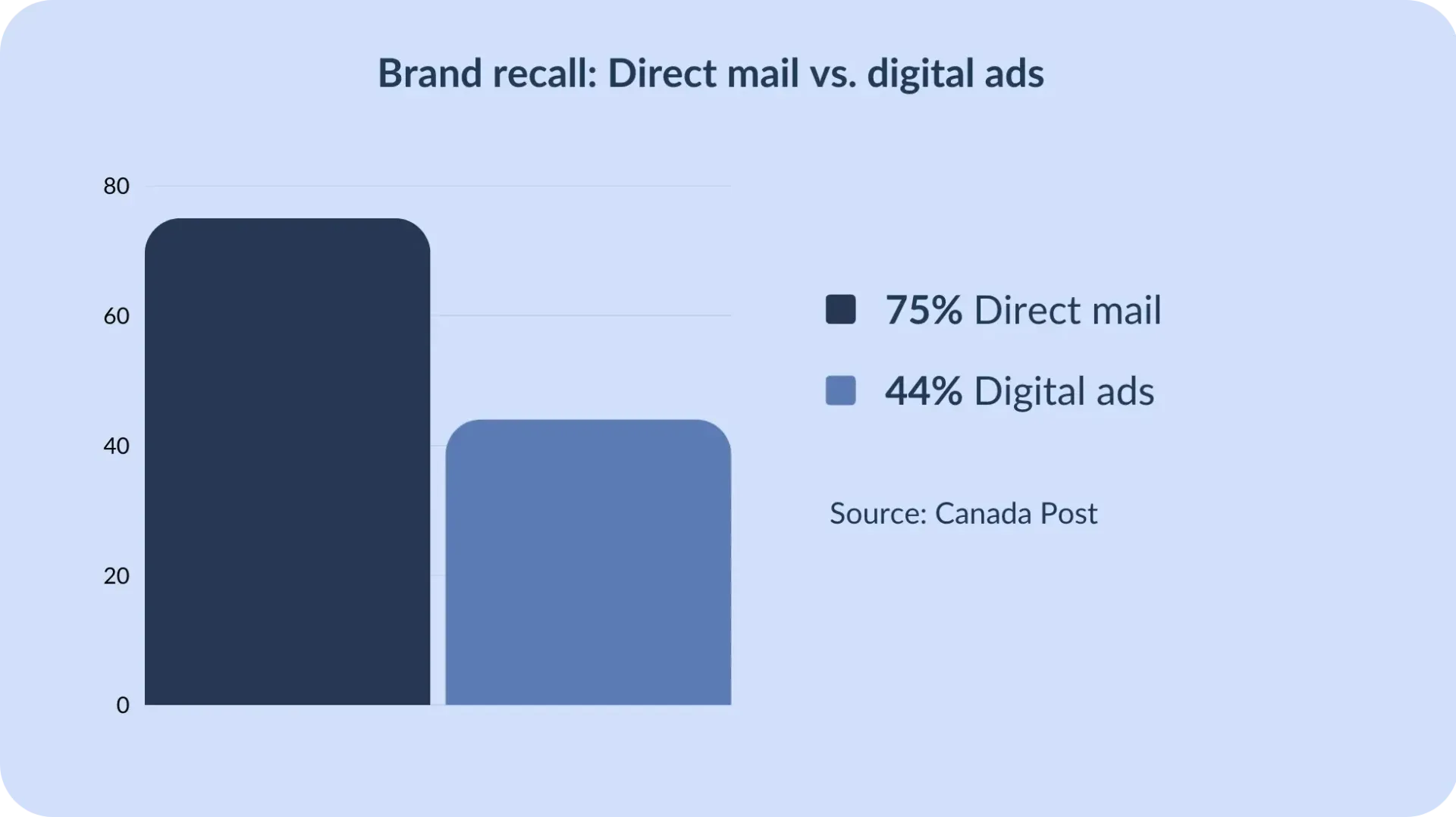
This is corroborated in a study performed by a Canadian neuromarketing firm, which compared the effects of direct mail pieces with digital media (email and display ads). They concluded that recall was 70% higher among participants who were exposed to a direct mail piece (75%) than a digital ad (44%.)
Physical ads strengthen perceived value and desirability
The Temple University study revealed that people subconsciously assign more value and desire towards products and services they encounter in a physical format. This means direct mail is particularly effective at two key stages of the customer journey: exposure to information and retrieval of information.
These effects aren’t limited to one study or one country, with other research showing similar patterns. Royal Mail’s 2009 and 2015 neuromarketing studies found that mail generated stronger engagement, emotional intensity, and memory compared with email and television. A 2021 University of Tokyo study found that reading or writing on paper led to stronger memory recall and higher brain activation than performing the same tasks on tablets or smartphones. Paper created richer, more spatially anchored memories, suggesting the brain encodes physical information more effectively.
Together, this body of research shows that the brain responds differently and more deeply to physical touch. And the implications for marketers are manifold. With the sensory experience comes emotional resonance, better memorability, higher perceived value, and greater purchase intent.
Touch prompts a sense of ownership
Beyond emotional impact and memory, touch plays a powerful role in shaping how people assign value to things they encounter. This tendency to assign higher value to something the moment it feels even partially “ours” is called the endowment effect.
A study published in the Journal of Consumer Research found that merely touching an object results in an increase in perceived ownership of that object. When that happens, we assign more value to the object. Additional research from Cambridge University Press shows the same effect even with temporary possession: just holding something for a short period can trigger the same psychological response. You find things more valuable if they are in your possession.
You can see this in everyday life: when you pick up a book in a store and flip through the first few pages, it suddenly feels different from the others on the shelf, more familiar, more suited to you. Or consider trying on a jacket: you immediately start imagining where you’d wear it and why it might be worth keeping. When you’re in a rental car, as soon as you’re in front of the wheel, adjusting the seat heights, driving it on the roads, that’s no longer any car, it feels like your car. You like it better, it drives smoother, you appreciate it more.
Direct mail taps directly into these psychological mechanisms. A printed mailer is handled as opposed to just being seen, creating an instant, subconscious sense of ownership. That tactile interaction makes the piece feel more personal and relevant.
Object permanence
Another unique strength of direct mail is its connection to the psychological principle of object permanence, which is the idea that physical objects continue to exist even when they’re out of sight. A well-designed mailer or catalog remains in the recipient’s environment, allowing for repeated exposure over time. Even if it’s initially set aside, it can be rediscovered days or weeks later, keeping the brand and message top of mind.
In contrast, digital ads disappear the moment a user scrolls past them. The lingering presence of physical mail not only reinforces brand recognition but can also prompt unplanned purchases, brand reappraisal, or word-of-mouth recommendations.
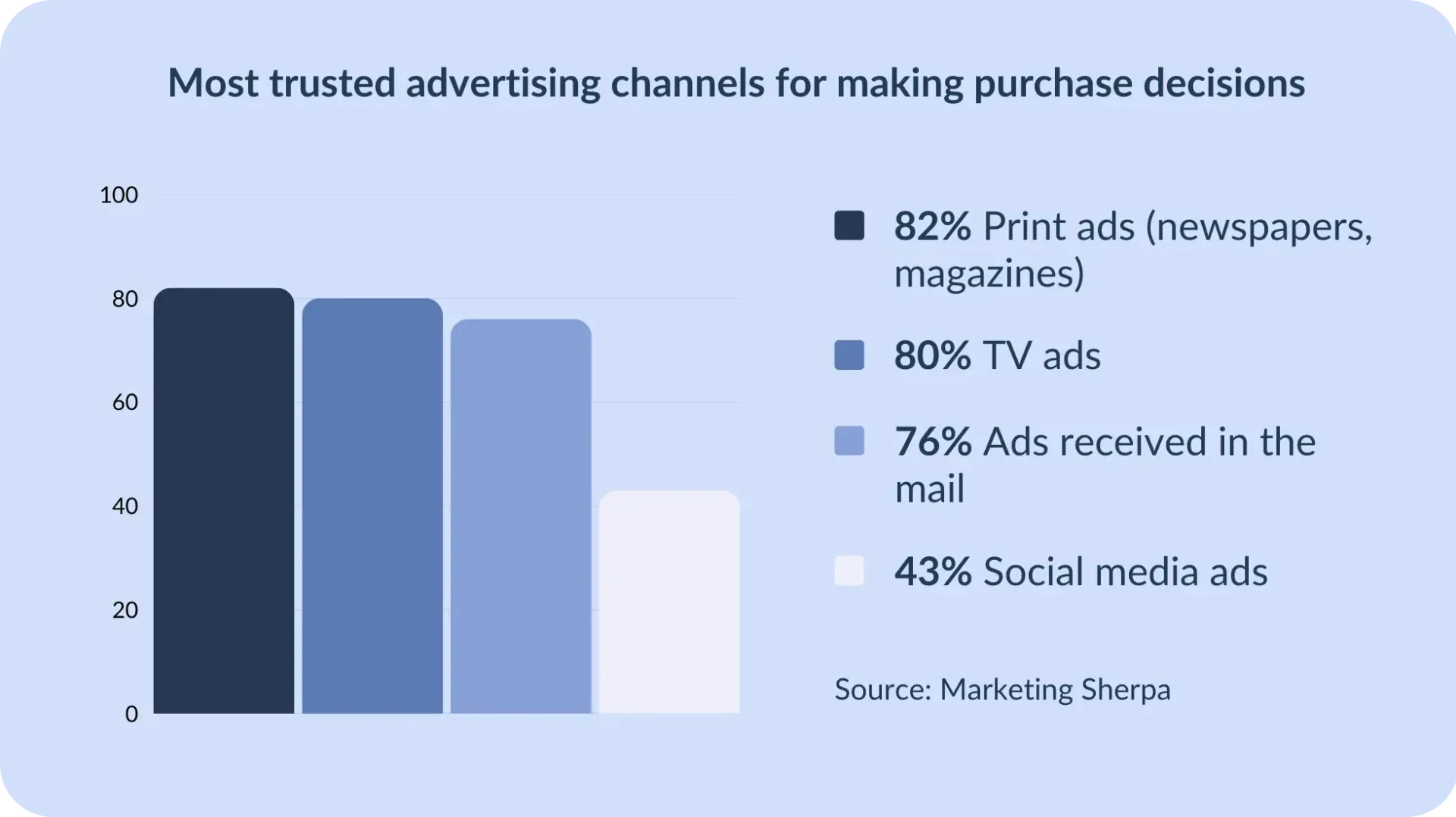
Direct mail builds trust
Beyond the inherent credibility of print as a medium, direct mail is associated with trust because of its relevance. By delivering offers that actually matter to people, brands create trust and lasting recognition even when no immediate action is taken. Modern direct mail is highly targeted: it relies on detailed customer insights, behaviours, and needs. Receiving this type of targeted messaging feels more relevant and, therefore, more credible.
The psychology behind the execution
The psychological power of direct mail becomes tangible at the execution level. How you structure the message, choose your colors, and personalize your content can materially influence attention, interpretation, and response.
Here are some drivers you have to consider at the execution level.
Clear messaging and CTAs
An impactful psychological lever in direct mail is what behavioral scientists call processing fluency. This is the principle describing how the brain’s experience of ease of understanding influences judgement and behavior. To put it plainly, processing fluency relates to the brain’s preference for cues that are easy to understand and act on. When a message feels simple to process, people find it more trustworthy and more persuasive.
In direct mail, this translates into:
- Single-minded messaging that makes the offer immediately obvious
- Direct, behavior-specific calls to action
- Strategic visual emphasis on the CTA using spacing, typography, or contrasting color
- One primary action rather than multiple competing ones
When people who receive your mailer don’t have to decipher the intention of the mail piece, their cognitive load drops and their likelihood of responding increases.
Use color theory to capture attention
With direct mail being such a visual medium, it’s no surprise that color may play a significant role. Extensive research published in the Management Decision journal has shown that anywhere from 62 to 90% of product assessments are based on color alone. The way you use colors can differentiate your products from the competitors, can influence moods and feelings, and even people’s attitude towards certain products. So, understanding the importance of colors in marketing, and subsequently applying that knowledge to your direct mail efforts could pay off in the long term.
Let’s look at some examples of how to use this in practice.
- Warm, high-arousal colors like red or orange can heighten urgency and draw the eye to key elements — think offers, deadlines, or CTAs.
- Cooler tones like blue or green signal trust, calm, and reliability. Messaging related to financial, health, or sustainability might benefit from this color scheme.
- Contrast is crucial: the brain detects differences more readily than absolute colors, making high-contrast CTAs faster to notice.
- Particularly important is to align your mailers to your brand palette. This reinforces recognition and the consistent use of color increases brand recall.
Personalization as a trigger emotional engagement
Personalization in direct mail is a uniquely powerful tool. When executed well, it taps into the brain’s self-referencing effect. That is a psychological phenomenon where people have enhanced memory retention for information that relates personally to them. Research published in the Journal of Interactive Advertising shows that seeing or hearing your own name or contextual cues increases attention, emotional engagement, and recall. So, for example, seeing “Hi, Brad! We picked this offer for you!” or “Angela, here’s 50% off on your next order” will work far better than a generic message.
In direct mail marketing, personalization can go beyond name-based personal greetings. You can use behavioral or lifecycle-based offers that reflect actual customer needs or actions. E-commerce businesses could send personalized replenishment reminders: “Running low on your skincare essentials?” or can follow up on abandoned purchases “Your cart items are waiting. Enjoy 15% off.” Or they can encourage cross-selling: “Loved your running shoes? Try our custom-fit insoles.”
Other effective personalization techniques include location or demographic tailoring or variable imagery and messaging that speaks directly to a segment’s values or motivations.
A personalized mail piece feels less like an ad and more like a message designed for the recipient. Naturally, that will increase both engagement and likelihood of conversion. For e-commerce brands, delivering this level of personalization is now easier than ever: integrations with platforms like Shopify allow customer data and behavioral triggers to automate and scale highly targeted direct mail campaigns.
Practical applications of neuromarketing concepts in direct mail campaigns
Here are some effective neuromarketing principles that can elevate direct mail performance, along with practical ways to apply them:
The power of “Free”
People are instinctively drawn to offers labeled “free,” even when the actual value is modest. The word triggers immediate attention and lowers perceived risk. You could feature “free” offers prominently on envelopes or headlines like “Free guide inside”, “Free consultation”, or include small physical giveaways such as samples or vouchers. A tangible freebie reinforces the sense of receiving something valuable before being asked to act.
The framing effect
How an offer is presented can be more persuasive than its actual content. Messages framed as gains rather than losses tend to feel more motivating and positive.
Applying this concept to direct mail is simple. Present benefits rather than drawbacks: “Save $20”. Break larger prices into smaller, more manageable amounts: “Just $1 per day” rather than “$365 per year”, and highlight outcomes over features: “Feel energized in 7 days” rather than “Reduces fatigue”.
Anchoring bias
The first number people see forms a mental benchmark that shapes how later prices are perceived. If you want to apply this to your mailer, you can lead with a higher reference price: “Normally $50. Now $19.99”, making the offer feel like a stronger deal. Premium options or large investment figures placed first can make subsequent offers seem more affordable by comparison.
Social proof
We rely on others’ behavior to validate our own choices, especially in uncertain situations. To make social proof work for you, include short testimonials, customer quotes, or statistics: “Trusted by 5,000+ customers”. Logos of recognizable partners, star ratings, or “bestseller” tags subtly signal safety and credibility.
Scarcity and urgency
Limited availability increases perceived value and encourages immediate action. Use genuine deadlines: “Offer ends May 30” or quantity limits: “Only 100 vouchers printed”. Unique QR codes or voucher numbers amplify the sense of exclusivity, making each piece of mail feel personally reserved for the recipient.
Loss aversion
People are more motivated to avoid losing something than to gain something new. An efficient way to lose this strategy would be to frame offers as something recipients could lose rather than a benefit they might gain: “Don’t miss your unused $200 credit” or “Avoid paying full price later.” This taps into a deeper, more urgent emotional driver.
The performance case for direct mail marketing
Direct mail continues to outperform expectations and it consistently delivers results that many marketers struggle to replicate in other channels.
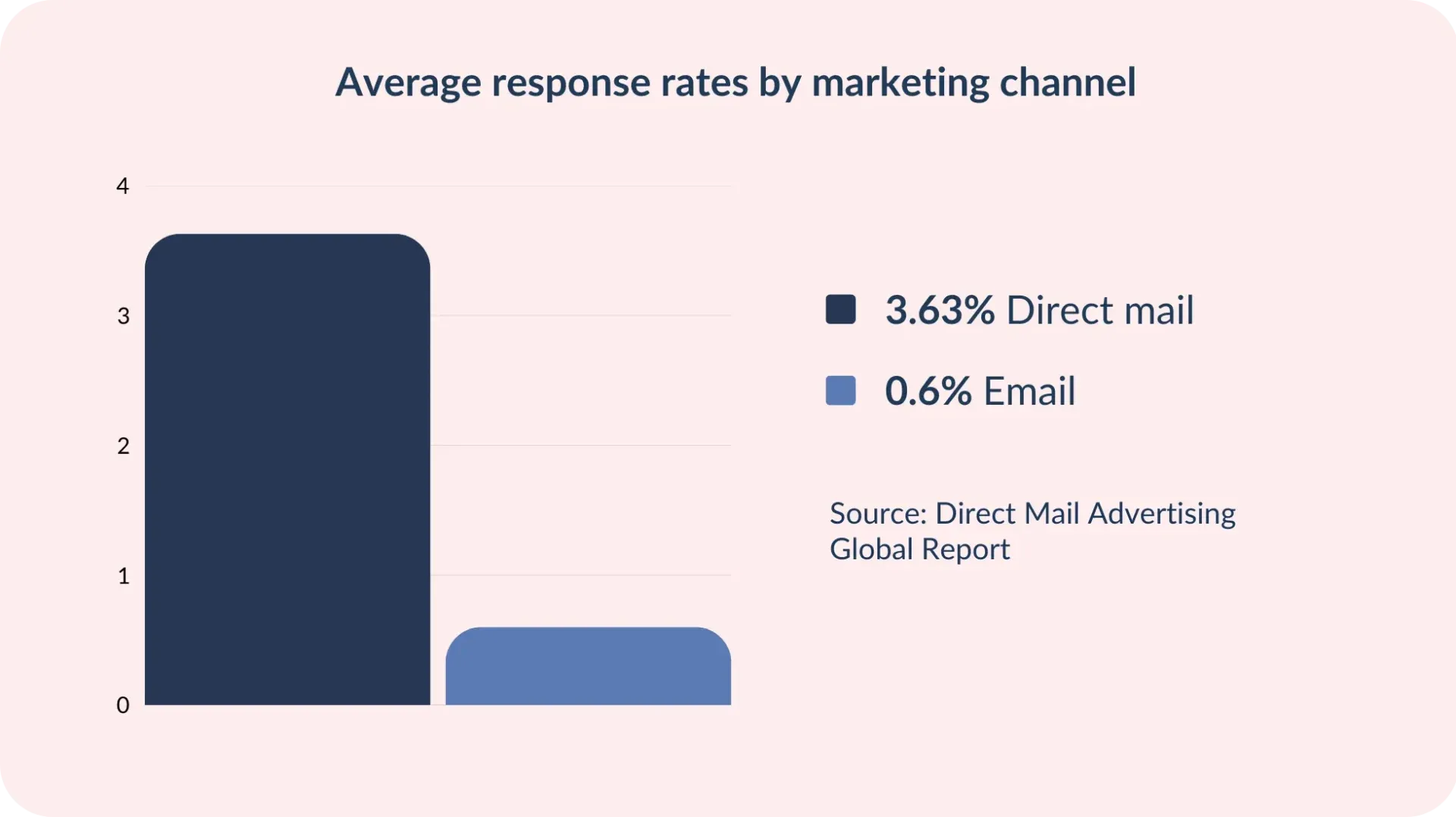
The statistics around direct mail are hard to ignore: 84% of marketers report that direct mail offers the highest ROI of any channel in their mix, and average response rates hover around 3-4%, a figure that outpaces email, paid social, and many forms of display advertising. Meanwhile, 60% of consumers say they take action after receiving a piece of direct mail. These numbers are strong evidence of what a channel can achieve when it is aligned with how people naturally process information and make decisions.
Ready to get started?
Turning behavioral insights into measurable performance is where direct mail’s real power emerges. When these psychological principles are applied consistently and at scale, direct mail becomes persuasive, predictable, repeatable, and accountable.
In that process, Oppizi can be your trusted partner. Through direct mail automation, advanced audience segmentation, and integrations with platforms like Shopify, Oppizi removes the traditional operational barriers to direct mail. At the same time, the Oppizi platform makes it simple to track and measure the impact of your campaigns.
A high precision measurable channel whose success is grounded in behavioral science is a strong ally to have in your marketing efforts.
Get started with direct mail today.