Last updated September 22, 2026
Summary
- A direct mail list is a database of addresses used to target individuals or businesses with physical mail. The two families are house lists, built from your own customer data, and prospect lists, sourced externally.
- House lists outperform prospect lists by a wide margin. The ANA Response Rate Report 2023 puts direct mail response at 15.6% for house lists and 10.8% for prospect lists.
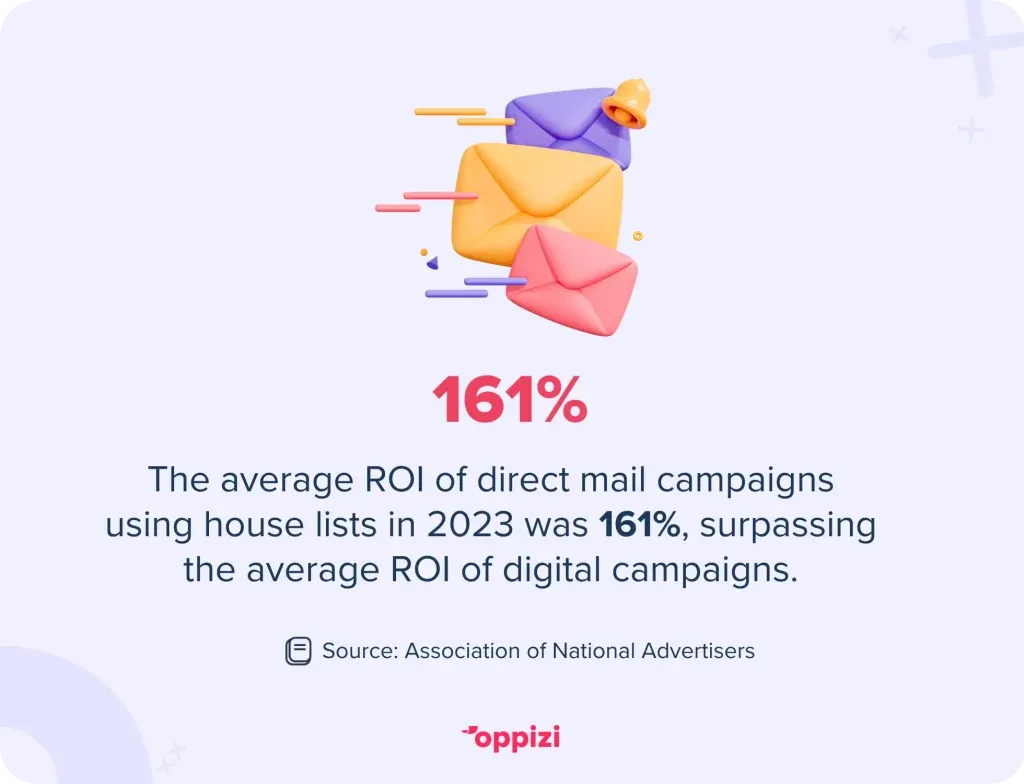
- Direct mail to house lists returned 160.9% ROI in the same report, the highest return of any medium ANA measured.
- Self-serve consumer records run roughly $0.02 to $0.13 each and fall to about $0.04 at 25,000 records or more. Business records run about $0.10 to $0.25 each.
- Your own CRM, loyalty and e-commerce data is the cheapest and strongest list you will ever mail. Verify addresses before you send.
The success of a direct mail campaign rests on the quality of the list behind it. Get the list right and everything downstream gets easier. Get it wrong and no amount of design or copy will save the drop.
This guide covers the types of direct mail lists available, what they cost per record, how they compare on response rate, and how to build one from data you already own.
What is a direct mail list?
A direct mail list is a database of addresses and associated information used to target individuals or businesses with physical mail. Lists can be tailored to specific marketing objectives so your message reaches the right audience rather than every address in a postcode.
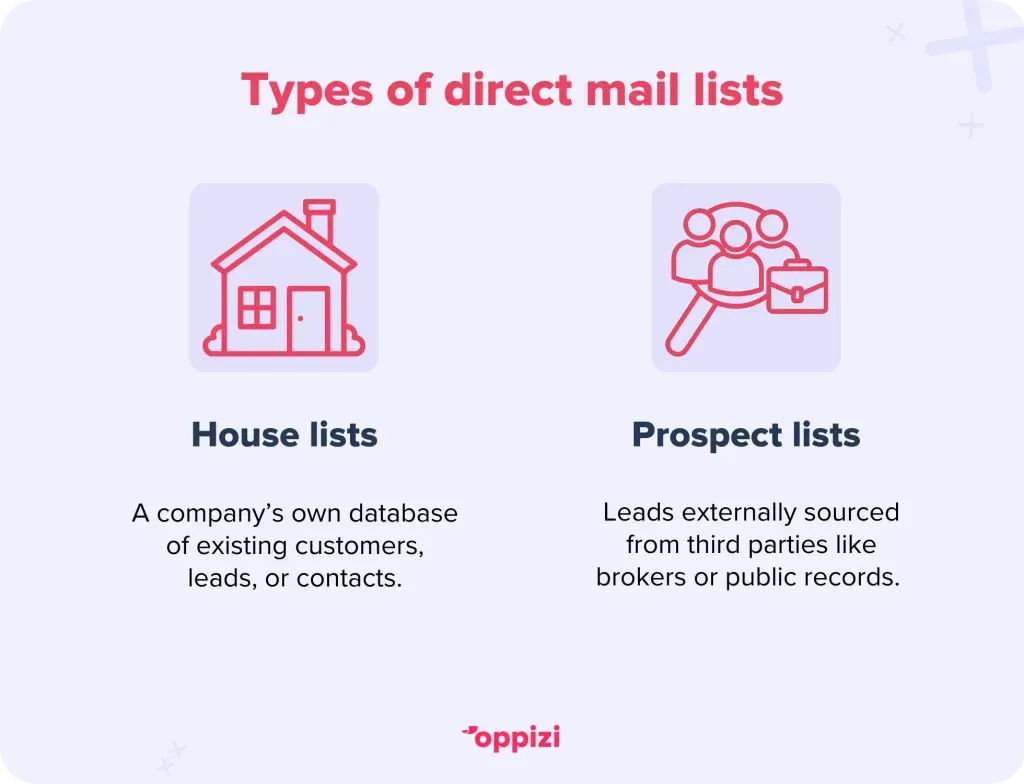
Direct mail lists fall into two primary types: house lists and prospect lists. The difference between them is the single largest driver of response rate, so it is worth understanding before you spend anything.
What types of direct mail lists are there?
There are two families, house and prospect, each with several subtypes.
House lists
A house list comprises information about your existing customers, leads, or contacts that your business has collected over time. These lists perform well because the recipients already know your brand, and the response gap is large: the ANA Response Rate Report 2023 put direct mail response at 15.6% for house lists against 10.8% for prospect lists. House lists are also ideal for retargeting campaigns, letting you re-engage previous customers with personalized offers.
Customer lists
Individuals or businesses that have purchased from or interacted with your company before. For example, small businesses can use customer lists to send personalized thank-you notes or discounts that encourage repeat business.
Lead lists
Potential customers who have shown interest, for example by signing up for your newsletter, but who have not converted yet. A gym could mail its class timetable with a first class free offer to people who registered interest but never booked.
Lapsed customer lists
Past customers who have not engaged in a while. Direct mail is well suited to win-back offers, because it reaches people who have stopped opening your email.
Prospect lists
Prospect lists contain potential customers who have not interacted with your business yet but fit your target audience profile. They are sourced externally and are designed to expand reach.
Consumer lists
These target individual households by demographics, purchasing behavior, and lifestyle. A pet supply retailer might target households that own pets. A restaurant could target larger households with family offers.
Business lists
Business lists focus on companies rather than individuals, segmented by industry, company size, location, or decision-maker title. A CRM vendor might target mid-sized retailers and address mailers to marketing managers.
Specialty lists
Highly targeted lists focused on niche audiences, such as donors to specific charities or subscribers to particular magazines. The narrower targeting is the point, and it generally costs more per record than a broad consumer file.
Compiled lists
Built by gathering data from public and private sources such as census data, property records, or surveys. Broad, and useful when reach matters more than precision.
Occupant lists
Occupant lists target every household in a geographic area with no demographic filter. They are cost-effective for local awareness. A new store might target all households within a five-mile radius to announce opening.
Homeowner lists
Targeted at property owners and segmentable by property value, ownership status, or home type. Well suited to home improvement and landscaping offers.
How do I build a direct mail list from my own customer data?
Start with what you already hold. The most reliable starting point is your CRM: pull contacts, segment them by purchase history, lifecycle stage, or engagement level, and check that mailing addresses are current. Useful sources include:
- CRM records: contact details and transaction history give you a ready-made foundation for targeting and personalization.
- Email sign-up and loyalty data: people who opted in already have some affinity for your brand, so they are worth mailing.
- E-commerce order data: purchase frequency, average order value, and product category support tightly segmented lists for specific offers.
- In-store and event sign-up forms: offline touchpoints are an underused source of clean, first-party address data.
Before you mail, run the list through address verification to remove duplicates and catch movers. This is not only good practice: USPS Domestic Mail Manual 602 requires that each address in a commercial First-Class Mail presort or USPS Marketing Mail mailing be updated within 95 days of the mailing date using an approved method such as NCOALink, with assessment charges above a 0.5% error threshold.

How much does a direct mail list cost?
Self-serve list providers publish per-record pricing that falls steeply with volume. Prices below were checked in September 2026.
| List type | Records | Price per record | Provider |
|---|---|---|---|
| Consumer | 1,000 | $0.125 | LeadsPlease |
| Consumer | 10,000 | $0.05 | LeadsPlease |
| Consumer | 25,000+ | $0.04 | LeadsPlease |
| Consumer (homeowner, mailing only) | standard | $0.025 | DataZapp |
| Consumer (prepaid volume) | high | from $0.015 | DataZapp |
| Business | 500 | $0.25 | LeadsPlease |
| Business | 5,000 | $0.17 | LeadsPlease |
| Business | 25,000 | $0.10 | LeadsPlease |
In short, consumer records run roughly $0.02 to $0.13 each and settle around $0.04 once you pass 25,000 records. Business records run roughly $0.10 to $0.25 each. Additional costs may include licensing fees, minimum order requirements, and charges for extra data points such as phone numbers or email addresses.
Two caveats. These are one-time-use purchase prices from self-serve providers; traditional broker list rental is quoted as a CPM with select charges and is not publicly rate-carded. And the larger legacy providers quote through sales rather than publishing rates, so treat any article citing a fixed per-record price from them with suspicion.
Per-record price is only part of the equation. A cheap, low-quality list that generates few responses costs more in the long run than a precise, well-maintained one. The factors that most influence price (targeting depth, data freshness, and source exclusivity) are also the factors that most influence performance.
What makes a good direct mail list?
The difference between a campaign that converts and one that lands in the recycling bin often comes down to list quality, long before the mailer is designed. A strong list shares a few characteristics:
- Accuracy: addresses are verified, deliverable, and current. Undeliverable mail is wasted spend.
- Relevance: the people on it match your ideal customer profile by geography, demographics, behavior, or intent. A broader list is not a better one.
- Recency: data ages quickly. Lists built on recent purchases, current registrations, and active subscribers outperform stale ones.
- Segmentability: enough data points to slice and personalize. Household size, income bracket, or purchase category make a message far more likely to land.
- Source integrity: lists compiled from reputable, permission-based, or verified sources perform better and keep you on the right side of privacy regulations.
Why use a direct mail list?
Targeted reach
A list lets you mail the people most likely to respond instead of everyone. That targeting is what separates the 15.6% house-list response rate from a saturation drop.
Personalization
With the right data you can tailor the message to each recipient, which raises engagement and conversion.
Tangible impact
Unlike digital ads, direct mail is physical. A well-designed mailer sits on a counter for days rather than disappearing from a feed.
Strong return on investment
Direct mail to house lists returned 160.9% ROI in the ANA Response Rate Report 2023, which ANA described as the top ROI of all media in the study. Prospect lists returned 33.7% in the same report, which is another reason to build your house list. For how to measure this on your own campaigns, see our guide to direct mail ROI.
Where can I buy a direct mail mailing list?
You can acquire direct mail lists from several sources:
- List brokers: specialists who help you filter by geography, demographics, and behavior so you are not paying for records that do not fit your audience.
- Self-serve list providers: providers that publish per-record rate cards and let you build and buy a file online.
- Trade associations: many industries have associations that maintain membership lists.
- In-house databases: if you already have customer data, this is your strongest and most cost-effective option.
- Public records: property records and other public databases can be valuable resources.
- Direct mail platforms: platforms like Oppizi let you plan, execute, and measure the campaign in the same place you activate the data, so list sourcing and campaign management are not split across separate tools.
How do I use a direct mail list effectively?
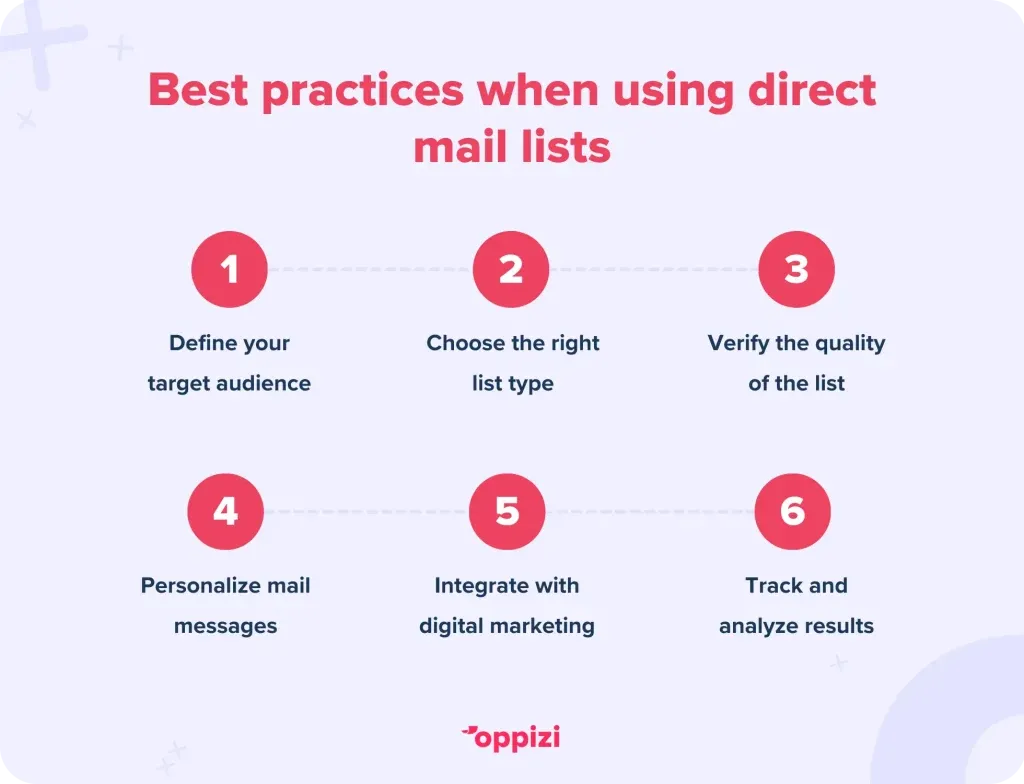
Define your audience
Be clear about the audience and the goal before buying or building anything. Setting SMART marketing objectives helps. Instead of targeting all homeowners, target homeowners in a given income bracket in urban areas.
Choose the right type of list
Align the list type to the goal. Launching a B2B product calls for a business list segmented by industry and decision-maker role.
Verify the quality of the list
Work with reputable providers and confirm the data is accurate and current. Outdated addresses waste budget and depress response.
Personalize your mail
Use the data to tailor the message. Address recipients by name and include details relevant to their demographics or past behavior using tools like variable data printing.
Integrate with digital campaigns
Combine offline marketing with digital marketing for a multi-channel approach, following a mailer with an email or social ad to reinforce the message.
Track and analyze results
Use unique codes or personalized URLs to track the success of your campaign, then refine the next drop on what you learn.
What rules apply to direct mail lists?
Direct mail is not governed by the CAN-SPAM Act, which applies only to commercial email. The rules that do apply to mailing lists in the United States are these:
- Prescreened offers: if you mail firm offers of credit or insurance using prescreened lists, FCRA section 1681b(c) governs the data you may use, and 16 CFR 642 sets the prescreen opt-out notice, including a short notice in at least 12-point type on the first page.
- Prohibitory orders: under 39 U.S.C. 3008, a recipient can compel USPS to order you to stop mailing them. You must delete those names from every list you own or control and may not include them in any list sale, rental, or exchange.
- Address hygiene: USPS Move Update under DMM 602 requires addresses to be updated within 95 days of mailing for qualifying commercial mail.
- State privacy law: the CCPA and CPRA cover offline personal information and the sale of mailing lists, giving California consumers rights to opt out of sale and to request deletion. California's Delete Act adds registration and deletion duties for data brokers, which captures many list vendors. Around twenty states now have comparable comprehensive privacy laws.
- Preference services: DMAchoice, run by the ANA, is a voluntary mail preference service rather than a legal requirement, but suppressing against it is good practice.
This is general information rather than legal advice. Check your own obligations with counsel before mailing at scale.

Conclusion
Direct mail lists are the foundation of successful direct mail campaigns. Understanding the types available, what they cost, and how to keep them clean is what separates a campaign that returns 160.9% from one that returns nothing. Start with the data you already own, verify it, segment it, and expand outward from there.
Frequently asked questions
- What is the difference between a house list and a prospect list?
A house list contains your existing customers and contacts. A prospect list is sourced externally and targets people who fit your audience profile but have not dealt with you yet. House lists respond better: 15.6% against 10.8% in the ANA Response Rate Report 2023.
- How much does a direct mail list cost?
Self-serve consumer records run roughly $0.02 to $0.13 each as of September 2026, falling to about $0.04 per record at 25,000 records or more. Business records run roughly $0.10 to $0.25 each. Traditional broker list rental is quoted as a CPM and is not publicly rate-carded.
- How do I choose the right type of direct mail list?
Work back from the campaign goal. For repeat business or win-backs, use your house list. For reach into a new audience, use a prospect list segmented as tightly as your targeting data allows. For local awareness where precision matters less than coverage, an occupant list is cheaper.
- How can I ensure the quality of my direct mail list?
Buy from reputable providers, refresh the data regularly, and run address verification before every drop. USPS Move Update rules require addresses on qualifying commercial mail to be updated within 95 days of the mailing date.
- How do I start building a direct mail list from my own data?
Start with your CRM, e-commerce platform, loyalty program, and sign-up forms. Export contacts with mailing addresses, segment them by behavior or lifecycle stage, and run the list through address verification before mailing. A small, well-curated house list will typically outperform a large generic purchased one, because the people on it already know you.