Last updated July 28, 2026
Struggling to measure your direct mail campaign’s return on investment? Don’t worry, we’ve got your back. In this simple guide, we’ll provide you with five easy steps to calculate an accurate return on investment for your direct mail marketing!
1. Start by Determining Your Metrics
There are a number of metrics that can be used to measure the success of your campaign; let’s explore a few.
Delivery and Response Time
In simple terms, this is the time it takes for the direct mail piece to reach the consumer and the time it takes for them to respond. You can monitor this by evaluating the time between mailing and responses to assess the campaign’s efficacy. Adding QR codes or coupons to your mailings can help you to track when and where customers are responding from - and, if your flyers are personalized, what they’re responding to.
Conversion Rate
Conversion rate (CVR) is one of the most important metrics in marketing campaigns. The conversion rate tells you the percentage of respondents who decided to complete your desired action, such as making a purchase or signing up for a service. You can calculate conversion rates by using an online calculator like The Online Advertising Guide’s Conversion Rate Calculator or by using the following formula:
CVR = number of conversions / number of mail pieces sent
Cost Per Acquisition
This metric is rather self-explanatory; cost per acquisition (CPA) is the cost associated with acquiring a customer or a consumer completing a certain action. This action could be a sale, lead, click, download, or any other predetermined goal. You can calculate CPA like this:
CPA = total cost of campaign / number of conversions
Alternatively, you could create a campaign with Oppizi. Our handy dashboard features 14 key performance indicators, including CPA and CVR, which update in real-time. You don’t need to calculate a thing!
Customer Lifetime Value
Customer lifetime value, or CLV, is the predicted total revenue your business expects to earn from a customer throughout their entire relationship with your brand. CLV provides valuable insights into the long-term financial value of a customer relationship, and can help with resource allocation, strategic decision-making, and more. The CLV formula is:
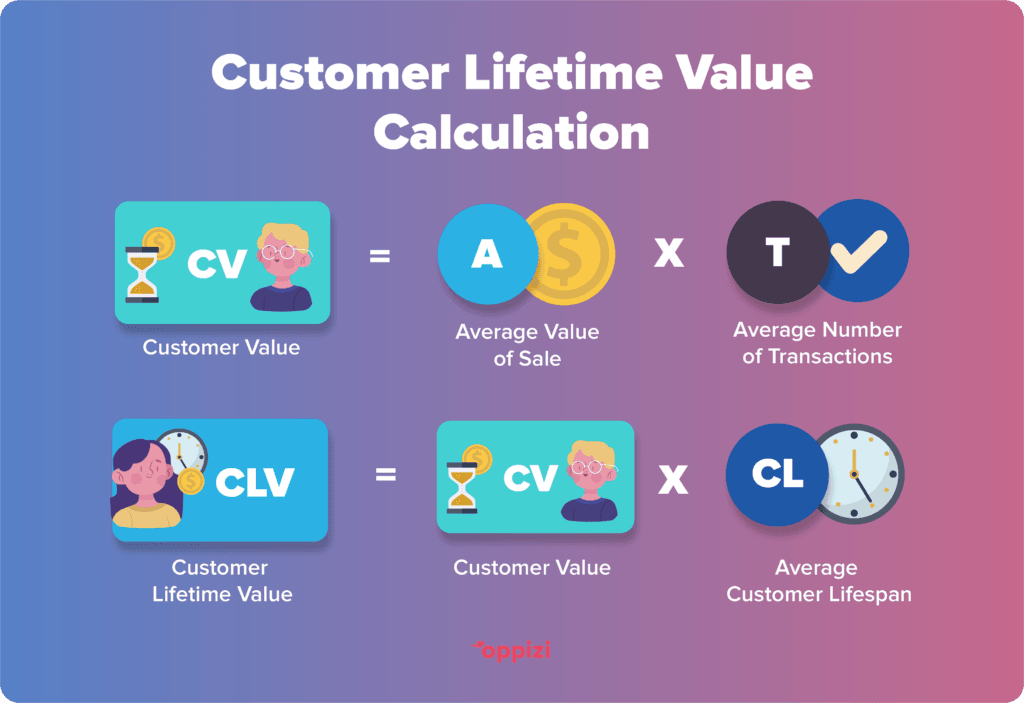
To calculate CLV, you need to determine the following:
- Step 1 - Find the Average Order Value by dividing Total Revenue by the number of orders received.
- Step 2 - Calculate Purchase Frequency by dividing the number of orders by the unique customers.
- Step 3 - Establish Customer Value by multiplying a customer's average order by their purchase frequency. Customer Value (CV) = Avg order x Purchase Frequency.
- Step 4 - Get the Customer's Average Lifespan, which is the average duration a customer stays active before becoming inactive.
- Step 5 - Use the Customer Lifetime Value Formula: Customer Value x Customer's Average Lifespan.
Now you can compute CLV:
Customer Lifetime Value = [Annual Revenue/Total Number of Unique Customers for the Year] x [Average Lifespan of Customers]

2. Set Your Campaign Goals
If you want to achieve direct mail success, you must have an end goal, as this gives your campaign a sense of direction. In turn, having a sense of direction ensures that your team is aligned and able to track the campaign’s performance accurately.
Now, let’s discuss how to create campaign goals that are right for your business:
- Understand your business objectives: Start by understanding the broader business objectives. Align your campaign goals with these objectives to ensure that your direct mail marketing efforts contribute to the overall success of your organization.
- SMART criteria: Use the SMART goal criteria (Specific, Measurable, Achievable, Relevant, Time-bound) to structure your goals. Make sure each goal is specific, has measurable key performance indicators, is achievable, relevant to your business and audience, and has a defined timeframe.
- Audience-centric approach: Consider the pain points and preferences of your target audience. Indeed, your goals should mirror what you want to achieve in terms of audience engagement, satisfaction, or behavior. You want your direct mail campaign to resonate with the intended recipients!
- Prioritize goals: Focus on your goals based on their importance and impact. This helps in honing in on the most critical aspects of the campaign and supports resources in being allocated appropriately.
- Consider the marketing funnel: Whether you’re aiming to increase sales, boost engagement, or generate leads, your goals should correspond to the specific stage of the customer journey you’re targeting.
By following these goals, you can ensure that your direct mail campaign is built upon a stable foundation. If you want a smooth-running, effective campaign, then this is the way forward.
3. Implement QR Codes or Unique URLs
Adding unique URLs or QR codes to your direct mail offers several advantages, simplifying the process of calculating return on investment (ROI). These tools help marketers understand how effective their campaigns are by tracking user responses to physical mail pieces online.

By using QR codes and unique URLs, each recipient's response can be attributed to a specific mail piece, allowing for precise measurement of campaign effectiveness. The tools also provide detailed information on user behavior and engagement, which can be used to optimize future campaigns.
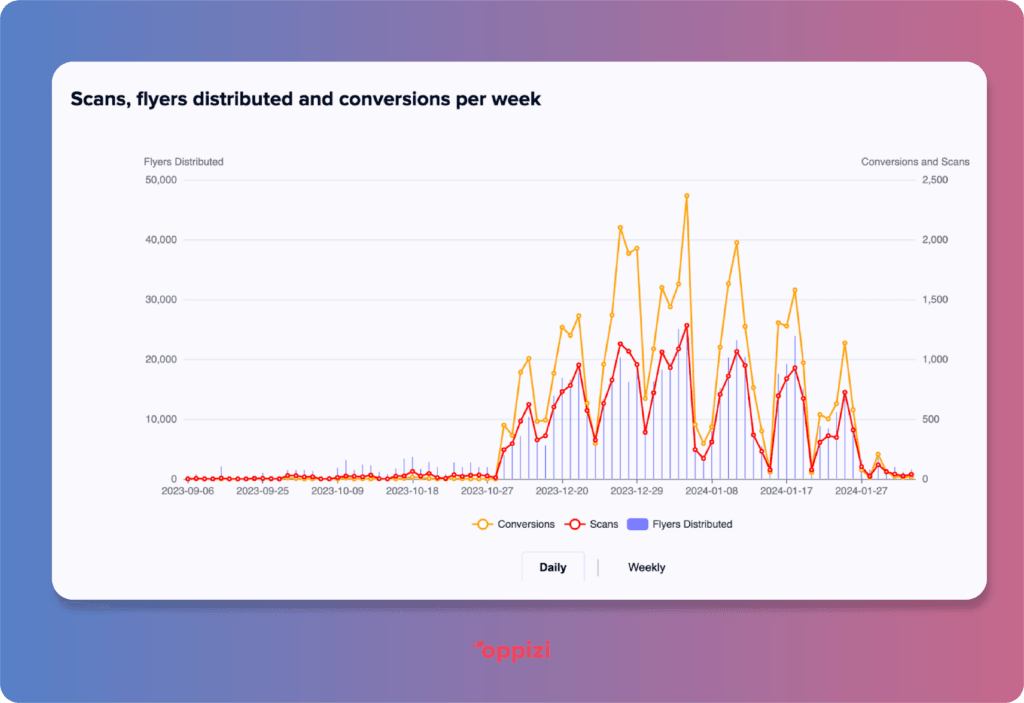
The Oppizi Ads platform offers a sophisticated tracking system by generating unique QR codes for each mail piece or batch of flyers. This enables businesses to monitor and analyze the number of scans and redemptions accurately.
Tracking scans and redemptions through individual QR codes provides valuable insights into the effectiveness of direct mail campaigns, allowing advertisers to measure engagement levels and assess the return on investment.
Moreover, personalized URLs are a great way to provide a unique online experience for the recipients of your marketing campaigns. By including the recipient's name or other relevant details, you can make the mail more personalized and engaging.
Additionally, real-time analytics make it easy to monitor important metrics such as click-through rates and conversion rates. The data collected through QR codes and unique URLs also enables you to segment your audience based on their behavior, giving you the power to optimize future direct mail campaigns for specific segments of your audience.
When it comes to designing a mailing campaign, it is crucial to pay close attention to the placement of QR codes and unique URLs within the design. It is recommended to place them in a highly visible and easily scannable area of the design. Additionally, a clear call-to-action should be included near the QR code, instructing the recipients on how to scan it or encouraging them to visit their unique URL for an exclusive offer or personalized message. By implementing these design elements, you can increase the likelihood of recipients engaging with and responding to your mailing campaign.
4. Test and Optimize
One way of testing your campaign is A/B testing, also known as split testing. This is a method used in direct mail marketing to compare two variations of a campaign to determine which performs better. The goal is to optimize specific elements of a direct mail piece to maximize the overall effectiveness and achieve better results.
Examples of A/B testing in direct mail might include comparing response rates between two different headlines, testing the effectiveness of different call to action phrases, or evaluating the impact of varying graphics or design layouts.
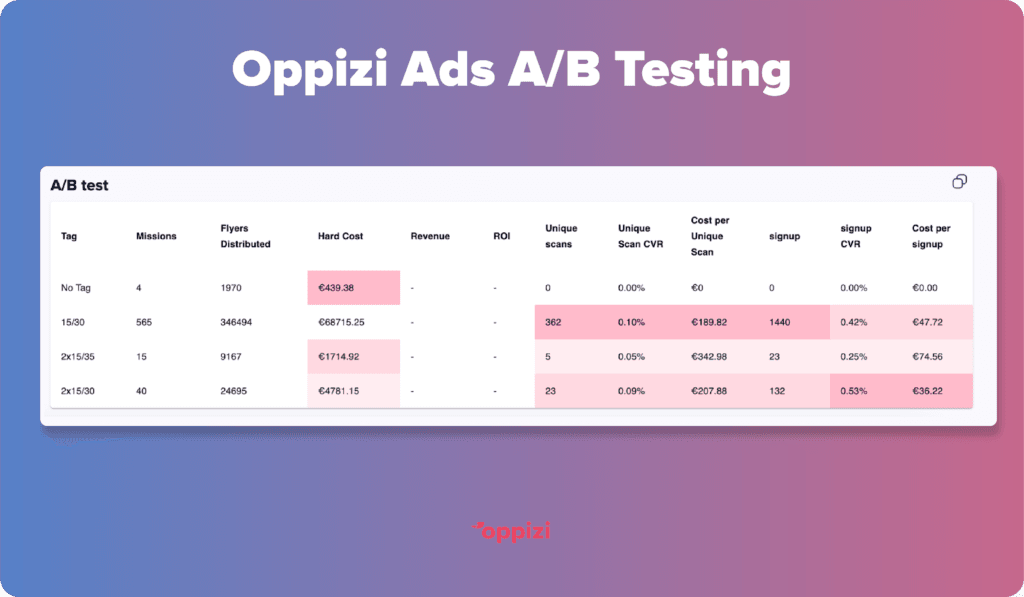
Oppizi Ads provides native support for AB testing directly within the dashboard interface. This feature allows users to create and launch different variations of direct mail campaigns and accurately measure the performance of each variant. This data-driven approach helps in maximizing the effectiveness of direct mail campaigns and improving overall campaign ROI.
How to A/B Test and Optimize Your Direct Mail Campaign
Follow these steps to optimize your direct mail campaign by conducting A/B testing and measuring your results:
- Define objectives: Clearly define the goals and objectives of your direct mail campaign. This could include increasing response rates, improving conversion rates, or enhancing overall customer engagement.
- Identify variables: Select specific elements within your direct mail piece that you want to test. Common variables include headlines, copy, images, calls-to-action, colors, formats, or even different offers.
- Create variations: Develop two (or more) variations of your direct mail piece, each incorporating a different version of the selected variable. For example, if testing headlines, create two versions with distinct headlines.
- Randomize and segment: Assign different variations to segments of your target audience. This helps ensure that any differences in performance are not due to the characteristics of a specific segment but are reflective of the changes made in the direct mail piece.
- Mail out: Send the different variations to their respective segments. It's essential to ensure that the overall distribution and timing are consistent for all variations.
- Measure responses: Track the responses and interactions generated by each variation. This could include metrics such as response rates, conversion rates, and any other key performance indicators relevant to your campaign objectives.
- Analysis: Compare the results of the different variations. Identify which version performed better in terms of achieving the campaign objectives. This analysis provides insights into which elements resonate more effectively with your audience.
- Implement learnings: Apply the learnings from the A/B test to future direct mail campaigns. If a particular headline, offer, or design element resulted in better performance, incorporate these findings into your overall direct mail strategy.
- Iterate and repeat: Continuous improvement is a key aspect of A/B testing. Use the insights gained to iterate on your direct mail pieces, and repeat the testing process to further refine and optimize your campaigns over time.
5. Measure Your ROI
Now that you’ve got metrics in place, you’re tracking conversions, and monitoring costs, you can complete the final calculation. In order to calculate ROI, use the following formula:
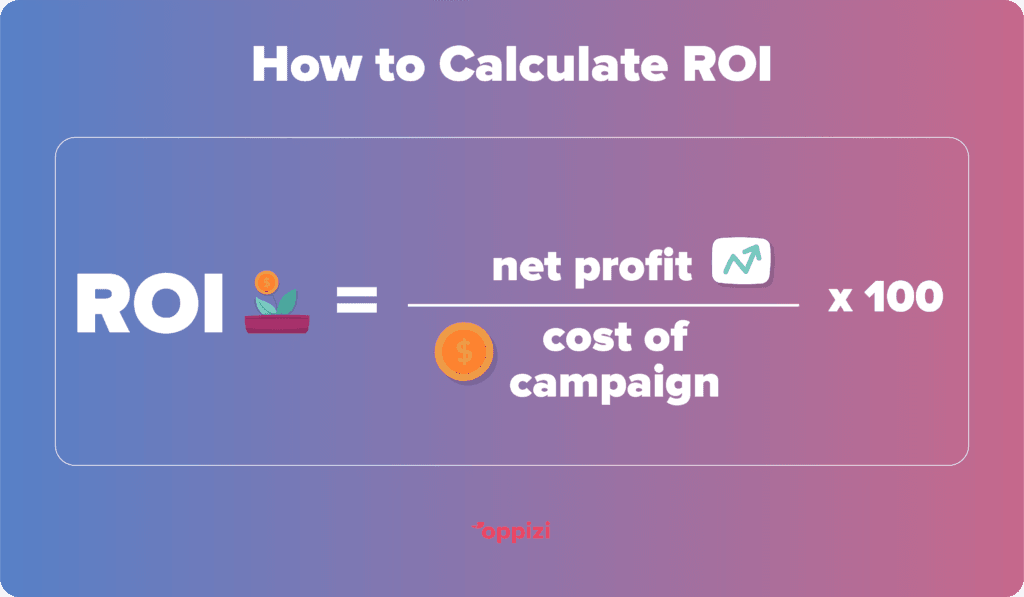
ROI = net profit / cost of campaign * 100
Upon calculating your return on investment, the next step is to analyze the results within the context of your campaign objectives. Assess whether the ROI meets expectations and identify areas for improvement or optimization in future campaigns.
Key Tactics for Measuring Direct Mail ROI
The art of measuring the return on investment (ROI) for direct mail campaigns is an essential skill every marketer should master. It provides a clear picture of how well your marketing efforts are performing and whether they're yielding desired results.
When calculating your return on investment (ROI), it is important to consider physical costs, such as printing and postage, as well as indirect expenses, like strategy development, design creation, implementation of tracking systems, and data analysis. By considering all of these factors, you can gain a more comprehensive understanding of the overall cost-effectiveness of your campaign.
Why You Need Direct Mail in Your Strategy
Direct mail marketing can be a powerful tool for advertising despite the growing popularity of digital marketing strategies. What sets it apart from its online counterparts is its physical nature, which offers potential customers something tangible to interact with.
It is worth noting that 60% of direct mailings are opened, and 40% of them are read thoroughly by recipients. This high visibility of direct mail can lead to increased sales, with 56% of consumers making purchases after receiving direct mail.
Final Thoughts
In this blog, we have outlined five steps to easily measure your campaign's success. These steps include setting objectives, determining key metrics, implementing tracking methods, and calculating ROI. By implementing these practices, you can refine your strategy, ensuring that your investment yields measurable returns.
Looking to increase brand visibility? Launch an Oppizi campaign in minutes and connect with your audience offline. Create your campaign now!