Last updated October 15, 2026
Summary
- Banks, credit unions, lenders, insurers, and advisors use direct mail to win new customers and keep existing ones
- Compliance follows the product: FCRA prescreen notices, Regulation Z trigger terms, Regulation DD APY rules, Regulation P, FINRA Rule 2210, and the SEC Marketing Rule
- CAN-SPAM covers email, so it doesn't apply to printed direct mail
- Cold financial and insurance mail averages a 0.8% response rate, per JICMAIL (UK-measured)
- Oppizi runs addressed direct mail, EDDM, inserts, and flyering from one platform with campaign tracking and no monthly platform fee
Financial services firms use direct mail to put offers and expertise in front of people when it matters: card and loan offers, account promotions, refinance letters, insurance quotes, and advisor invitations. It works best when the list is tight, the offer is clear, and the copy clears compliance before it prints.
Last updated: October 2026
In short: banks, credit unions, lenders, insurers, and advisors use direct mail to win and keep customers. Cold addressed mail from financial and insurance advertisers averages a 0.8% response rate (JICMAIL, UK-measured), and every piece has to meet the rules for its product, from FCRA prescreen notices to Regulation Z trigger terms, Regulation DD, FINRA Rule 2210, and the SEC Marketing Rule. Oppizi runs addressed direct mail, EDDM, inserts, and flyering from one platform, with campaign tracking and no monthly platform fee.
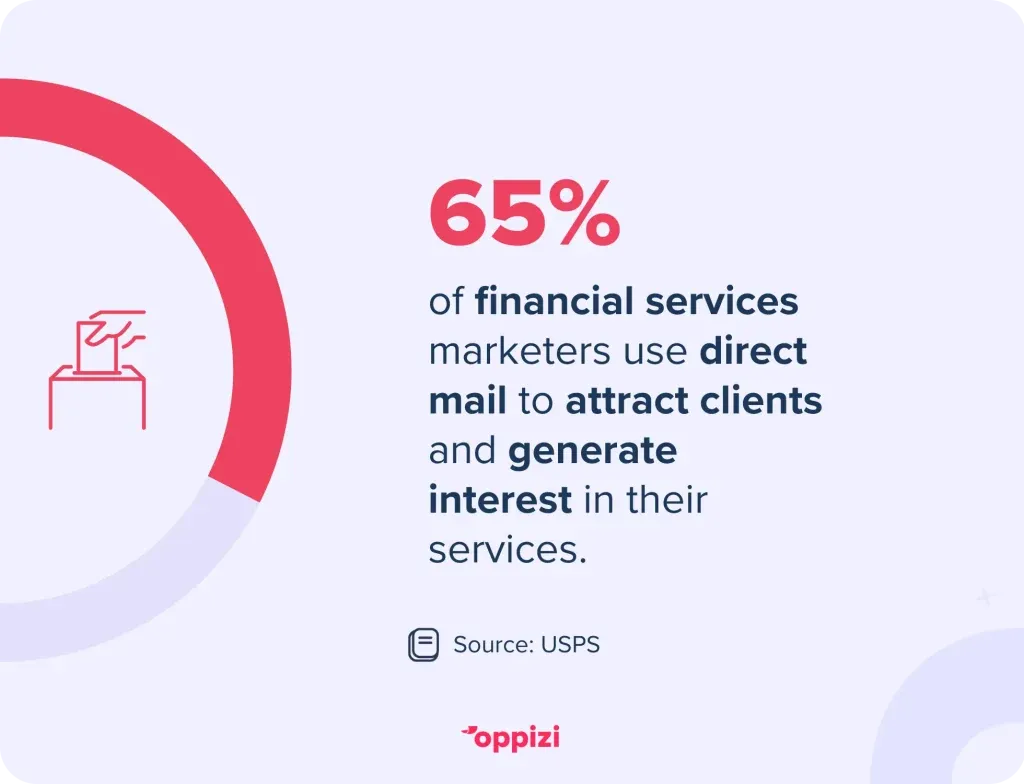
Direct mail is a planned, budgeted channel in this category. In a 2020 Forrester Consulting study commissioned by USPS, 65% of financial services marketers said they used direct mail to drive interest in their services.
How do financial services firms use direct mail?
Financial services firms use direct mail to win new customers with account, card, loan, policy, and advisory offers, and to keep existing customers with reviews, renewals, and timely updates. Here's why it fits the category before we get to the steps for a successful campaign.
Why direct mail works in finance
- People trust it. A real letter or postcard feels more serious than an online ad. In finance, trust matters.
- It reaches the right people. You can mail specific groups by location, life stage, or relationship with your firm.
- It stands out. A mailbox doesn't compete with a million other messages the way a feed does.
- It's personal. A named letter with a relevant offer reads like a one-to-one conversation, which matters when the subject is someone's money.
How well does it perform? Per the JICMAIL Response Rate Tracker, cold addressed mail from financial and insurance advertisers averages a 0.8% response rate (UK-measured). The full benchmark table, and how to measure return on investment, is further down.
Which financial firms use direct mail, and for what?
- Banks and credit unions promote checking and savings accounts, credit cards, and personal loans. See our guide to bank direct mail.
- Mortgage lenders and brokers send purchase and refinance offers to homeowners and buyers. See mortgage mailers.
- Insurance companies and agents generate quote requests and cross-sell policies to existing customers. See insurance direct mail.
- Wealth management firms send high-quality, personalized letters, where the feel of the piece matches the service.
- Fintech companies use mail to launch a product or reach audiences that are hard to find online.
How financial institutions can use direct mail
- Promote new accounts. Let people know about special offers for savings accounts, loans, or credit cards.
- Market loans and mortgages. A well-timed mailer can spark interest in refinancing or personal loans.
- Reach high-net-worth clients. Exclusive mailings can highlight premium financial services.
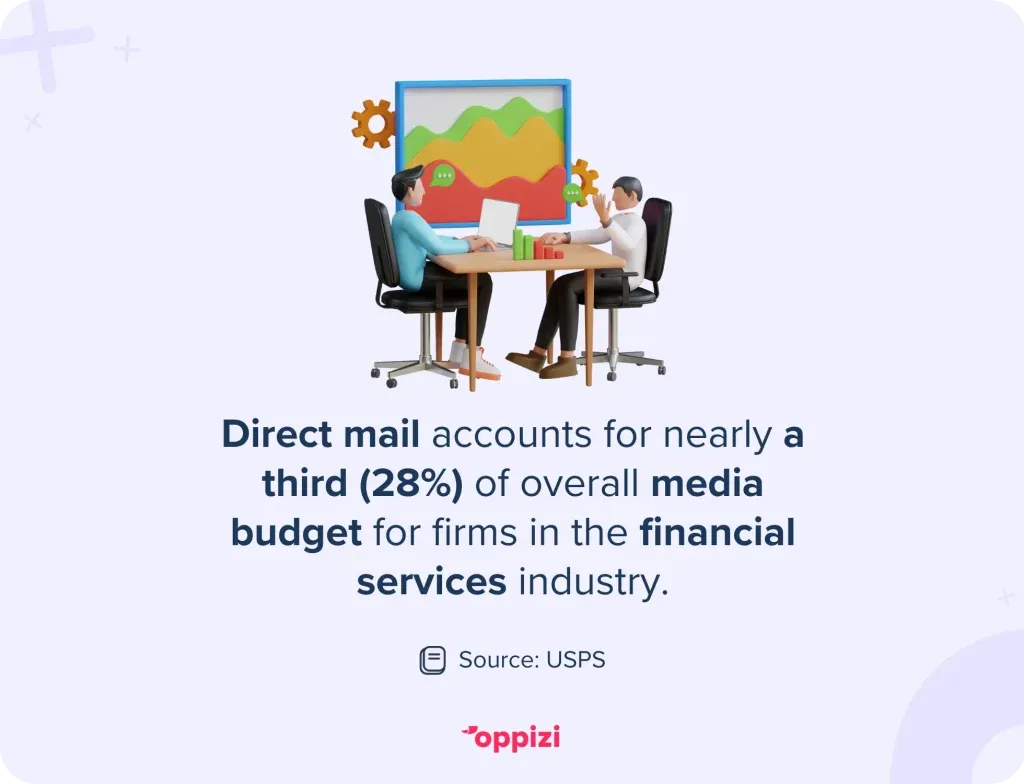
Far from being outdated, it's still a core tool for financial marketers. In the same USPS study, direct mail accounted for 28% of overall media budget for financial services firms.
Does direct mail work for financial advisors?
Yes, direct mail suits financial advisors because most practices serve a local area, client relationships run for years, and a well-made letter signals care before the first meeting. You can reach households by geography and life stage, such as pre-retirees in the ZIP Codes around your office, with a message that fits where they are.
Compliance applies here too. If you're a registered representative of a broker-dealer, a mailing to more than 25 retail investors within 30 days is a FINRA Rule 2210 retail communication that a principal approves before use. If you're an SEC-registered investment adviser, it's an advertisement under the SEC Marketing Rule.
How financial advisors can use direct mail
- Find new clients. Offer a free consultation or share tips on retirement planning and taxes.
- Keep clients happy. Send birthday cards, check-in letters, or reminders about financial reviews.
- Share useful info. A short newsletter or brochure can show clients you're an expert they can trust.
What are the direct mail compliance rules for financial services?
Financial services direct mail is regulated by product: prescreened offers fall under the Fair Credit Reporting Act (FCRA), credit ads under Regulation Z, deposit ads under Regulation DD, customer data under Regulation P, and investment mail under FINRA Rule 2210 or the SEC Marketing Rule. This table is a working summary, not legal advice, so run every piece past your compliance team before it prints.
| If your mailer | Rule | What it requires |
|---|---|---|
| Is a prescreened credit or insurance offer built from a consumer report | FCRA, 15 U.S.C. 1681b(c) and 1681m(d); 12 CFR 1022.54 (FTC: 16 CFR Part 642) | It must be a firm offer of credit or insurance, and every written solicitation carries the prescreen opt-out notice, a short notice and a long notice, with the toll-free opt-out number |
| States a term for a credit card or other open-end credit that isn't home-secured | Regulation Z, 12 CFR 1026.16 | A triggering term, such as a fee or finance charge, requires the other charges, any periodic rate as an APR, and any membership fee |
| Advertises a loan or other closed-end credit | Regulation Z, 12 CFR 1026.24 | Stating a down payment, number of payments or repayment period, payment amount, or finance charge requires the down payment, the terms of repayment, and the APR |
| Advertises a deposit account rate | Regulation DD, 12 CFR 1030.8 | Any rate of return is stated as an annual percentage yield (APY), and an account can't be called free if maintenance or activity fees may apply |
| Uses customer information to build the list | GLBA, Regulation P, 12 CFR Part 1016 | Sharing nonpublic personal information with a nonaffiliated third party needs the privacy notice, the opt-out notice, and a chance to opt out, unless an exception applies |
| Is a broker-dealer communication | FINRA Rule 2210 | Mail to more than 25 retail investors within 30 calendar days is a retail communication: a registered principal approves it before use, and it must be fair and balanced |
| Is an investment adviser advertisement | SEC Marketing Rule, 17 CFR 275.206(4)-1 | No untrue or unsubstantiated material statements, and conditions on testimonials, endorsements, and performance |
| Offers any consumer financial product | UDAAP, 12 U.S.C. 5531 | No unfair, deceptive, or abusive acts or practices |
What does the FCRA require for prescreened offers?
A prescreened mailer has to be a firm offer of credit or insurance, and each written solicitation must carry the prescreen opt-out notice. Under 12 CFR 1022.54 that notice has a short portion, which states the consumer's right to opt out and gives the toll-free number, and a long portion, both in the same language as the offer.
Which words trigger extra disclosures in credit and deposit ads?
Specific terms trigger extra disclosures. In a loan ad, stating a down payment, the number of payments or repayment period, a payment amount, or a finance charge means you must also state the down payment, the terms of repayment, and the APR. A stated APR on its own is not a triggering term. In a deposit ad, any rate of return has to appear as an APY, and you can't call an account free if maintenance or activity fees may apply.
What about customer data and fair lending?
Customer data and fair lending both shape who gets the mail. Regulation P limits sharing customers' nonpublic personal information with nonaffiliated third parties, so confirm which notice, opt-out, or exception applies before a customer file leaves your systems. For credit offers, Regulation B (12 CFR 1002.4(b)) bars advertising statements that would discourage applicants on a prohibited basis, so have your legal team review audience selection, especially for mortgage and credit products.
Does CAN-SPAM apply to direct mail?
No, CAN-SPAM doesn't apply to printed direct mail. It governs commercial electronic mail messages, which the law defines as messages sent to an email address. If your mailer drives people to an email sign-up, CAN-SPAM covers the emails that follow, and the product rules above still apply to the mailer itself.
What response rate can financial services direct mail expect?
Cold addressed mail from financial and insurance advertisers averages a 0.8% response rate, per the JICMAIL Response Rate Tracker (UK-measured), against 1.0% for cold addressed mail across all sectors.
| Mail type | Average response rate | Scope |
|---|---|---|
| Cold addressed mail, all sectors | 1.0% | 2023 to 2025 average, UK-measured |
| Cold addressed mail, financial and insurance | 0.8% | 2022 to 2025 sector average, UK-measured |
| Mail to an existing financial services customer list | 1.3% | Existing customers only, UK-measured |
JICMAIL measured 4,939 UK campaigns through matchback, tracking codes, and test-and-control rather than by survey. The 1.3% figure applies only to mail sent to an existing customer list. Cold addressed mail returns 2.1x the campaign cost in revenue, rising to 2.7x above 100,000 pieces. Treat these as a planning baseline rather than a forecast: your list, offer, and creative decide where a campaign lands.
How do you run a financial services direct mail campaign?
Pick one audience, one offer, and one next step, clear the copy with compliance, and track every response so the next mailing is sharper. Here's how:
1. Know your audience
Are you reaching first-time home buyers, retirees, or small business owners? The more specific you are, the better your results.
2. Make it personal
Use customer data, within the limits of your privacy notice, to tailor your message. Include names, relevant offers, or financial solutions that fit their needs.
3. Give a strong offer
People need a reason to respond. Whether it's a free consultation, a low-interest loan, or a no-fee account, make it clear and valuable. If you quote a rate, a payment, or a fee, check the disclosure rules above first.
4. Keep it simple
Use clean design, strong visuals, and easy-to-read text. Skip the industry jargon and speak in plain language.
5. Tell them what to do next
Whether it's visiting your website, calling an advisor, or booking a review, make the next step obvious and easy.
6. Measure your results
Track responses to see what works. Use that data to improve your next campaign.
How does direct mail help retain financial clients?
Direct mail helps retain financial clients by keeping you present between transactions. Getting new clients is great, but keeping the ones you already have matters just as much.
Stay on their radar
A simple mailer lets clients know you're still there. A thank-you note, a reminder about their annual review, or a helpful tip sheet shows you care and keeps them engaged.
Keep them coming back
Clients don't always think about financial services until they need them. A well-placed mailer about new products, better interest rates, or special offers makes it easy for them to choose you again.
Share useful financial tips
People appreciate financial advice they can use. A printed newsletter or market update gives them insight on saving, investing, or planning for retirement, while keeping your name top of mind.
Reconnect with past clients
Some clients drift away. A personal mailer with a special offer or a reminder about your services can bring them back.
Build trust
Financial decisions are big decisions. A well-designed letter, a high-quality brochure, or a personalized offer makes your business look professional and reliable.
Direct mail keeps your relationships strong and your clients engaged. It's a simple, effective way to stay connected and keep your business growing.
What makes financial services direct mail perform better?
One clear offer, a real name, quality materials, an obvious next step, testing, and a timely follow-up make financial mail perform better. Here's each in practice:
- Keep it simple. Focus on one key offer or benefit. Too much information overwhelms people.
- Make it personal. Generic mail gets ignored. Use names and tailor offers to make it feel relevant.
- Use quality materials. Thick paper and professional design make your brand look trustworthy.
- Be clear about next steps. Tell people exactly what to do: call, visit your website, or book an appointment.
- Test different versions. Try different headlines, offers, and formats to see what gets the best response.
- Follow up. A quick email or phone call after the mail lands keeps your message fresh.
What mistakes should financial services mailers avoid?
The costliest mistakes are vague offers, skipped compliance review, and no way to track results. Here's the full list:
- Being too vague. A generic message gets ignored. Be clear about what you're offering and who it's for.
- Skipping compliance review. A missing disclosure or opt-out notice can stop a campaign after it prints. Get sign-off before the proof is final.
- Skipping personalization. "Dear Customer" feels cold. Use names and tailor the message to make it feel relevant.
- Too much information. Financial topics can be complex, but your mailer shouldn't be. Keep it short and highlight key benefits.
- Weak or missing call to action. If people don't know what to do next, they won't act. Tell them clearly: call, visit your website, or book a meeting.
- Bad design and cheap materials. A flimsy mailer with cluttered design makes a bad impression. Use high-quality paper and a clean layout.
- Not tracking results. If you don't measure response rates, you won't know what works. Use custom phone numbers, unique URLs, or offer codes to track performance.
Avoid these, and your mail has a better chance of getting noticed and getting results.
How does direct mail work with digital marketing in financial services?
Direct mail works with digital marketing by making the same message show up in more than one place, so people are more likely to act. It's strong on its own and better paired with digital marketing.
- Direct mail and email: Send a mailer first, then follow up with an email. Some people respond to physical mail right away, while others need a digital reminder.
- Personalized URLs: A unique web address on each mailer connects the piece to your site and makes every visit measurable.
- Social media and digital ads: After sending mail, target the same audience with social media posts or online ads. Seeing your message in multiple places makes people more likely to act.
- Follow-up calls or texts: A mailer introduces your services, but a call or text can turn interest into action, within the consent rules that apply to calls and texts.
Start your financial services direct mail campaign
Oppizi runs addressed direct mail, EDDM, inserts, and flyering from one platform, with campaign tracking built in and no monthly platform fee. Addressed direct mail runs $0.54 to $0.65 per piece with data included, and we've sent 16.4M+ pieces of US direct mail. Your compliance team owns the copy, the disclosures, and the list rules; we handle printing, mailing, and tracking.
Ready to plan your next mailing? Sign up with Oppizi and build your first financial services campaign.
Frequently asked questions
- How do financial services firms use direct mail?
Banks, credit unions, lenders, insurers, and advisors use direct mail to acquire customers with card, loan, account, and policy offers, and to retain them with reviews, renewals, and updates. Platforms such as Oppizi run addressed direct mail, EDDM, inserts, and flyering from one place, with campaign tracking and no monthly platform fee.
- What are the direct mail compliance rules for financial services?
It depends on the product. Prescreened credit and insurance offers need the FCRA prescreen opt-out notice. Credit ads follow Regulation Z trigger-term rules, deposit ads follow Regulation DD, customer data follows Regulation P, and investment mail follows FINRA Rule 2210 or the SEC Marketing Rule. CAN-SPAM covers email, not printed mail.
- Does direct mail work for financial advisors?
Yes. Advisors usually serve a local area and build long relationships, which suits mail. Use it to invite prospects to a consultation or seminar and to keep clients engaged between reviews. Broker-dealer representatives need principal approval under FINRA Rule 2210, and SEC-registered investment advisers must meet the SEC Marketing Rule.
- What response rate does financial services direct mail get?
Cold addressed mail from financial and insurance advertisers averages a 0.8% response rate, per the JICMAIL Response Rate Tracker, which measured UK campaigns through matchback and tracking codes. Mail to an existing financial services customer list averages 1.3%. Both are UK-measured, so treat them as a planning baseline rather than a forecast.
- Does CAN-SPAM apply to direct mail?
No. CAN-SPAM covers commercial electronic mail messages, which the law defines as messages sent to an email address, so a printed mailer falls outside it. Financial mailers still face the FCRA, Regulation Z, Regulation DD, Regulation P, FINRA, SEC, and UDAAP rules that apply to their product and data.
- Is direct mail expensive for financial services?
It costs more per piece than email, because printing and postage add up, so a tight list matters. With Oppizi, addressed direct mail runs $0.54 to $0.65 per piece with data included and no monthly platform fee. Mailing only well-qualified households keeps your cost per response in check.