Last updated September 28, 2026
When you hear people talking about marketing these days, the conversation usually revolves around digital technologies and campaigns. If you feel like there’s something missing from the topics typically mentioned, you’re right: direct mail marketing.
But isn’t that just a thing of the past? Absolutely not. In fact, direct mail has evolved to meet the demands of our changing world. Today, it offers precise targeting and often outperforms various other advertising strategies.
Let's explore what direct mail marketing is, how it has grown in recent years, and the results it can deliver for your business. You’ll quickly understand why so many companies are rediscovering its power, while others fall behind by ignoring it.
What is direct mail marketing?
First, let’s define direct mail marketing. Also known as direct mail advertising, it refers to sending physical mail pieces directly to potential customers using mailing lists. This method allows businesses to reach a large audience while personalizing messages for people in specific locations.
Direct mail marketing examples
- Letters
- Postcards
- Print catalogs
- Self-mailers
- Brochures
- Flyers
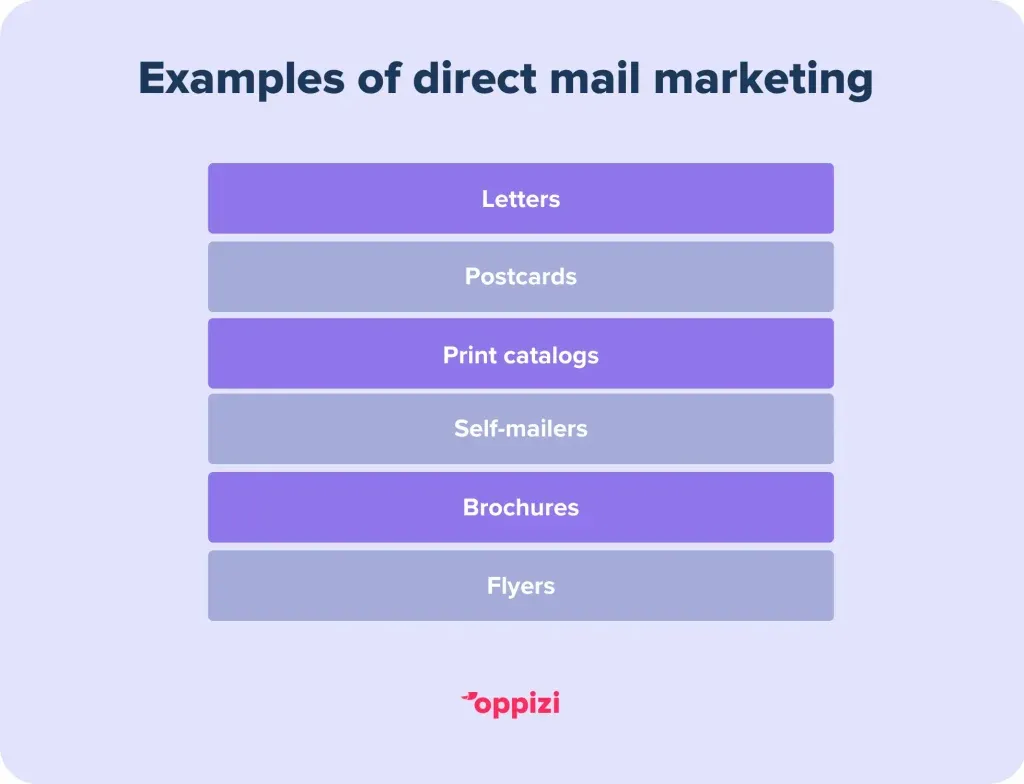
Data indicates that direct mail marketing is an effective and well-received alternative to digital advertising. However, certain types of postal advertising are more effective than others. The most common forms include letters, postcards, print catalogs, and self-mailers.
Each format serves a unique purpose, allowing businesses to tailor their marketing strategies to specific goals and audiences.
What types of direct mail are most effective?
A self-mailer refers to any promotional material sent without an envelope, such as a flyer or brochure. While all these materials can be effective, postcards have emerged as the most popular advertising format in recent years.
Postcards have steadily gained popularity over the past 12 years, while the use of envelopes has dropped by an average of 15% across all industries. Marketers increasingly favor postcards for their cost-effectiveness and ability to deliver concise messages quickly.
However, flyers and letters also have their advantages: flyers are great for sharing detailed information about products or services, while letters offer a personal touch that can strengthen customer relationships.

Personalization: Why it matters in direct mail marketing
Regardless of the style of mail marketing a company chooses, one factor is crucial: direct mail personalization. Including recipients' names on promotional materials can boost response rates by up to 135%. This aligns with the fact that consumers often perceive direct mail marketing as more personalized and tailored to their needs.
Using multi-channel campaigns to boost results
It’s also important to remember that, like all advertising campaigns, direct mail marketing is most effective when combined with other forms of advertising and communication.The United States Postal Service (USPS) reports that marketers experienced a 60% increase in ROI when combining direct mail with digital channels. This integration also led to a 68% rise in website visits, a 63% boost in response rates, and a 40% conversion rate.
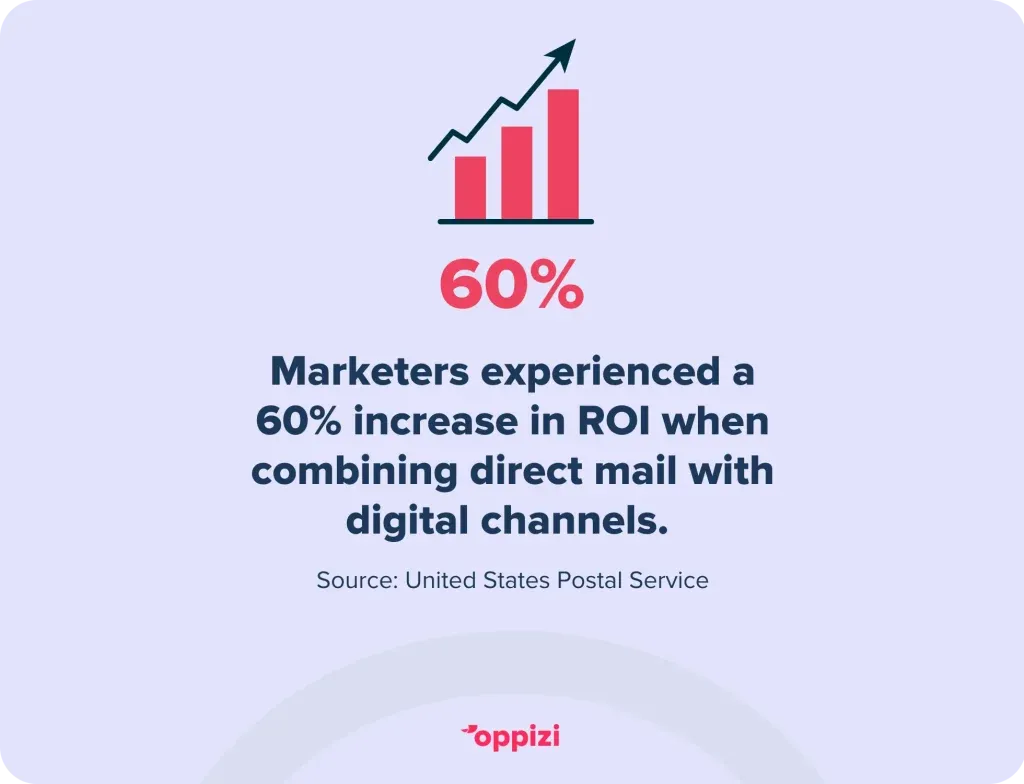
These statistics clearly show that using direct mail alongside digital marketing greatly improves campaign performance and results.
Why are companies investing in direct mail marketing?
With the industry’s rapid growth, companies that overlook direct mail marketing risk falling behind—especially when targeting local customers.
By leveraging direct mail, your business can establish personal connections and enhance brand visibility, giving you a competitive edge in a crowded marketplace.
Growth trends in direct mail marketing
On a global scale, the direct mail advertising market has shown consistent growth, increasing from $76.68 billion in 2023 to $79 billion in 2024. This represents a compound annual growth rate (CAGR) of 3.0%.
Looking ahead, the direct mail advertising market is projected to reach $84.7 billion by 2027, with an expected compound annual growth rate (CAGR) of over 2%.
Direct mail usage across the U.S. market
In 2023, American marketers invested more than $39 billion in direct mail. During the same year, the United States Postal Service delivered 59.4 billion pieces of marketing mail.
In 2024, 82% of marketers intended to increase their spending on direct mail, a significant rise from the 58% who planned to do so in 2023. Furthermore, approximately 25% of marketing budgets are allocated to direct mail, with 41% of marketers investing more than 25% of their budget in this channel.
Generational preferences for direct mail marketing
Studies indicate that people of all ages enjoy receiving mail. For instance, 90% of Millennials report that they enjoy receiving direct mail. This preference aligns with the generation's broader appreciation for physical media; despite growing up in the digital age.
Millennials tend to trust printed materials more than other media, with 57% stating they have responded to offers or promotions received by mail. Similarly, older generations like Gen X (born between 1965 and 1980) also appreciate mail marketing.
In one survey, 70% of Gen Xers reported that they find print mail to be more personalized than digital advertising and are more likely to read postal communications than emails.
Even younger generations, like Gen Z (born between 1997 and 2012), are likely to engage with marketing materials sent by mail, especially when those materials include interactive or digital components, such as QR codes that direct them to a website, social media account, or online video.

What’s the cost of direct mail marketing?
The cost of direct mail marketing can vary depending on several factors, including the type of mailer, the size of your campaign, geographic location, and the level of customization you require. You’ll need to consider design costs, printing fees, mailing list prices, postage, and distribution costs.
While direct mail can be a highly effective way to reach your target audience, understanding the costs involved will help you plan your budget efficiently. Direct mail providers like Oppizi make it easy and cost-effective to launch a trackable direct mail campaign—create a free account today to explore price estimates and take the first step toward growing your business.
Direct mail marketing and USPS EDDM services
Oppizi services are available across the globe, but if you’re in the U.S., Every Door Direct Mail (EDDM) is another direct mail option worth considering. In partnership with USPS, Oppizi’s EDDM complements your digital marketing tools seamlessly, providing a cost-effective way to target specific neighborhoods or zip codes with your message.
Why Direct Mail Marketing Outperforms Digital Advertising
It delivers ROI
According to Forbes, U.S. advertisers spend $167 per person on direct mail to generate $2,095 in sales, yielding a remarkable 1,300% return on investment. With such impressive results, it’s clear why advertisers rely on direct mail to promote their products and services.
Direct mail boasts the highest return on investment (ROI) at 112% among all marketing channels. It is followed by SMS with an ROI of 102%, email at 93%, and paid search at 88%.
Great response rates
Direct mail delivers a strong response rate because recipients are more likely to engage with physical ads compared to digital channels like social media or email.
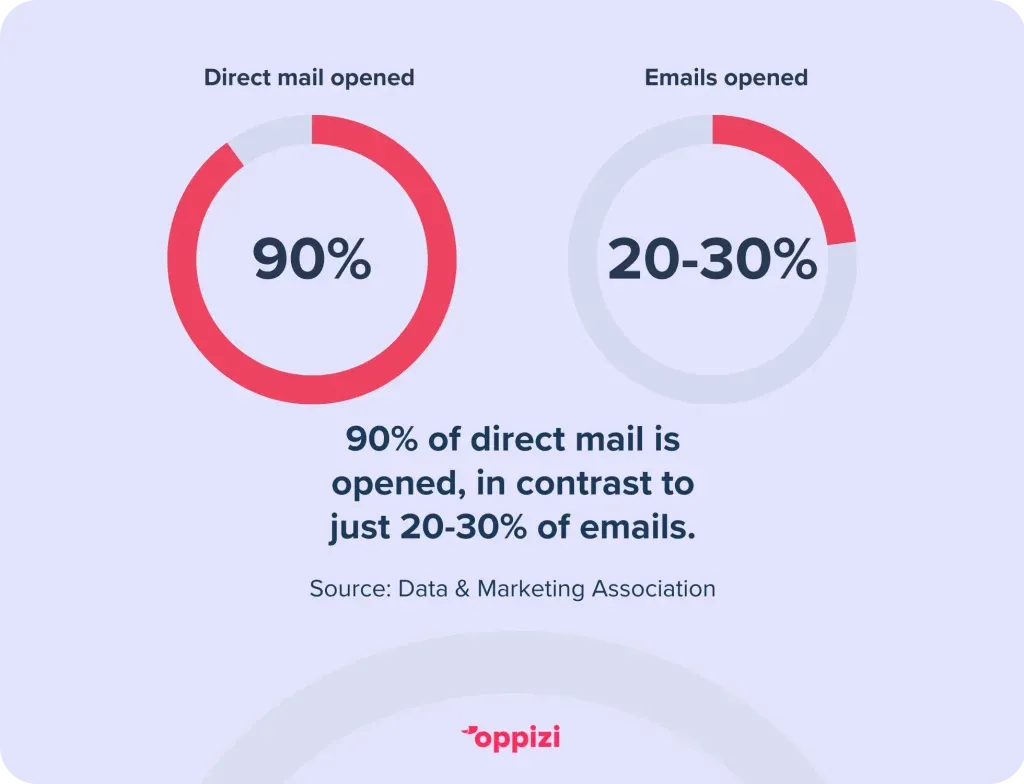
Statistics show that 90% of direct mail is opened, in contrast to just 20-30% of emails. Furthermore, 42.2% of direct mail recipients either read or scan the mail they receive. This suggests that not only do most people open direct mail, but a substantial number also engage with its content.
Additionally, printed materials have a longer physical presence. Unlike email marketing, in which emails can be deleted in seconds, mail must be handled and recycled, giving it a greater chance to capture attention—even if it eventually ends up in the trash.
Customer engagement and conversion rates
This explains why direct mail marketing achieves much higher response rates compared to other advertising methods. While email unique click rate was 2.3% in 2024, direct mail response runs 5 to 9 percent on house lists and 3 to 5 percent on prospect lists. Overall, direct mail response rates are estimated to be five to nine times higher than those of other marketing channels.
If that’s not convincing enough, the customer conversion rate underscores the power of direct mail marketing. In 2020, 62% of consumers who responded to direct mail made a purchase from the company within three months.
Additionally, 39% of consumers indicated that they chose to try a new business for the first time after receiving advertising materials in the mail. When compared to click-through and conversion rates online, direct mail stands out as a highly effective marketing channel.
How direct mail stands out as a non-intrusive channel
While customers may be irritated by companies that send excessive emails, they tend to be less bothered by direct mail. In fact, people generally have a lower aversion to receiving physical mail than to other advertising methods.One reason for this is that direct mail often targets customers who are already inclined to be interested in the products or services offered, either due to previous engagement with the business or because the business is local to them.This targeting approach may explain why many people perceive direct mail as less invasive than other marketing forms. In fact, a survey of American consumers revealed that 73% preferred receiving materials via direct mail, as it allows them to read them at their own convenience.
Consumers appreciated that they could save direct mail materials for later and didn’t need to make immediate purchase decisions. As a result, they viewed direct mail as a more friendly and respectful form of communication compared to other advertising methods.
Finally, direct mail marketing has become even more effective in recent years, particularly following the outbreak of COVID-19. During the pandemic, as remote work and lockdowns became the norm, one-third of consumers reported feeling fatigued by technology and the overuse of screens.As a result, print marketing materials were viewed as a welcome relief from screen-intensive lives. Physical mail provided a refreshing break from endless Zoom calls, Teams meetings, and email chains. As reliance on computers grew, people began to crave the comforting tangibility of communication in print.
Final thoughts: Choosing a direct mail marketing service
The direct mail marketing industry has experienced significant growth in recent years and holds great potential for further development, especially as we navigate an increasingly digitized, post-pandemic world.Despite younger generations being immersed in the information age, print media remains a vital part of future communication and advertising.By merging new technologies with the traditional methods of mail marketing, advertisers and companies can capitalize on the opportunities presented by this personalized and tangible approach.
If you’re looking for direct mail marketing companies, Oppizi goes the extra mile to bring you success. We send your message straight to potential customers’ homes, enhancing brand awareness and driving digital engagement. Don’t wait—create your campaign today!