Last updated July 28, 2026
You’ve invested in a flyer campaign, direct mail drop, or local billboard. The creative is strong, the message is clear, but when the campaign wraps up, one big question remains: did it actually work?
Online, we live and breathe metrics: clicks, conversions, open rates, whereas offline marketing doesn’t always feel as measurable. But it’s a myth that it can’t be tracked. The truth is, with the right tools, you can measure offline campaigns just as effectively as digital ones.
At Oppizi, we help brands bridge this gap every day. Offline marketing is powerful, but measurement is what makes it scalable. Here’s how to track and analyze your campaigns so you can make smarter, data-driven decisions.
9 offline marketing KPIs you should track
Want to know if your offline campaigns are working? Tracking the right metrics is the first step. It helps you understand performance, prove your ROI, and improve future efforts. Here are some effective ways to measure offline marketing success.
1. Web traffic from offline sources
Track web traffic originating from offline campaigns by using unique URLs, QR codes, or campaign-specific promo codes on your marketing materials. This helps you measure which offline activities, like print ads or direct mail, are driving people online.
Monitoring this KPI allows you to optimize your offline channels for better digital engagement. It also provides insights into customer behavior and the effectiveness of integrated marketing strategies.
2. Leads generated
Measure the number of leads that result from offline campaigns, such as trade shows, events, or flyers. You can track this through sign-up forms, call-ins, or event registrations linked to specific campaigns.
Tracking leads as a KPI helps assess which offline tactics are most effective at generating potential customers. By understanding lead quality and quantity, you can refine targeting and messaging for future campaigns.
3. Sales revenue from promotions
Revenue generated from promo codes, coupons, or special offers shows the direct impact of offline campaigns. Unique codes for each campaign highlight which ads are driving sales. With up to 62% of U.S. consumers seeking promo codes before they buy, this KPI can deliver strong, trackable results.
4. Campaign conversion rate
Track how many leads from offline campaigns actually convert into paying customers. While it may seem hard to track this metric as it correlates to offline campaigns, you can use CRM systems or point-of-sale data to attribute conversions to specific offline sources.
Your campaign conversion rate shows the efficiency of your offline marketing in turning interest into revenue. High conversion rates indicate strong messaging and targeting, while low rates suggest areas for improvement.
5. Customer acquisition cost (CAC)
Calculate CAC by dividing the total offline marketing spend by the number of new customers acquired through those efforts. Customer acquisition cost helps you understand the cost-effectiveness of your campaigns. Tracking CAC allows you to allocate your budget to the most profitable channels.

6. Customer engagement and feedback
Customer surveys and feedback data reveal how people are responding to your offline marketing. Asking “How did you hear about us?” during checkout or via email gives you direct insights into campaign effectiveness and which channels are resonating.
You can also collect feedback from customers who interacted with offline campaigns through surveys, comment cards, or post-purchase interviews. This KPI helps gauge customer satisfaction and perception of your brand, and insights from feedback allow you to refine messaging, offers, and overall experience.
7. QR code scans
Engagement through QR codes is a growing KPI in offline campaigns. Scans indicate customer interest and willingness to interact with your brand digitally, even if they don't convert. Last year, QR codes were scanned 26.95 million times, four times more than the year before, making them an increasingly powerful engagement indicator.
8. Branded search traffic
An uptick in branded searches shows that your campaign is boosting awareness and visibility, even if customers don’t convert immediately. If more people are searching your company name after a campaign, it’s a strong signal that your offline marketing is working.
Setting clear KPIs for your offline marketing campaign is important. They give you measurable insights into how effective your efforts are. With clear indicators, you can see how your strategies are working, make better decisions, and improve future campaigns to get the most return on your investment.
9. Foot traffic / store visits
Depending on your industry, you may considering tracking how many customers visit your physical location as a result of offline campaigns. Methods include in-store counters, redemption of in-store offers, or survey questions asking how customers heard about you.
This KPI provides direct insight into the real-world impact of your marketing efforts, especially for retailers or service-based businesses. Understanding foot traffic patterns helps you plan promotions and staffing more effectively.
Why measure offline marketing?
Offline channels like flyers, direct mail, and print ads are still one of the most effective ways to reach people in the real world. They create physical touchpoints, generate brand awareness, and spark action.

But without measurement, you’re flying blind. Tracking offline marketing helps you:
- Prove ROI, which is crucial for securing stakeholder buy-in.
- Identify your best-performing channels: know where your budget is working hardest.
- Refine targeting and messaging: improve campaigns with every iteration.
How to track offline campaigns in real-time with Oppizi
Measuring offline marketing doesn’t have to mean waiting weeks for results. With Oppizi, you can see what’s working as it happens and adapt before the campaign ends. Here’s how it works:
Step 1 - Launch your campaign with trackable assets
When you run offline campaigns with Oppizi, every flyer, mailer, or insert is tied to QR codes or unique promo codes so you can measure engagement directly. No more guesswork about whether a flyer actually drove customers to your store or website.
Step 2 - Monitor live engagement
As soon as people start scanning, redeeming, or visiting your campaign pages, Oppizi’s system records these interactions in real-time. All campaign activity flows into one intuitive dashboard, where you can track distribution progress, engagement, and conversions at a glance.
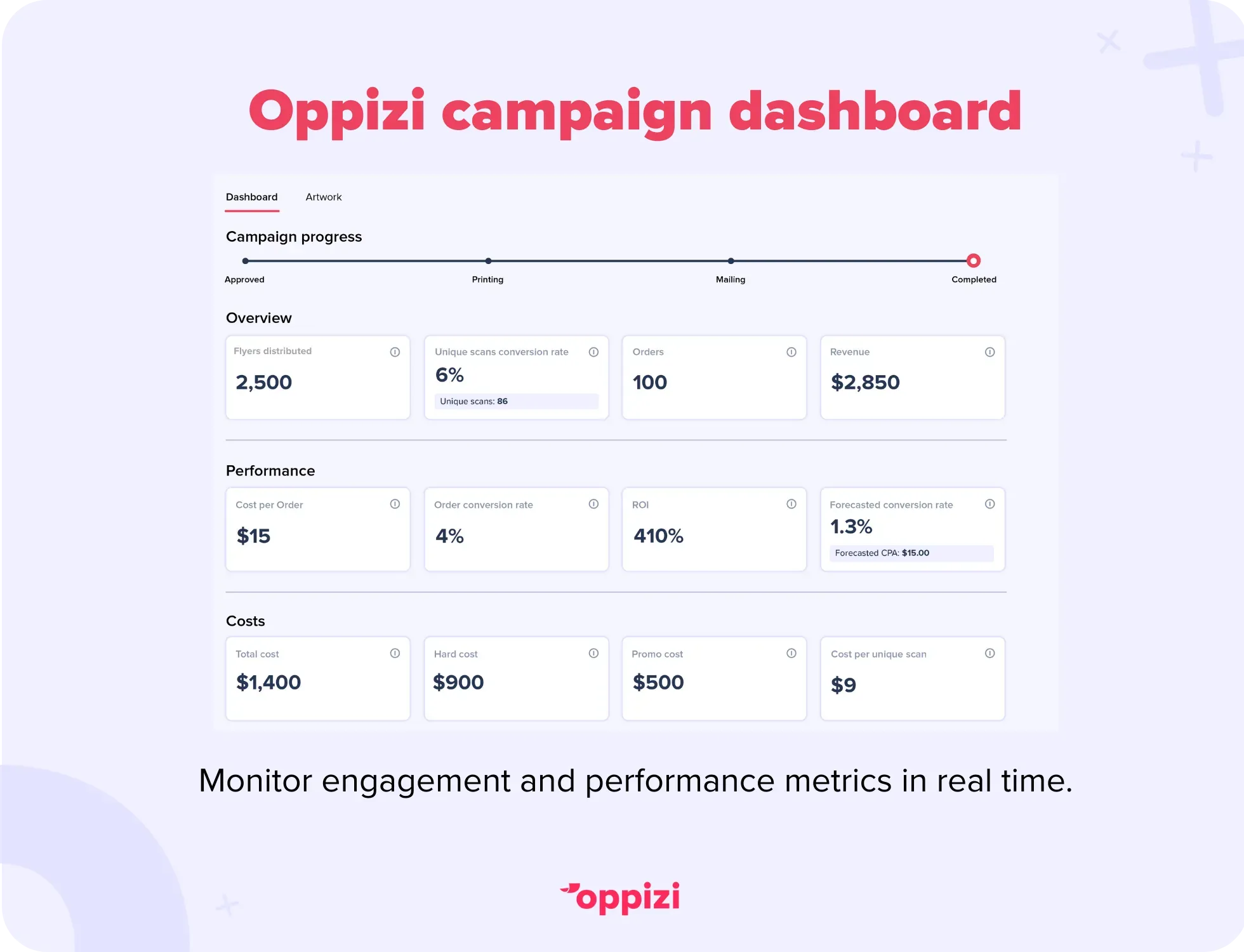
Step 3 - Adjust on the go
Not all campaigns perform equally across locations or audiences. With Oppizi’s real-time insights, you can identify high-performing areas and messages and double down, while tweaking or pausing elements that aren’t resonating. This flexibility ensures your marketing budget is always working efficiently, rather than reacting after the campaign ends.
Step 4 - Optimize and scale
Every interaction provides insights for future campaigns. With real-time tracking, you can refine messaging, placement, and targeting, building a playbook for more effective campaigns. Over time, your offline marketing becomes sharper, more efficient, and more profitable, with each campaign informing the next.
Tips for enhancing offline marketing tracking
Want to make your offline marketing campaigns more effective? Here are some practical tips to help you track your efforts and boost your results.
1. Combine online and offline data
Bring together your online and offline metrics. This gives you a complete view of how customers interact with your brand. By linking your CRM with offline tracking tools, you can see the whole customer journey, from first awareness to final purchase. This helps you find out which channels get the most engagement.
2. Try A/B testing for offline campaigns
A/B testing isn’t just for digital marketing; it works for offline too. Test different messages, designs, and offers in your print materials or ads. See which version performs better, so you can improve your strategy based on what your audience likes.
3. Use geo-tracking technologies
Think about using geo-tracking for events or stores. Tools like beacons can show how customers move around your space. By monitoring their movements, you can send personalized offers based on their location, which helps drive more foot traffic.
4. Create engaging offline content
Add interactive elements to your offline marketing. Encourage customers to participate by running contests or surveys. You can also offer promotional codes that require online actions. This kind of content grabs attention and helps you gather useful information about customer preferences.
5. Follow up with multi-channel campaigns
After your offline campaign, boost your results with follow-up digital efforts. Use retargeting ads or personalized emails to reconnect with customers who interacted with your marketing. This creates a seamless experience that encourages conversions and reinforces your brand message.
In direct mail campaigns, including a gift card or coupon can boost response rates to as high as 13.81%. If you want more people to engage with your brand, give them something in return. The numbers prove that rewards like discounts or gift cards get results,
6. Watch your competitors
Keep an eye on how your competitors track their offline marketing. Look at their strategies and results to spot opportunities in your own approach. By knowing what others do, you can refine your tactics and stay ahead.
FAQs about tracking offline marketing
What is offline tracking?
Offline tracking is the process of measuring how people respond to marketing that happens in the physical world, like flyers, direct mail, events, or billboards. Instead of clicks and impressions, you track things like coupon redemptions, QR scans, phone calls, foot traffic, or survey responses.
How do I track offline leads?
Tracking offline leads means following a customer’s journey from initial offline touchpoint to conversion. Practical ways to do this include:
- Assigning promo codes or QR codes to your flyers, mailers, or posters.
- Using unique phone numbers for each campaign.
- Capturing source information at checkout or signup (e.g., “flyer in store,” “direct mail”).
- Syncing this data with your CRM to see which channels drive the highest-quality leads.
With the right tracking in place, you’ll not only see where your leads are coming from but also which offline channels generate the best return on investment.

Conclusion
Offline marketing is no longer a guessing game. When you measure effectively, you turn every flyer, mailer, or poster into a trackable driver of growth. From promo codes to QR scans and real-time dashboards, the right tools reveal exactly how your customers engage and where your investment delivers the strongest returns.
By treating offline the same way you treat digital - measurable, optimizable, scalable - you can sharpen your strategy, prove ROI, and create campaigns that genuinely move the needle.
With Oppizi, you don’t just run an offline campaign - you see it working in real time. Our platform handles everything from distribution to live analytics, so you can focus on results, not spreadsheets.
Ready to start? Launch your next offline campaign with Oppizi and discover how effortless tracking can transform your marketing.