Last updated July 28, 2026
If your offline marketing feels like a black box, you are not alone. Many CMOs, marketing directors, and brand managers struggle to measure the impact of TV, radio, print, out-of-home, and in-store campaigns. Marketing Mix Modeling, or MMM, changes that. It turns offline spend into measurable results you can act on.
In this post, we’ll break down how to use MMM for offline channels. You’ll see each step clearly, and we’ll show how to make the process simple while giving accurate, actionable insights.
What is marketing mix modeling?
Marketing Mix Modeling is a statistical method for measuring how different marketing channels contribute to sales and revenue. Unlike digital attribution, which tracks clicks and online conversions, MMM looks at overall offline data. It uses historical marketing spend, sales trends, pricing, promotions, seasonality, and external factors to measure the impact of each channel.
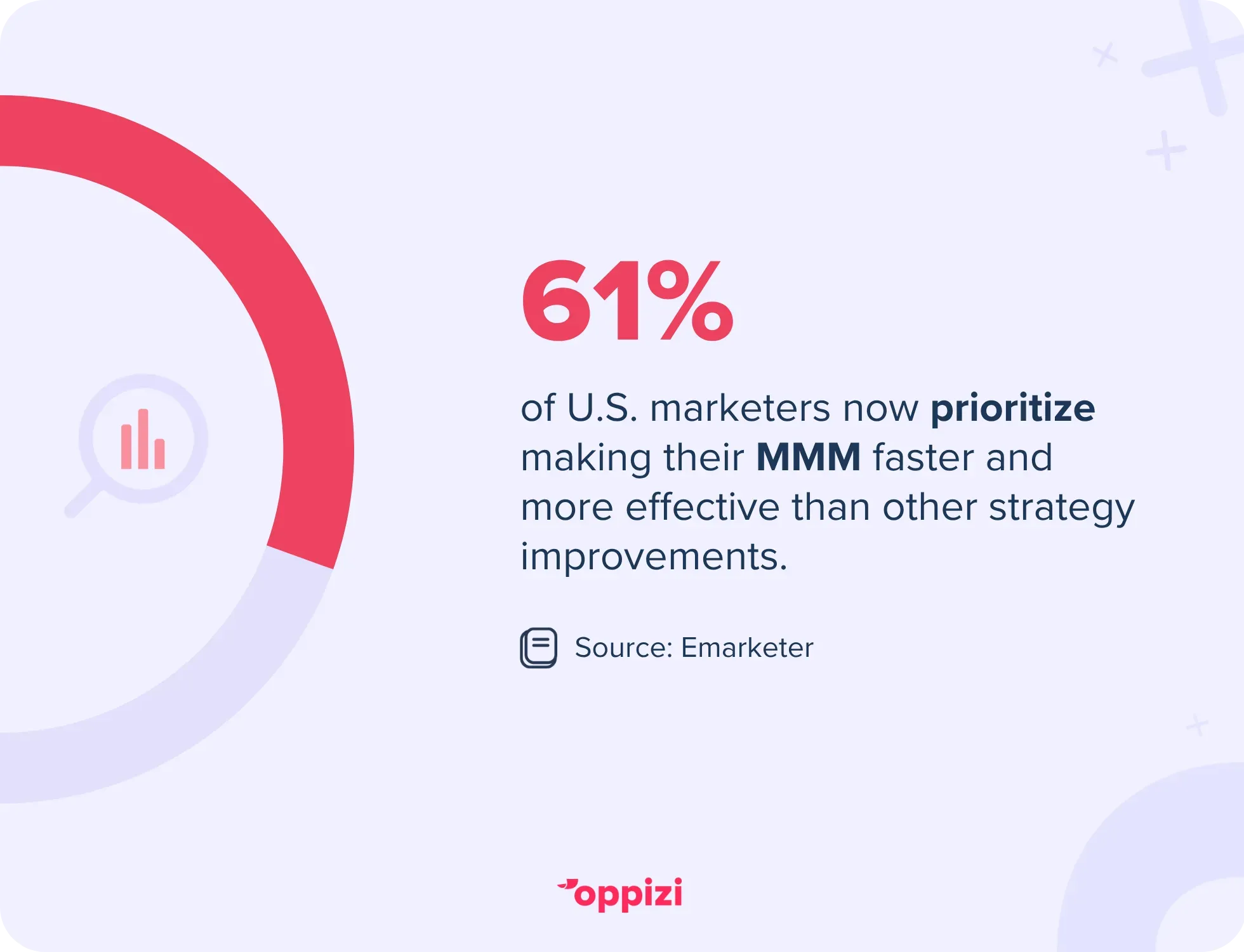
MMM gives a clear picture of which campaigns drive revenue, which lag behind, and how to allocate budgets for the greatest impact. It’s no surprise that 61% of U.S. marketers now prioritize improving the speed and effectiveness of their MMM over other strategy upgrades.
Why MMM matters for offline channels
Offline marketing is still crucial for many industries, including retail, CPG, automotive, and pharma. These channels often don’t have the detailed tracking that digital campaigns provide. Without proper measurement, marketers can:
- Overspend on low-performing channels.
- Misjudge seasonal or regional effects.
- Miss out on synergies between channels.
MMM solves these problems by giving data-driven insights. It helps marketers plan and create marketing budgets and campaigns with confidence. For example, you can measure how a TV spot in a specific city drives in-store sales. Or see how outdoor advertising works together with radio to boost brand awareness.
Step 1: Collect accurate data
The foundation of any successful MMM is reliable, complete data. For offline channels, you need to gather:
- Marketing spend: Track all investments in TV, radio ads, print advertising, out-of-home, events, sponsorships, and in-store promotions.
- Sales data: Use point-of-sale numbers, revenue reports, and SKU-level performance to measure results.
- External factors: Include weather, holidays, competitor activity, and economic trends that affect customer behavior.
- Pricing and promotions: Record discounts, bundles, loyalty programs, and any temporary pricing changes.
Consistency matters. Data should be at the same time intervals, weekly or monthly, and ideally cover at least two years. This helps capture seasonal patterns and long-term trends.
Step 2: Structure your data for modeling
Once you have the data, it needs to be organized for analysis. Focus on:
- Time alignment: Make sure all datasets share the same time intervals. Misaligned data can lead to inaccurate results.
- Channel categorization: Break down marketing spend by channel and sub-channel. For example, divide TV by network or radio by region.
- Data transformation: Normalize sales data, adjust for inflation, and handle any missing values. Clean data is key for accurate modeling.
Properly structured data reduces bias and gives you more confidence in your results.
Step 3: Select the right modeling approach
MMM uses different statistical techniques. The most common are:
- Linear regression: Simple and easy to understand. Best when channels act independently.
- Hierarchical models: Handle nested data, like campaigns across multiple regions or stores.
- Bayesian models: Provide probabilistic estimates and show uncertainty. Useful for forecasting and scenario planning.
Which method you choose depends on your business, the amount of data, and how complex your offline campaigns are.

Step 4: Account for lagged and diminishing effects
Offline campaigns often take time to show results. A TV ad may influence purchases over several weeks, while print ads build impact slowly. Two important concepts help capture this:
- Adstock: Measures how advertising effects decay over time, showing how long a campaign continues to drive sales.
- Diminishing returns: Shows the point where additional spending brings smaller gains.
Including these factors ensures your MMM reflects real consumer behavior, not just a snapshot of spend versus sales.
Step 5: Control for external influences
Offline marketing rarely works on its own. Competitor activity, seasonal demand, and economic conditions can all affect results. Sometimes these factors have more impact than your campaigns. To get accurate insights, you need to include them in your model:
- Competitor spend: Include competitor campaign data when possible. This helps you understand market shifts.
- Seasonality: Use historical patterns to capture predictable spikes or dips, like holidays or back-to-school periods.
- Macroeconomic indicators: Adjust for inflation, fuel prices, or consumer confidence that affect buying behavior.
Factoring in these influences ensures your MMM shows the true impact of your offline channels.
Step 6: Run the model and interpret results
Once your data is clean and structured, you can run your MMM. Focus on these outputs:
- ROI by channel: See which offline channels deliver the highest return.
- Incrementality: Understand how much extra revenue each campaign produces beyond the baseline.
- Synergies: Identify how channels work together, like how radio ads boost in-store promotions.
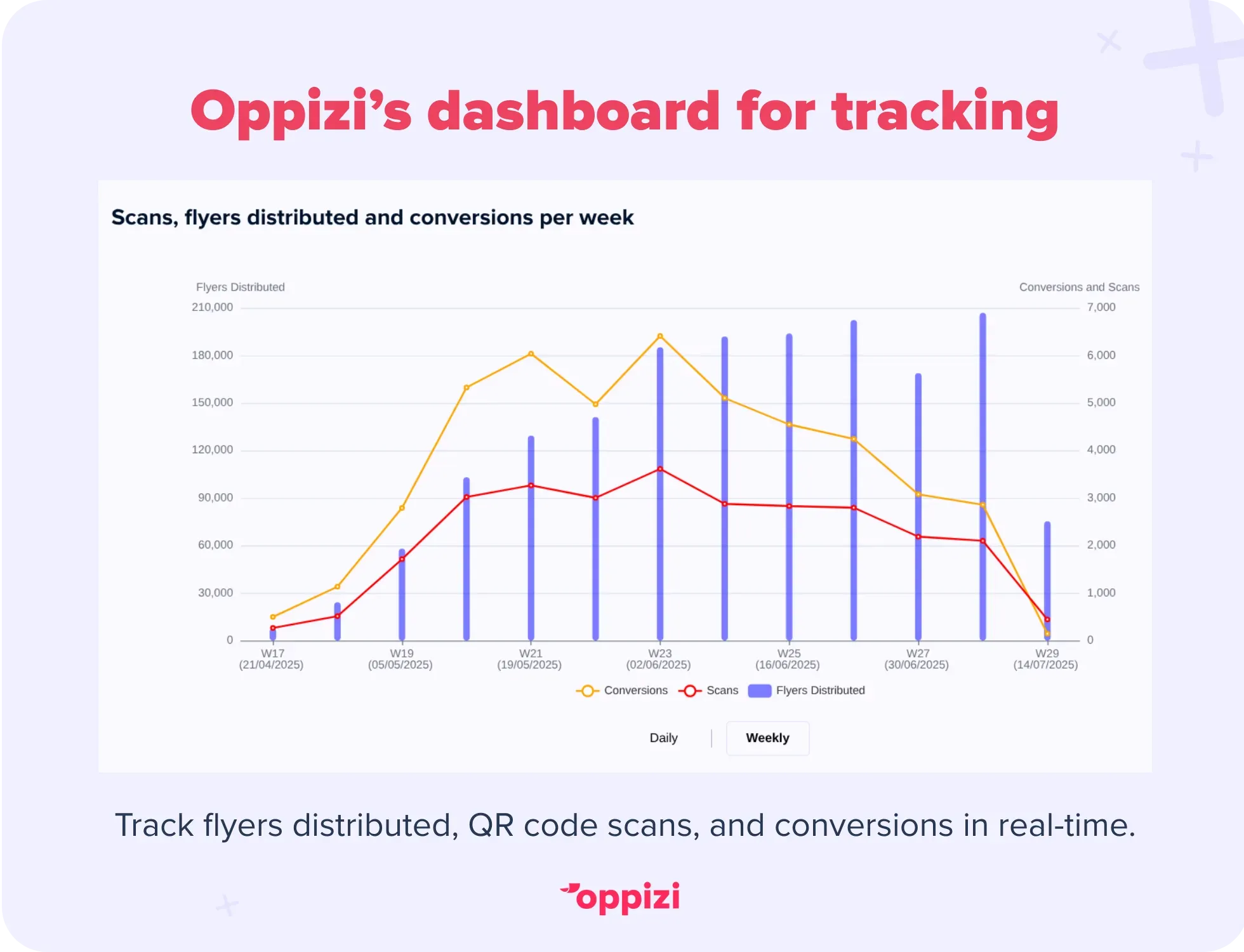
For some forms of offline marketing, such as direct mail, flyer distribution, and EDDM, it was once thought that collecting data and tracking results was difficult or impossible. With Oppizi, however, offline campaigns can be tracked in real-time by using our simple dashboard.
Step 7: Scenario planning and budget optimization
MMM is not just about looking back. It helps you make decisions for the future. Once you know how each channel performs, you can test different budget scenarios to find the most effective strategy:
- Shifting investment: Increase spend on radio in regions with consistently high ROI.
- Reallocating budgets: Reduce low-performing print campaigns and move funds to TV or digital channels that perform better.
- Testing synergies: Try combined campaigns, such as outdoor ads with event sponsorships, to measure extra lift.
Scenario planning turns MMM into a tool for smarter budgeting and more confident planning.
Step 8: Validate and iterate
No model stays perfect forever. Regular validation keeps your MMM accurate as conditions change. To maintain reliability:
- Check performance: Compare predicted sales to actual results to spot gaps.
- Refresh data: Update your model with new campaigns, competitor activity, and market shifts.
- Reassess structure: Review channel categories and external factors to ensure the model reflects your current strategies.
Validating and iterating helps your MMM stay aligned with reality. It gives your team confidence to act on its recommendations.
Common challenges in offline MMM
Even with a solid framework, Marketing Mix Modeling for offline channels has challenges that need careful attention:
- Data gaps: Offline campaigns often lack precise tracking. You may need to fill gaps with reasonable assumptions or proxies.
- Complex interactions: Channels can influence each other in unexpected ways, which makes attribution harder.
- Time lag: Results from offline campaigns can take weeks or months to appear, making immediate ROI harder to see.
- External shocks: Sudden events, like competitor launches or economic changes, can affect outcomes and require model adjustments.
Best practices for MMM in offline channels
To get the most from Marketing Mix Modeling, follow these best practices:
- Maintain consistent data standards: Track all spend in detail with weekly or monthly granularity.Segment by geography or audience: Regional or demographic differences often reveal hidden opportunities.
- Incorporate external factors: Include holidays, weather, and competitor activity to improve model accuracy.
- Regularly update models: Keep your inputs fresh to reflect current campaigns and market conditions.
- Communicate insights clearly: Use dashboards and executive summaries so stakeholders can act quickly.
Following these practices ensures MMM delivers practical insights you can use to make decisions confidently.

FAQs on marketing mix modeling for offline channels
What is Marketing Mix Modeling (MMM) and why is it important?
MMM is a way to analyze marketing data to see which channels drive sales and how much they contribute. It is especially useful for offline channels like TV, radio, print, and out-of-home, which digital tracking cannot measure. MMM helps marketers see the real return on investment across all channels.
How does MMM differ from digital attribution?
- Digital attribution tracks individual customer actions using cookies or IDs.
- MMM looks at overall sales and marketing data over time.
- It is privacy-friendly, does not rely on user-level tracking, and covers both online and offline channels.
What data is needed to build an MMM?
A strong model usually requires at least two years of weekly data, including:
- Media metrics: GRPs for TV and radio, readership for print, and impressions for out-of-home.
- Business data: Sales, pricing, promotions, and distribution.
- External factors: Seasonality, competitor activity, and economic trends.
How is MMM applied to offline channels like TV and radio?
- TV: Uses GRPs and TRPs to measure reach and frequency.
- Radio: Modeled at the market level and adjusted for seasonal listening patterns.Out-of-home (OOH): Needs accurate posting dates, locations, and impression estimates.
What are the main challenges in MMM, and how can they be avoided?
Common issues include poor data quality, misattributing offline impact, ignoring cross-channel interactions, and overfitting the model. You can avoid these by:
- Running strict data validation checks.
- Using techniques like cross-validation and nested models.
- Considering both direct and indirect effects of each channel.
Conclusion
Marketing Mix Modeling shows how offline channels drive results. With accurate data and the right models, marketers can see how offline campaigns perform, adjust budgets effectively, and increase ROI.
Oppizi makes gathering data simple. Our advanced tracking and easy-to-use platform let you monitor offline campaigns in real time. You can make smarter, faster, and more confident decisions.
Start measuring the true impact of your offline marketing today. Sign up with Oppizi and make every marketing dollar work harder for your business.