Last updated July 28, 2026
Today’s offline channels offer the capabilities modern teams expect: precise targeting, measurable performance, scalable customization, and clear learnings to optimize future campaigns. They complement digital efforts, and quite effectively at that.
Physical media guarantees access to real households, real neighborhoods, and real buying contexts, where attention is less fragmented and brand messages are harder to ignore. As a result, marketers are adjusting their playbooks, recognizing that not all high-intent moments happen on a screen.
Among the most widely used offline marketing tactics are direct mail, flyering, and insert media. In this article, we’ll take a closer look at each of them individually; how they work, where their strengths and limitations lie, and when it makes the most sense to use them across the funnel. We’ll also explore how combining multiple offline channels and/or pairing them with digital can unlock better results. Let's dive in!
Understanding 3 key offline marketing channels
Direct mail, flyering, and insert media are rooted in the same fundamentals: physical formats, printed assets, and the unique impact that only tangible media can deliver. Yet each is a distinct channel, with its own distribution model, cost structure, and levels of targeting and customization options, making it important to know which tactic(s) to choose for your business goals.
Direct mail
Direct mail is a highly targeted marketing channel that delivers printed materials (i.e., postcards, letters, brochures, or catalogs) directly to individual households or named recipients via postal services.
What sets direct mail apart is the level of control it provides.
Targeting and distribution
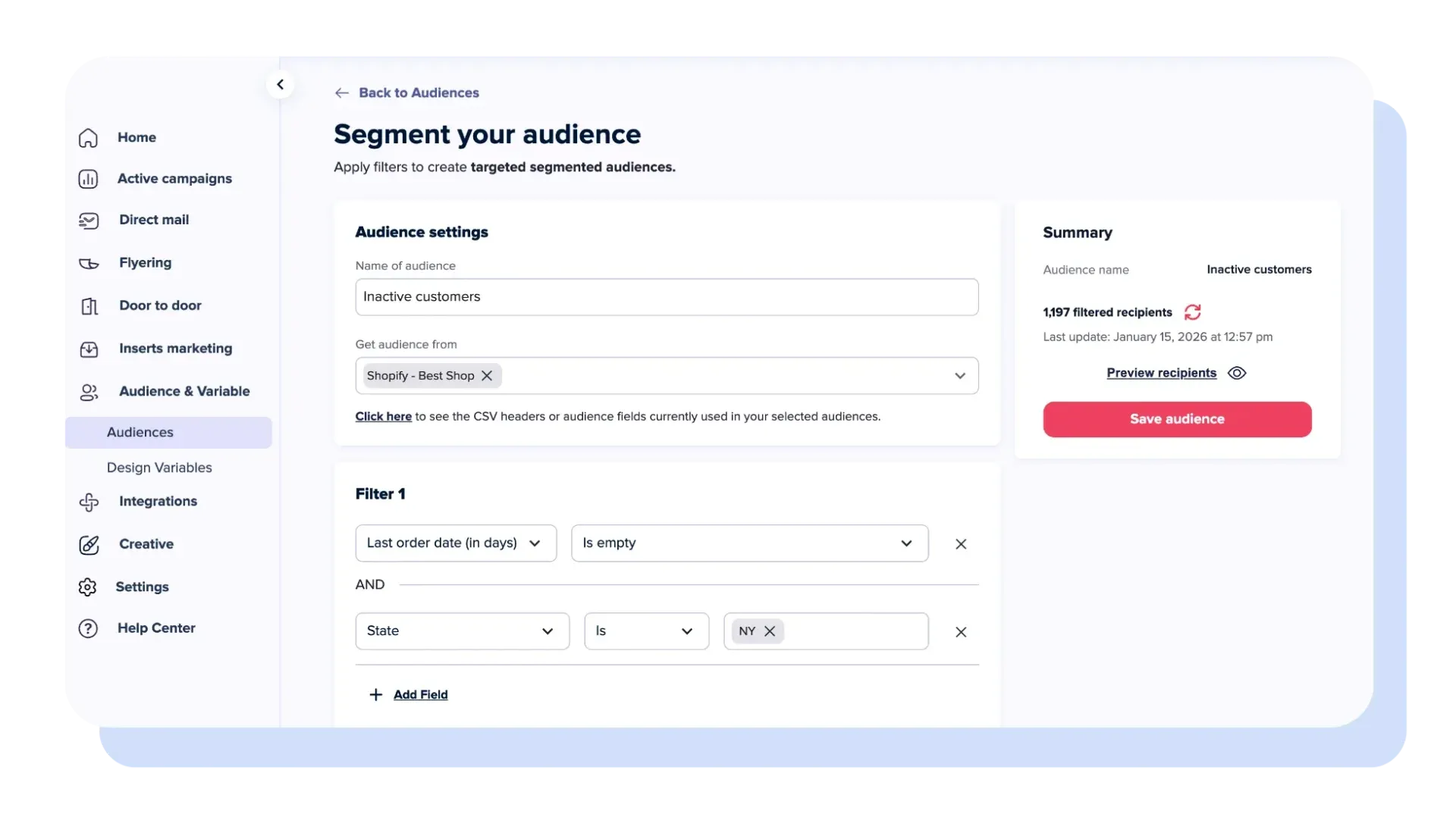
Instead of broad blanket targeting, modernized direct mail marketing allows brands to define exactly who should receive a campaign using automated mailing lists and live customer data. Audiences can be segmented by location, demographics, purchase behavior, lifecycle stage, or past interactions, making direct mail one of the most precise offline channels available.
Direct mail providers like Oppizi now integrate directly with various e-commerce platforms or customer engagement tools enabling brands to trigger automated physical mail campaigns based on real user behavior (purchases, abandoned carts, churn risk, or lifecycle milestones.) This transforms direct mail into a scalable, always-on acquisition and retention channel.
Personalization further amplifies its effectiveness. With variable data printing, each piece can feature unique names, locations, offers, or product recommendations.
Tracking and measurement
Modern direct mail offers multiple layers of attribution and performance tracking. At the most basic level, campaigns can be tied to:
- Unique QR codes and personalized URLs
- Promo code redemption
- Dedicated landing pages or phone numbers
These mechanisms link physical mail to online behavior and conversions. For example, a retail brand can send personalized postcards with unique QR codes to lapsed customers; when a recipient scans and purchases, the conversion is attributed to the relevant campaign. This enables accurate measurement of CPA, revenue per recipient, and incremental lift versus a control group.
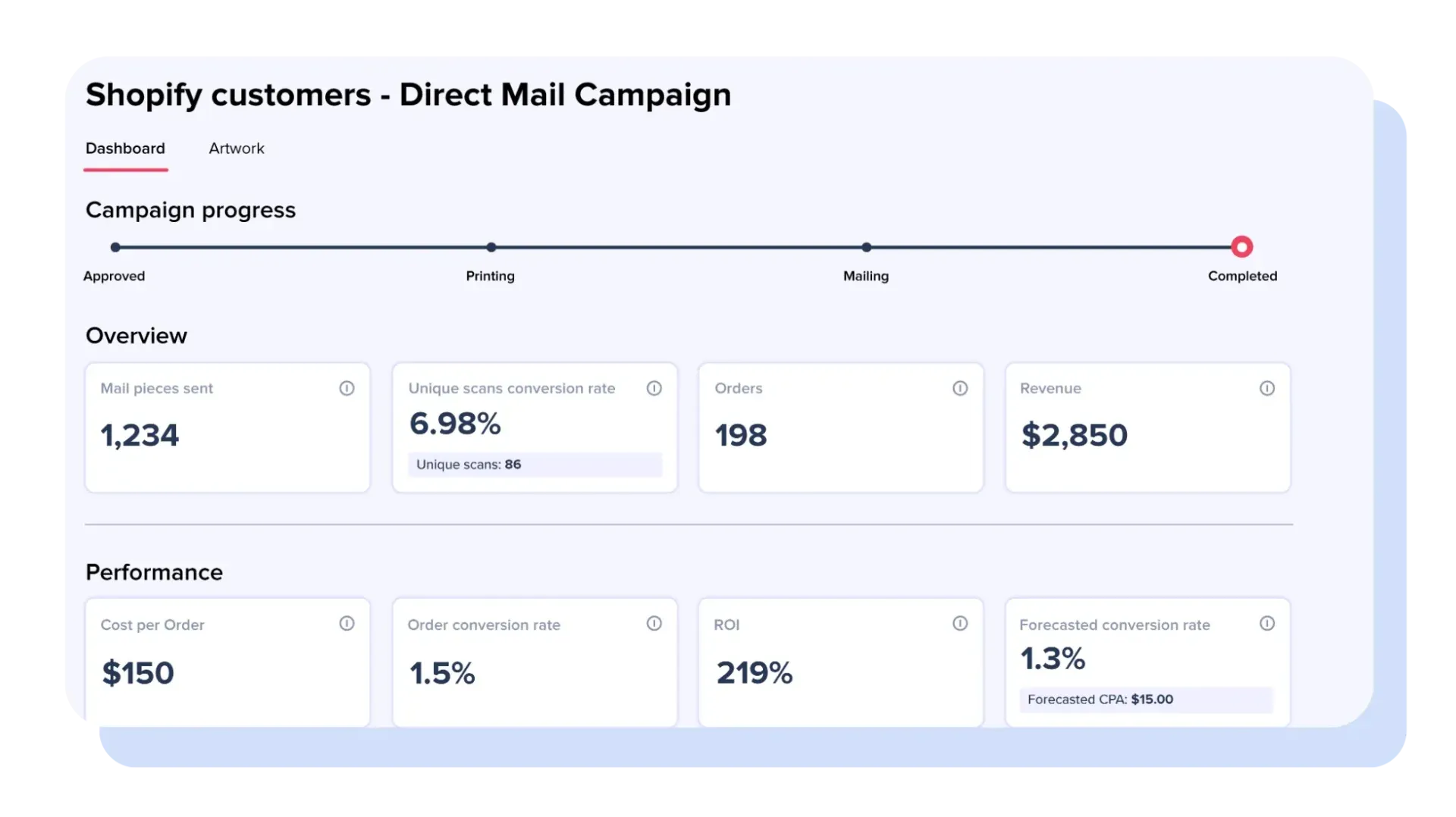
Direct mail providers like Oppizi extend this further by centralizing performance data in live reporting environments. Teams can monitor campaigns in real time through dashboards tracking key metrics, from delivery rates and engagement to conversions and ROI, then use those insights to refine targeting, creative, and distribution strategies for future sends.
Strengths and limitations
Because campaigns are built on mailing lists and customer data, brands can tightly control who receives what, when, and why. This enables advanced segmentation, lifecycle targeting, and personalization. The format itself is another advantage. Physical mail benefits from high visibility, longer shelf life, and lower competition than digital environments. Neuroscience research consistently show that physical mail activates deeper emotional engagement and stronger memory recall than digital formats
The trade-offs are largely operational and economic. Direct mail requires clean, compliant data, longer production timelines, and higher unit costs than channels like flyering or insert media. Costs will also be dependent on the type of direct mail you choose (postcards and catalogs come with different price tags.)
Poor list quality or weak creative can quickly erode performance, and scaling adds logistical complexity. These frictions can be easily avoided by partnering with a specialized direct mail provider which will remove much of the operational intricacy of running a direct mail campaign.
Flyering
Flyering refers to distributing printed materials, typically leaflets, flyers, or brochures directly in public or residential spaces. It prioritizes scale and physical presence over individual-level targeting, making it one of the fastest ways to put a message in front of a large number of people within a defined geographic area.
Targeting and distribution
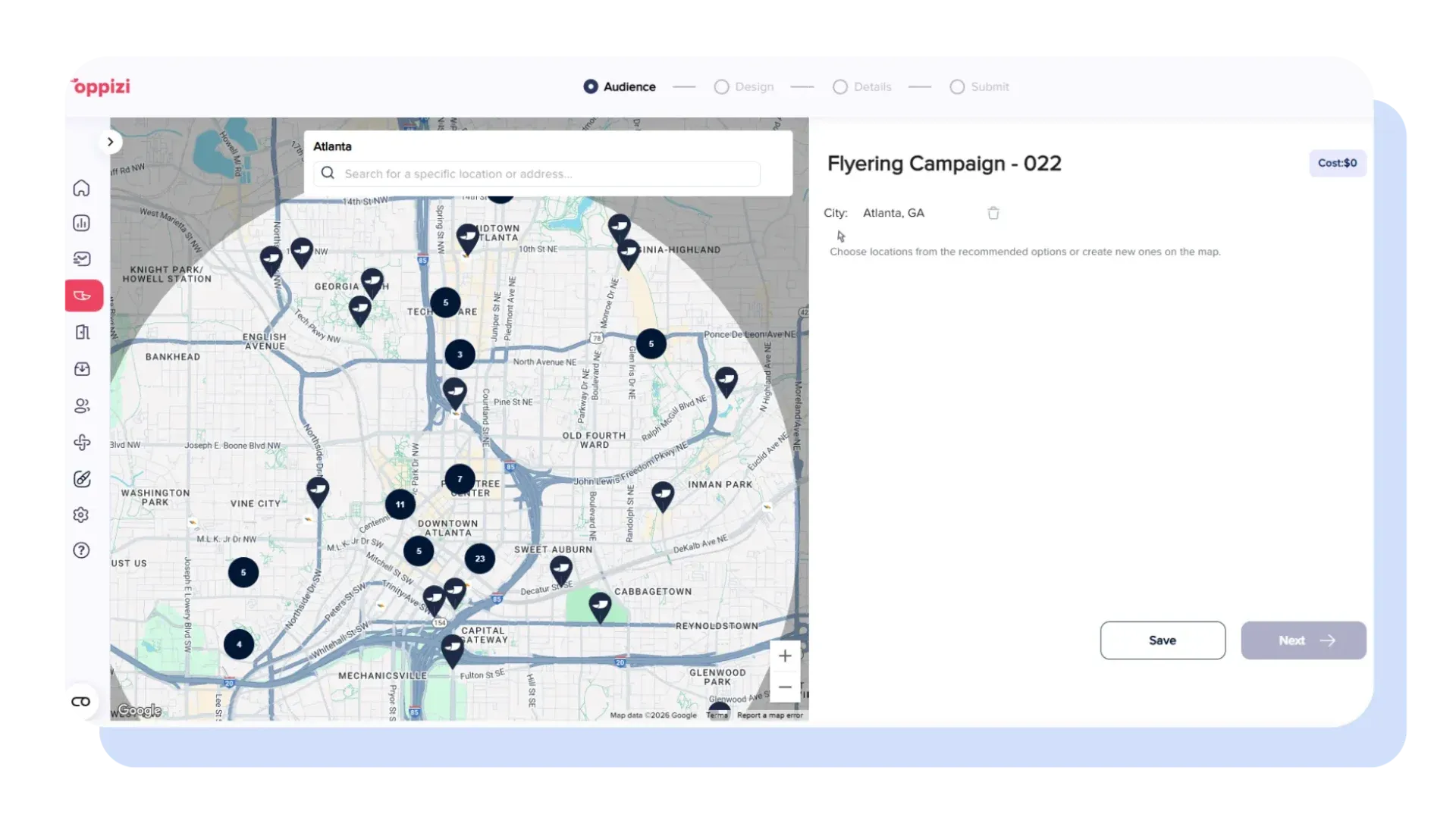
Flyering can include door-to-door delivery, in-store placement, or distribution in high-footfall areas. Instead of selecting recipients from mailing lists, brands choose where distribution should happen: specific neighborhoods, commercial districts, transit hubs, campuses, or event zones. Targeting is therefore indirect, relying on proxies such as:
- Residential density
- Income level by area
- Proximity to stores or service locations
- Foot traffic patterns
- Time of day and day of week
Tracking and measurement
Flyering is often perceived as difficult to measure, but in practice, performance depends heavily on the quality and transparency of the execution.
Attribution still relies primarily on mechanisms such as:
- QR codes or short URLs
- Promo codes
- Dedicated landing pages
- In-store redemption tracking
Offline providers like Oppizi offer access to their vetted distributor network and monitor flyer delivery activity through live GPS tracking, giving clients access to a web-based dashboard where they can view distribution progress in real time and track campaign performance across a range of key performance indicators.
Strengths and limitations
Flyering is a cost-effective offline marketing technique. It allows brands to reach thousands of people in a specific area over a short timespan, without the need for personal data or complex setup. It is particularly effective for local activations, store openings, events, food delivery services, gyms, political campaigns, on-demand services and other contexts where proximity matters more than personalization. Distribution can be tightly aligned with timing (weekends, evenings, event days) to maximize visibility.
However, it’s important to consider that even with careful area selection, many recipients will fall outside the ideal customer profile, which makes it more effective as an awareness or acquisition channel compared to address-based channels like direct mail.
Insert media
Insert media marketing refers to placing your materials (i.e., flyers, postcards, or vouchers) inside another company’s physical distribution, such as e-commerce orders, subscription boxes, newspapers, magazines, or product shipments.
Targeting and distribution
Instead of building your own delivery network or mailing list, you “piggyback” on an existing one. The result is guaranteed household penetration combined with contextual relevance: your message arrives alongside a product the recipient has already chosen to engage with. This makes insert media particularly attractive for brands looking to tap into established audiences quickly, without the operational complexity of running their own distribution.
Brands select distribution partners based on audience overlap, based on factors such as customer demographics, purchasing behavior, or lifestyle indicators, then place inserts into outgoing packages over a defined period or volume.
Common targeting dimensions include:
- Type of product purchased (e.g., beauty, food, electronics)
- Subscription category (e.g., fitness, parenting, pets)
- Customer demographic profiles
Tracking
Insert media measurement typically relies on similar tools to other offline channels. Unique promo codes, QR codes, dedicated landing pages can all be used to measure the effectiveness of your campaigns. With offline providers like Oppizi, all the data is available within a unified dashboard, making it easy to track your affiliate marketing campaigns.
Strengths and limitations
This channel’s main strength is contextual credibility. Being placed inside a trusted brand’s shipment lends instant legitimacy and increases the likelihood that the inserted material is seen and handled rather than discarded. However, targeting is also more dependent on the third-party, and costs can be higher for premium partners with desirable audiences.
Best use cases throughout the funnel
While direct mail, flyering, and insert media can all drive results, they don’t serve the same purpose in the customer journey.
Top of funnel: awareness and local visibility
At the awareness stage, reach and repetition are the real game changers. Flyering is often the most effective option here. Its ability to reach specific neighborhoods, commercial areas, or event locations makes it ideal for:
- Store openings and local launches
- Event promotion
- New service rollouts
- Hyperlocal brand awareness campaigns
Insert media can also perform well at this stage when the goal is to introduce a brand to a highly relevant audience. Direct mail is generally less efficient for pure awareness due to higher costs per contact. However, it can be effective for premium or high-consideration products where brand perception and message depth matter.
Mid-funnel: consideration and product education
In the consideration phase, relevance and message quality become critical.
Direct mail excels here. Address-based targeting, segmentation, and personalization make it possible to deliver tailored messaging to prospects who have already shown interest such as website visitors, previous customers, or lookalike audiences.
Insert media also plays a strong role at this stage, particularly for product discovery, trial offers, and cross promotions. Because recipients are already engaging with a related brand or product, the barrier to attention is lower than with mass distribution.
Bottom of funnel: conversion, retention, and reactivation
Direct mail is the clear offline leader for bottom of funnel campaigns. Its advanced automation and performance tracking capabilities make direct mail particularly effective for high-intent use cases such as:
- Abandoned cart recovery
- Subscription acquisition
- Contract renewals
- Upselling opportunities
- Customer reactivation
- High-value promotions
When combined with automation and CRM data, it enables timely, personalized outreach that directly supports revenue objectives.
How to combine channels for better results
High-performing offline strategies rarely rely on a single channel. They combine formats to increase reach and reinforce messaging. Each offline channel plays a distinct role. Flyering builds fast, local visibility. Insert media introduces the brand in trusted contexts, while direct mail converts interest into action through precision and personalization.
For example, a food delivery brand might launch in a new neighborhood using flyering to drive awareness, follow up with insert placements in local subscription boxes to build familiarity, and then deploy direct mail to high-intent households with a time-bound sign-up offer.
However, the real performance gains come when offline and digital are designed to work together. Common high-performing combinations include:
- Flyers with QR codes leading to personalized landing pages
- Direct mail synced with retargeting ads to reinforce messaging
- Insert media offers connected to email or SMS follow-ups
- Offline-triggered traffic segmented and nurtured through CRM flows
Choosing the right offline channel
The real differentiator isn’t just which channel you choose, but how well it’s executed, from targeting and creative to distribution, measurement, and optimization.
That’s where experience matters. After more than a decade working in offline marketing, Oppizi has helped brands design, launch, and scale campaigns across all three formats, refining the technology, distribution networks, data infrastructure, and operational processes required to make offline perform like a modern growth channel.
From automated direct mail workflows to large-scale flyering operations and strategic insert partnerships, we’ve built the systems that turn physical media into predictable, measurable performance.
If you’re looking to build offline into a valuable part of your marketing engine, the right partner makes all the difference. And that’s exactly what Oppizi was built to be.Launch a campaign today.