Last updated July 28, 2026
For years, precision targeting was considered a digital-only advantage for marketers. Online channels promised relevance at scale, while offline marketing was written off as broad, static, and hard to measure.
That assumption no longer holds.
Advances in data, audience modeling, and location intelligence now allow brands to apply the same targeting logic offline as they do online, often with richer signals of context and intent. Where people live, commute, and shop in the real world can now inform who you reach, when you reach them, and with what message.
In this article, we’ll look at how advanced offline targeting works in practice across direct mail, flyering, and inserts, and how each has evolved into a scalable, data-led tool for acquisition and retention.
Why offline targeting used to be limited
For much of its history, offline targeting was largely defined by distribution convenience rather than audience insight. Decisions were based on what could be accessed and executed easily: postal codes, city zones, retail catchment areas, or high-traffic streets. As a result, targeting typically stopped at zip codes and broad demographic categories, leaving little understanding of who the audience truly was or how they behaved.
What was missing was intent, adaptability, and feedback. Offline campaigns couldn’t easily differentiate between acquisition, reactivation, or retention audiences. Once live, campaigns were fixed and measurement opportunities minimal. Scaling meant increasing volume rather than improving precision.
But offline targeting wasn’t inherently limited; its potential simply hadn’t been unlocked. What changed wasn’t the channel itself, but the data, technology, and measurement layers now applied to it.
4 core capabilities of effective offline targeting
In digital marketing, targeting is the practice of building clearly defined audiences based on behavior, intent, and context, which enables marketers to test creative and scale what performs.
Offline targeting now operates on the same principle. Smarter targeting comes with some concrete benefits:
- It enables smarter budget allocation and reduces wasted spend
- It increases conversion rates
- It makes offline scalable
- It supports full funnel marketing
- It improves the customer experience
- It aligns offline channels with digital strategy
While the mechanics differ across channels (as we’ll explore later), the underlying shift is universal. Offline marketing has moved from broad assumptions to execution driven by actionable insight, made possible in large part by a new generation of offline providers that combine data, technology, and execution at scale.
Let’s explore the four core advances that have made this shift possible.
Better audience intelligence (who you reach)
Modern offline targeting begins with clearly defined audiences, not broad geographies. Instead of relying solely on postcodes or catchment areas, offline providers have enabled brands to build audiences using:
- First-party data (customers, subscribers, CRM lists)
- Modeled audiences (lookalikes, high-propensity prospects)
- Behavioral signals (purchase history, inactivity, engagement)
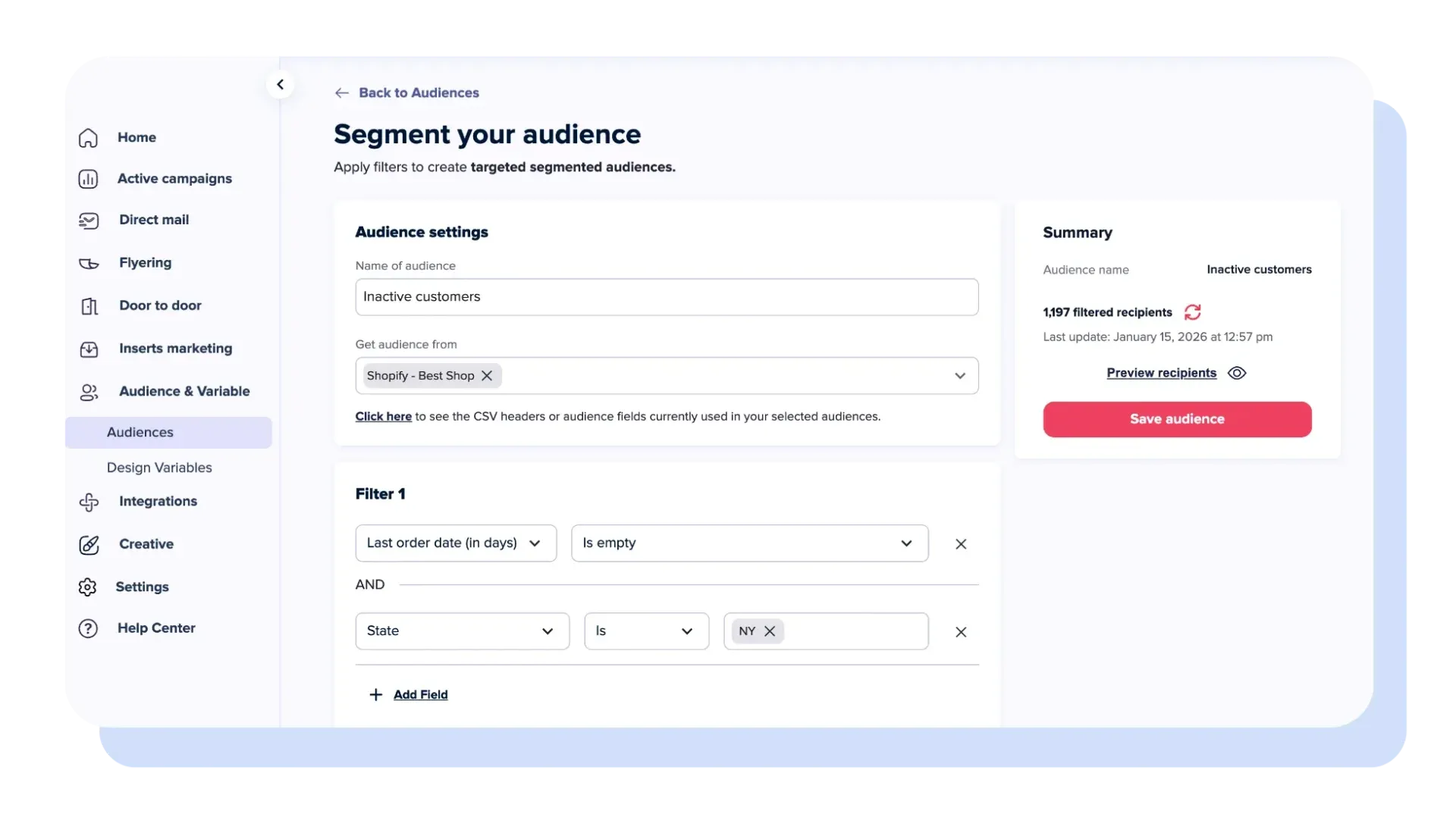
With new technology and automation possibilities, these audiences can be securely activated across offline channels, allowing campaigns to target or suppress individuals based on intent and lifecycle stage. As a result, offline execution shifts from “where to distribute” to “who to reach” and enables distinct strategies for prospecting, reactivation, and retention.
Enhanced contextual precision (where & when you reach your audience)
Effective offline campaigns combine hyper-local geographical targeting with precise timing to reach specific audiences when intent is highest.
Brands can activate campaigns around specific days, times, or seasons when relevance peaks: back-to-school periods, seasonal promotions, weekday commuter hours, or weekend leisure moments. Context adds another critical layer. Campaigns can be deployed near events, along commuter routes, close to retail locations, or within residential areas that match the target audience profile.
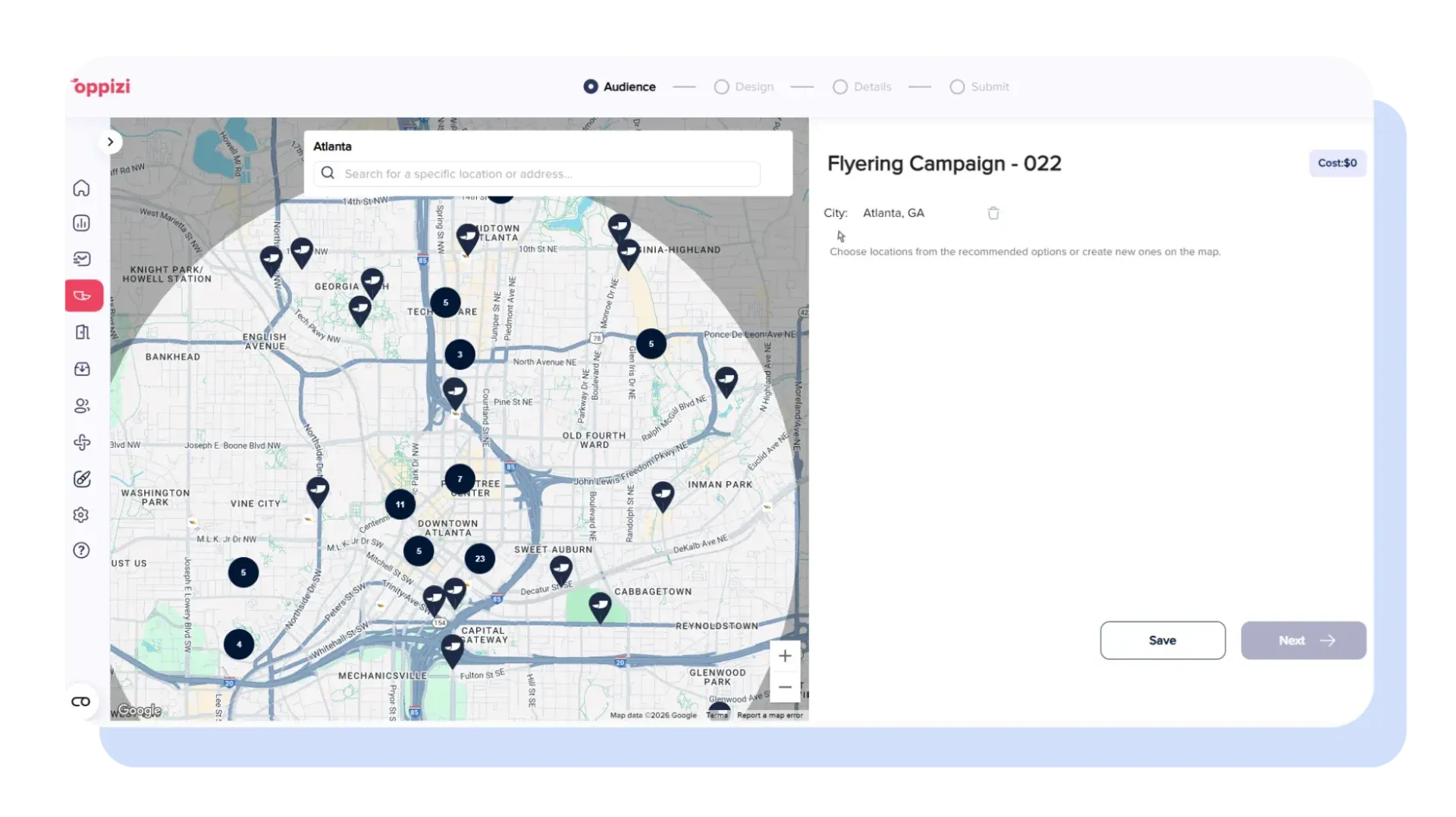
Platforms like Oppizi make these decisions actionable by identifying high-performing distribution zones and popular areas based on historical campaign data. For enterprise brands running large-scale flyering campaigns, for example, this is taken a step further with tailored distribution recommendations built around specific business objectives, target audiences, and market conditions.
Improved intent and funnel alignment (why you reach them)
Advanced targeting is also about reaching audiences for the right reason, in addition to being there at the right time and in the right place. So, let’s talk about intent.
Modern targeting capabilities allow brands to differentiate between offline audiences who are discovering a product for the first time, those who have shown interest but haven’t converted, and existing customers who are ready to re-engage or buy again.
This shift is powered by data; leading offline providers enable brands to leverage first-party customer information through CRM integration. With Oppizi, you can take this a step further and generate lookalike audiences in order to build distinct offline segments for similar customer groups for:
- Prospecting and demand generation
- Demand capture near points of purchase or moments of high intent
- Reactivation of inactive customers or abandoned carts
- Retention through loyalty programs and personalized offers
Each segment requires tailored messaging, creative formats, and distribution strategies, and these differences can now be operationalized at scale across offline channels such as flyering, direct mail, and insert media.
In practice, this means offline campaigns can be planned as funnel-specific activations. A flyering campaign near a university during enrollment season serves a different strategic purpose than a direct mail reactivation campaign sent to lapsed customers, even if both aim to drive conversions.
Increased scalability (how you improve and grow)
What separates advanced targeting from basic segmentation is the ability to measure performance, learn from outcomes, and apply those learnings to improve campaigns over time.
Brands can track response and conversion metrics such as website visits via QR codes or custom URLs, sign-ups, purchases, app installs, promo code usage, and even incremental store visits through geo-based analysis. This data reveals which neighborhoods, distribution zones, commuter routes, or event-based activations deliver the strongest results.
Here's what it looks like to track your direct mail campaign progress on Oppizi's dashboard:
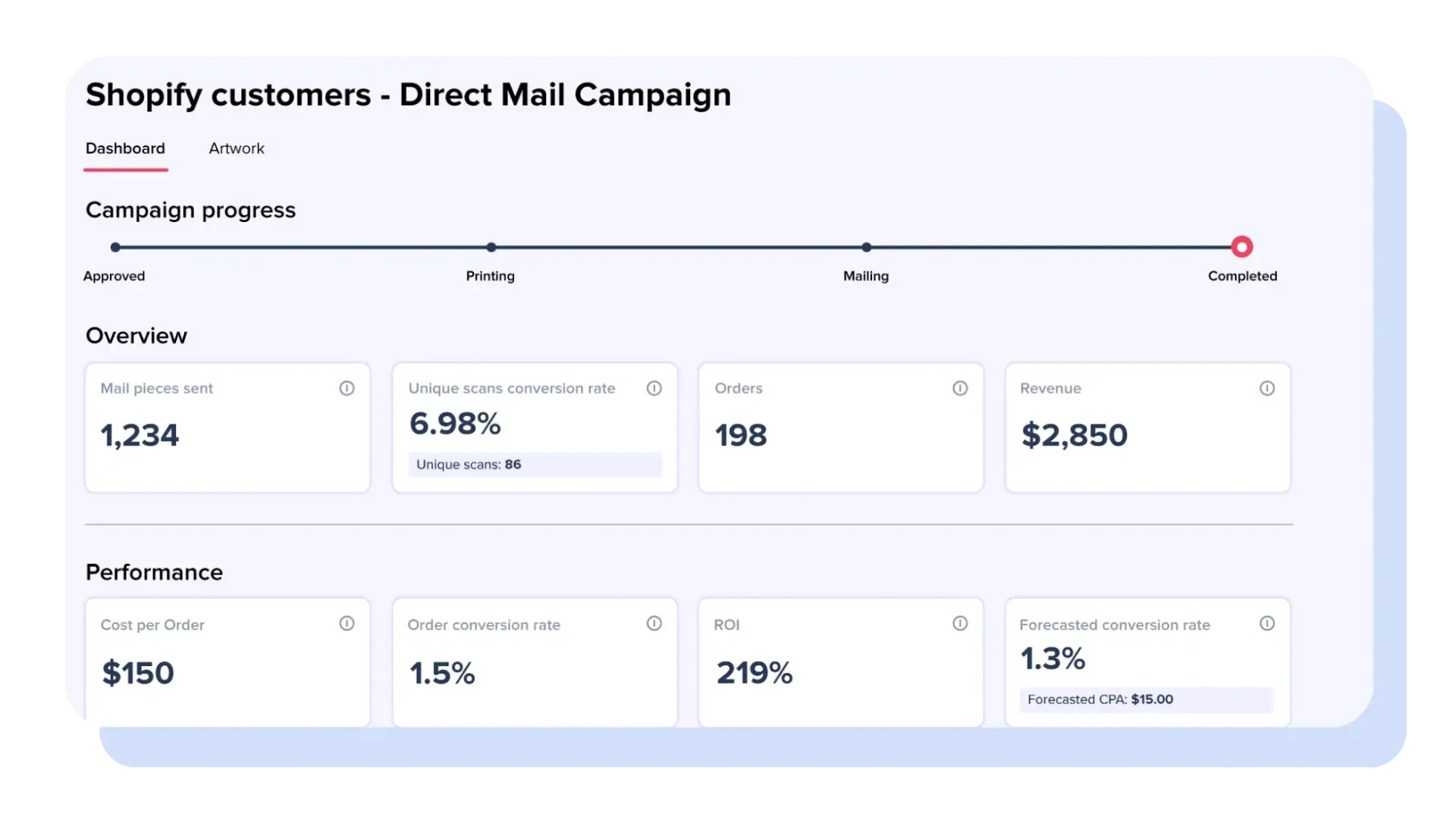
With these insights, offline targeting becomes a continuous, data-driven system: high-performing audiences are scaled, underperforming zones or segments are refined or removed, and successful campaigns can be replicated across new markets. The result is a more efficient, measurable, and scalable approach to offline marketing that drives consistent growth.
When campaigns are built on these pillars, offline channels become an effective and scalable way to grow your business.
Channel by channel breakdown
The approach to advanced targeting varies by offline channel, with each medium offering unique opportunities to reach the right audience at the right time.
Direct mail
Direct mail is a highly effective offline channel because it allows for granular audience targeting. Its performance starts with the quality of the mailing list: the more accurate, up to date, and well-segmented that list is, the higher the likelihood of meaningful engagement and conversion.
The most reliable approach is to leverage your own data to build or automate your mailing lists, pulling from:
- Customer / subscriber databases (CRM)
- Ecommerce platforms (e.g., Shopify)
- Marketing automation / engagement platforms (e.g., Braze)
- Loyalty program data
- Lead capture forms (events, sign-ups, quote requests)
Brands can also work with trusted offline providers like Oppizi who facilitate the development of prospect audiences built from modeled attributes and verified addresses. Regardless of the source, list quality is critical: it drives deliverability, response rates, and ROI, so data should always come from compliant providers with strong hygiene standards.
Because of its targeting precision, direct mail is also particularly effective for reactivation campaigns. Direct integrations with platforms such as Shopify make it easy to segment based on customer behavior and target select customers with timely, relevant messages that prompt them to interact with your brand.
Advanced targeting is supported by variable data printing and automation, which allows each mail piece to adapt its message, offer, or creative based on the recipient’s profile without slowing down production. Personalization is becoming a core aspect of marketing communication, with more than 70% of consumers now expecting personalized interactions from brands and 76% feeling frustrated when those expectations aren’t met.
This level of targeting is what enables direct mail to consistently deliver relevance, engagement, and strong campaign performance.
Flyering
Flyering connects brands with people in motion, creating a direct line to consumers at moments of high relevance. It captures demand by distributing near retail locations, transport hubs, event venues, or stores, placing your message in front of people already in a buying or decision-making mindset. Proximity itself becomes a signal of intent, and the flyer acts as a timely nudge.
For flyer distribution, targeting is built around predictable audience patterns. Universities, business districts, residential neighborhoods, and popular streets all attract specific demographic groups at specific times. When distribution is aligned with these patterns, brands can consistently reach defined audiences even before active demand exists.
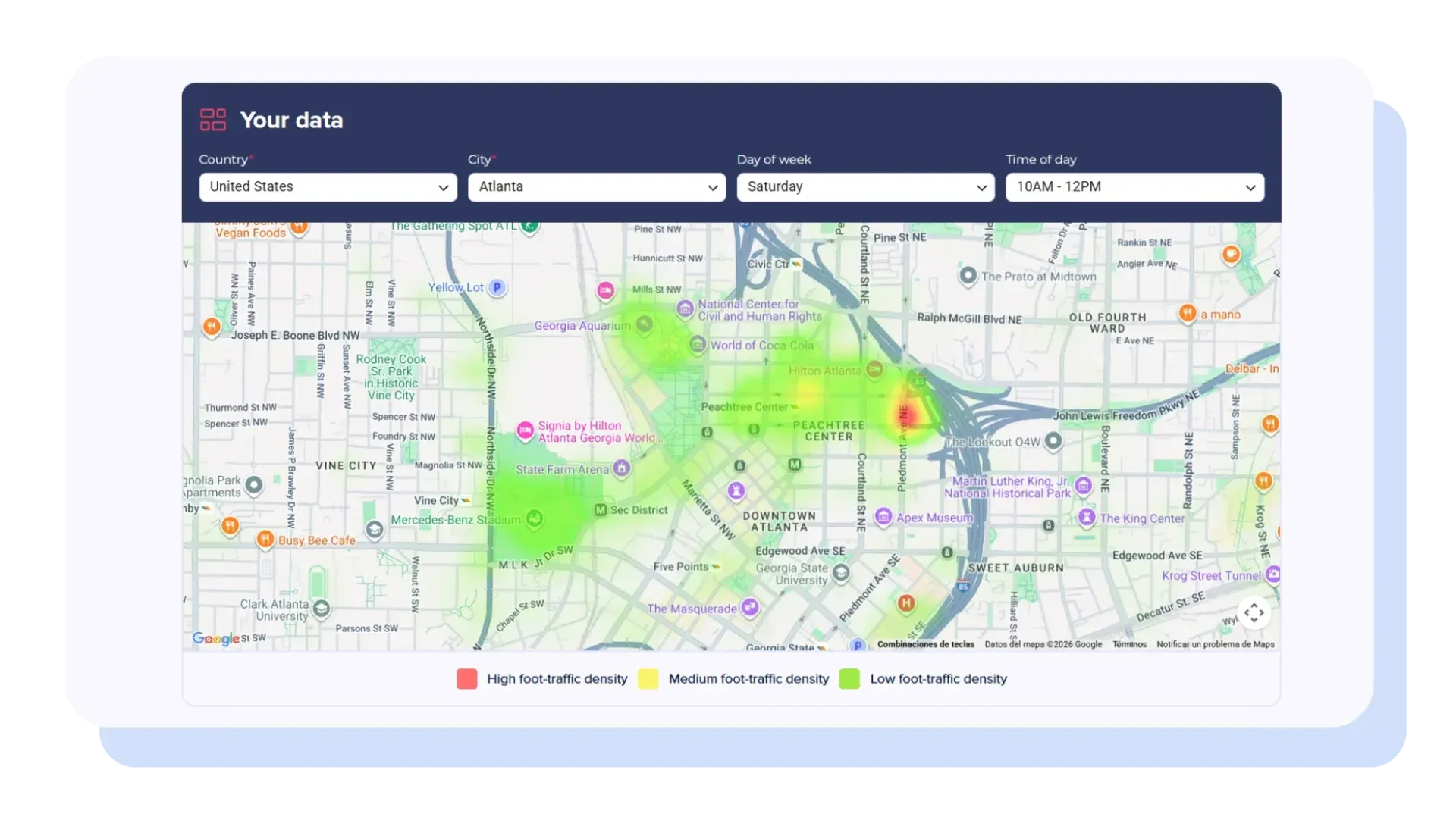
For brands looking to optimize their offline advertising efforts, you can use a footfall analysis tool to identify high-traffic areas in a given city. It’s a simple starting point to identify high-potential distribution zones before launching a campaign.
Insert media
Inserts are printed materials placed inside select third-party packages. They provide a unique advantage by going beyond location or household data, leveraging existing consumer relationships to connect with people through brands and platforms they already engage with.
Brands can select partners whose customer base closely matches their ideal audience, using demographic and behavioral data to ensure alignment. A mobility platform, for example, can reach local university students with limited transportation options in deliveries from regional retailers.
This approach allows for far more precise prospecting than generic distribution. By starting with a known customer profile and extending outward, brands combine the credibility of a trusted distributor with the precision of data-informed targeting, making inserts a highly effective tool for reaching the right audience at the right time.
Ready to experience advanced offline targeting in action?
Today, offline marketing is defined by relevance, intent, and measurability. Advances in technology, data automation, as well as more sophisticated execution capabilities allow brands of all sizes to apply the same strategic discipline to physical channels that they expect from digital when it comes to targeting.
This is the approach Oppizi was built around. Oppizi enables marketers to plan and execute offline campaigns with unmatched accuracy, with dedicated experts who provide tailored guidance on audience selection, distribution zones, timing, and channel mix
If you’re ready to bring precision targeting to your offline strategy, start your next campaign with Oppizi and see just how powerful offline marketing can be.
Get in touch with Oppizi today.