Last updated July 28, 2026
If you’re running your online and offline marketing campaigns separately, you’re losing impact. Customers don’t think in channels. They move fluidly through the sales funnel, connecting the digital and physical worlds.
The real challenge for most marketers isn’t running campaigns, it’s aligning them. How do you measure the combined impact of a social ad and a flyer? Or create a customer journey that feels seamless, whether someone starts online or offline?
That’s where integration comes in. The good news is it doesn’t have to be complicated. With the right strategies, you can build consistency, track performance with clarity, and boost conversions. Here’s how to make it work.
Why connecting online and offline marketing matters
Today’s buyers are omnichannel by nature. They may see a social ad, research online, then purchase in-store, or discover a product in-store and order it online later. In fact, 73% of shoppers use multiple channels during their buying journey.
When you fail to connect these channels, you risk:
- Mixed brand messages
- Incomplete data on what’s driving conversions
- Missed opportunities to nurture and retain customers
On the other hand, companies that integrate both channels enjoy up to an 89% retention rate, compared to just 33% for those that don’t.
The long-term brand impact
Integrating online and offline channels isn’t just about driving sales— it shapes how customers perceive your brand over time. When your messaging, visuals, and values are consistent across every touchpoint, you create a cohesive experience that sticks. This kind of consistency:
- Builds trust: Customers feel confident engaging with a brand that’s reliable both online and offline.
- Strengthens recognition: Seeing the same branding in multiple places makes your business more memorable.
- Fosters loyalty: A seamless omnichannel experience nurtures emotional connections, encouraging repeat business and long-term advocacy.
In other words, omnichannel marketing strengthens your brand in ways that keep customers coming back. This approach can also form a key part of an overall go-to-market strategy, ensuring your brand makes a strong and lasting impression at every stage.
Actionable ways to connect online and offline marketing
Keep branding consistent everywhere
Whether it’s a flyer, your website, or a social ad, your colors, fonts, and tone should be unmistakably you. Brand consistency builds recognition and trust.
Turn online proof into offline trust
Print customer reviews, testimonials, or social posts in brochures, flyers, and in-store displays. This blends digital credibility with physical touchpoints.
Use QR codes and vanity URLs
QR codes on packaging, receipts, or direct mail make it effortless for customers to connect offline experiences with your digital presence. Vanity URLs can do the same in print ads.
Repurpose content across channels
Your blog posts, case studies, or guides can become direct mail, posters, or event handouts. For example, Eataly achieved a 30% conversion rate from hand-to-hand flyer distribution by turning its online messaging into physical collateral.
Mirror promotions across online and offline
If you’re running a sale, don’t just post it on social media - promote it in-store, in print ads, or even on billboards. Customers should see the same campaign, no matter where they are.
Collect and connect customer data
Capture emails in-store, link POS systems to CRMs, and integrate offline sales data with Google Analytics. This allows you to track how digital ads drive foot traffic, or how in-store promotions fuel online purchases.
Blend traditional with digital channels
TV, radio, and print still have impact, but amplify them with digital. Running a Spotify ad alongside a direct mail piece, or pairing YouTube pre-roll with in-store signage, strengthens recall and reach.
How Oppizi has helped brands connect digital and traditional channels
A great example of online-offline integration in action is Just Eat’s micro campaign with Oppizi, which was executed during a Champions League match in Paris in October 2023.
In just three hours, Oppizi’s team of brand ambassadors distributed 8,000 flyers outside the stadium. Each flyer wasn’t just a piece of paper; it was an invitation to connect online. By combining the physical interaction of receiving a flyer with a digital call-to-action to order via the JustEat app, the campaign bridged the gap between brand awareness and measurable conversions.
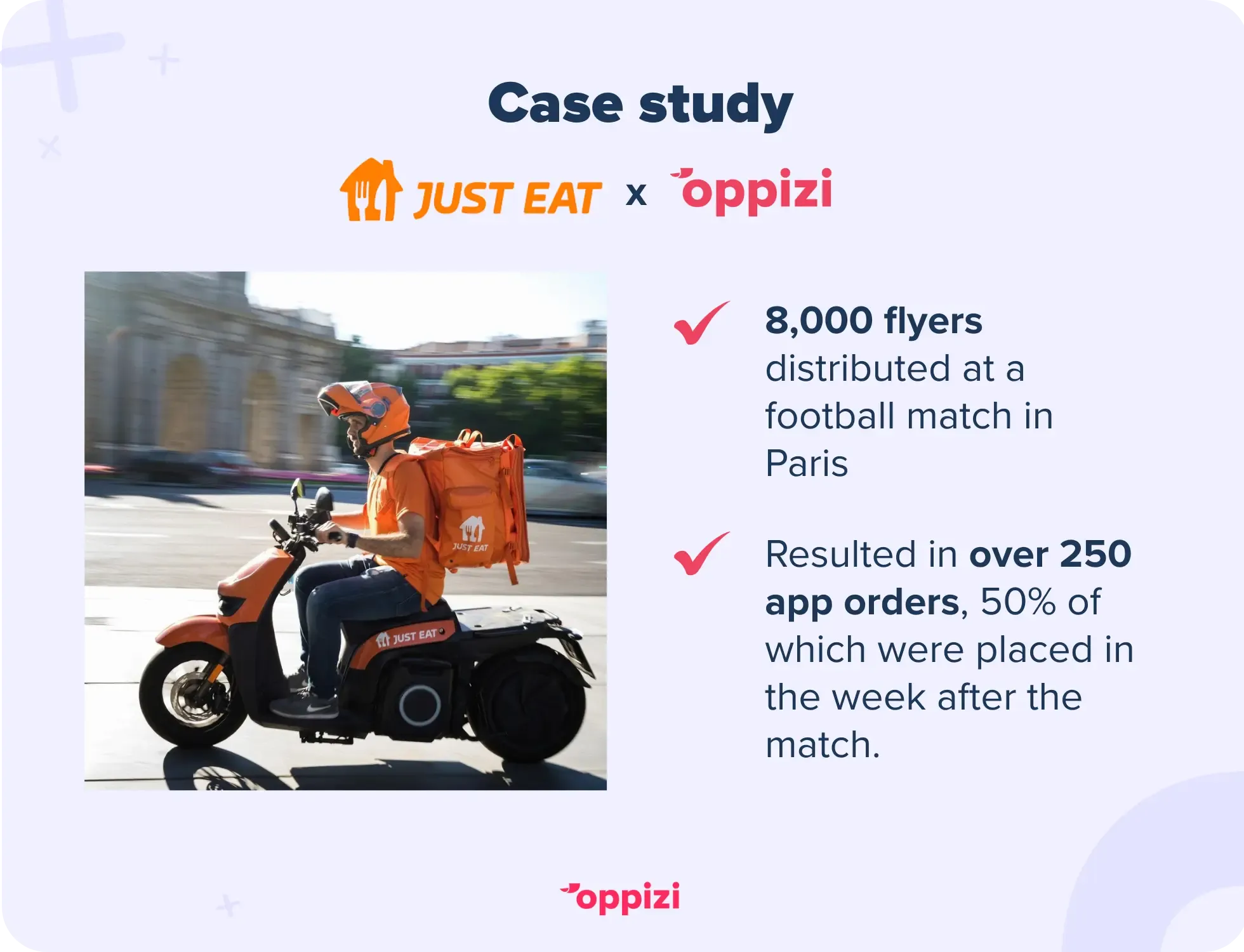
This campaign resulted in 250 app orders, with 50% of those placed in the first week alone, demonstrating the power of connecting offline experiences with digital channels:
- Immediate impact: The majority of conversions happened within days, proving the flyer-to-app journey was seamless and compelling.
- Memorable engagement: Face-to-face interaction with brand ambassadors created trust and recall that purely digital ads often struggle to achieve.
- Measurable ROI: By tracking flyer-driven app orders, JustEat could directly attribute sales to the offline activation, demonstrating true integration.
By combining offline touchpoints with digital conversion paths, Just Eat was able to turn a crowded sporting event into a customer acquisition channel.
How to measure offline performance
One of the biggest challenges offline marketing has faced historically is the ability to track and measure what actually works. Here’s how to close the loop:
- Custom promo codes can be monitored to see which print ads drive online sales
- QR code scans can be used to track engagement by measuring scans and attributing them to campaigns, placements, or regions
- POS integration to connect in-store purchases with email or social campaigns
- Surveys and feedback to uncover which touchpoints influenced decisions
- Cross-platform analytics (Google Analytics + offline conversion tracking) can help to understand the combined impact
This gives you a complete picture of how people move between channels, so you can refine and scale what’s working.
Offline integration: Do’s and don’ts
Do: ✔ Use unique tracking (QRs, codes, vanity URLs)✔ Centralize customer data in a CRM✔ Sync analytics tools for a holistic view✔ Personalize campaigns based on behavior
Don’t: ✘ Ignore offline data - it’s half the story✘ Use inconsistent branding across channels✘ Rely only on digital (offline still drives real-world action)✘ Overwhelm customers with touchpoints
In fact, when it comes to common mistakes in flyer campaigns, here’s what Alberto Granzo, Head of Operations at Oppizi Spain, had to say:
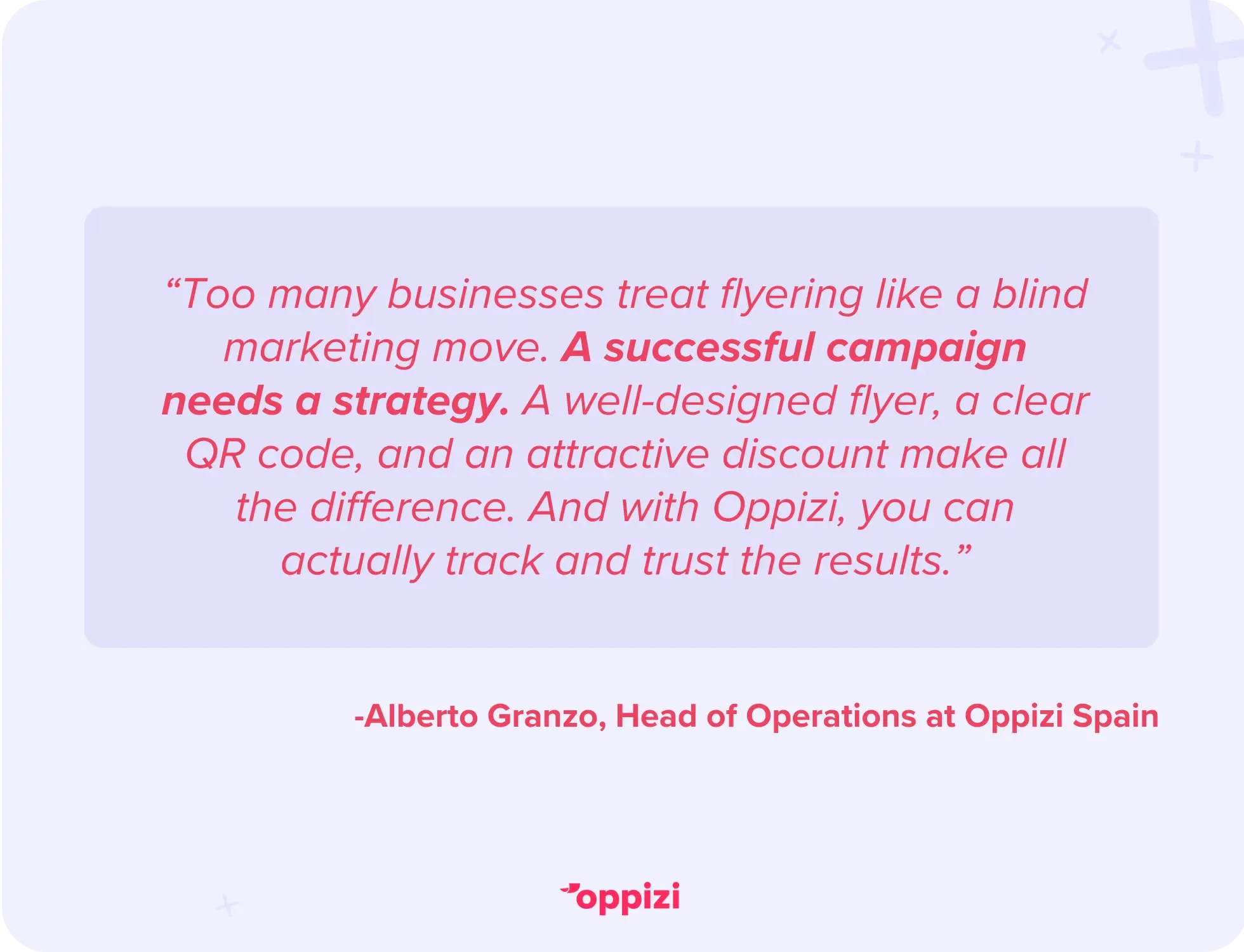
This is the key to connecting offline and online. With digital touchpoints like QR codes or trackable discounts, offline materials like flyers become a direct link to online engagement. That means you can prove ROI, refine campaigns based on data, and move customers seamlessly from a real-world interaction to a digital conversion.
Final thoughts
Customers don’t separate online and offline experiences, so your marketing shouldn’t either. By connecting both worlds, you build a stronger brand presence, gather smarter insights, and create a seamless journey that keeps customers coming back.
Think of offline as your untapped growth lever. Test it alongside your digital campaigns, track the results, and see how much further your reach goes. With Oppizi, you don’t just hand out flyers, you run data-driven offline campaigns that integrate seamlessly with your digital strategy.
Ready to experiment with offline marketing? Start a targeted campaign with Oppizi that plugs directly into your digital strategy.