Last updated July 28, 2026
Most marketers and product managers have mastered A/B testing online. You change a button color, swap a headline, or adjust pricing, and set up a test on an A/B testing platform to find out which version performs better.
But what happens when you want to test something physical, like your store’s entryway setup that customers see when they walk inside? You can’t just split-test this with a line of code.
And yet, these physical interactions matter just as much, sometimes more, than online ones. How do you know which store layout drives higher basket sizes? Which flyer design pushes more redemptions? Which staff script converts more upsells?
That’s where offline A/B testing comes in. It brings the discipline of experimentation into real-world environments so you can make smarter, data-driven decisions offline.
In this guide, we’ll show you exactly how to design, run, and analyze offline A/B testing, share key industry insights, and explain how Oppizi can help make it scalable across locations.
What is offline A/B testing?
Offline A/B testing (also called offline split testing or real-world A/B testing) applies the same logic as digital experiments, but in physical environments.
Instead of serving version A or B of a webpage, you test different store displays, promotions, signage, or service scripts. You compare how each performs against KPIs like sales lift, conversion rate, dwell time, or customer acquisition.
Done right, it lets you:
- Eliminate guesswork in retail and CPG marketing
- Validate promotions before rolling them out system-wide
- Understand customer behavior in real environments
- Measure ROI on physical campaigns like flyers or direct mail

Why offline A/B testing is worth the effort
Running tests offline is trickier than online because physical environments introduce challenges you can’t always control:
- Harder randomization – You can’t split customers 50/50 like online. Instead, you’re dealing with whole stores or regions, which may differ in traffic, demographics, or sales patterns.
- External factors – Weather, local events, or holidays can skew results, making it harder to isolate the impact of your test.
- Staff variability – Employees don’t always deliver promotions or scripts the same way, and small differences in execution can influence outcomes.
However, even with these hurdles, the payoff is worth it with:
- Data-driven improvements to store layouts, signage, and promotions.
- Smarter allocation of spend based on what works in the real world.
- Reduced rollout risk by validating ideas before scaling.
- Stronger customer insights by learning how people actually interact with products, signage, and promotions in the physical world.
- Competitive advantage. Many companies still rely on intuition for offline campaigns; running experiments lets you make decisions based on real results.
- Cross-channel learning. Insights from offline experiments can inform online campaigns, creating a feedback loop that strengthens overall marketing performance.
And there are already businesses that clearly see the value. 58% of companies now use A/B testing to optimize conversion rates, and the global A/B testing tools market is projected to grow at 14% annually through 2031.
Experimentation is not just a digital discipline—it’s a competitive advantage offline too.
Step-by-step: How to run offline A/B testing
1. Define your hypothesis & KPIs
Your test needs a measurable question. Examples:
- “Version A flyer will increase coupon redemptions by 10% compared to version B.”
- “Layout A will increase basket size by $5 compared to layout B.”
Choose KPIs that matter, like sales per customer, conversion rate, upsells, and dwell time.
2. Randomize across physical locations
Online, randomization is simple. Offline, you need to be creative. Here are some tips on how to do this:
- At the store level: Assign whole stores to group A or B.
- Pair-match stores: Match two stores with similar sales, size, or demographics; assign one as the control and the other as the variant.
- Rotate over time: If limited stores are available, alternate A and B weekly.
This approach reduces bias, ensuring that the results accurately reflect your test variable rather than geographical differences or customer demographics.
3. Calculate sample size & duration
For an offline A/B test to give you trustworthy results, you need enough people (or stores) in the experiment. If your sample is too small, you might miss the impact altogether.
Think of it this way:
- Sample size = how many customers or stores you include.
- Test duration = how long you run the experiment.
Together, these determine whether you’ll actually see the difference between version A and version B.
For example, say you expect a 5% increase in sales from your test, but your setup can only reliably detect changes of 8% or more. That means your test might not pick up the smaller (but still valuable) improvement. To fix this, you can either:
- Run the test for longer, or
- Include more stores/customers in the experiment.
The bigger the sample, the easier it is to spot real differences.
4. Control for real-world “noise”
Unlike online tests, the offline world is full of unpredictable factors that can throw off your results. Sales might spike because of a holiday weekend, a local festival, or even just because one employee happens to be great at upselling.
To make sure your test results reflect the change you’re testing, try to:
- Leave out unusual stores that don’t represent typical customer traffic.
- Run tests at comparable times, like matching weekdays with weekdays, so you’re not comparing a Monday slump to a Saturday rush.
- Train staff carefully, so they deliver the promotion, signage, or script in the same way at each location.
The goal is to minimize distractions so the only real difference between groups is the thing you’re testing.
5. Collect & analyze data
Pull data from POS systems, loyalty cards, foot traffic counters, or coupon redemptions. Compare performance between A and B groups using percentage lift, not raw numbers, to avoid bias from store size differences.
For example:
- Store A (control): 1,000 redemptions
- Store B (test): 1,200 redemptions→ 20% lift
Applying statistical tests like a t-test or chi-square test can help you confirm whether the difference is significant or just a random fluctuation.
6. Validate results & roll out
Once the winning variant is identified, it's time to scale it. If the results are not significant, do not dismiss the experiment; instead, refine the design, prolong the duration, or test different variables. Iteration is key to achieving long-term success.
Creative ways to A/B test print campaigns
Flyers, direct mail, and door hangers aren’t just for broad awareness, they’re perfect for structured A/B tests too. Here are a few variables you can experiment with:
- Design & visuals – Test a bold, image-heavy flyer versus a minimalist design. Do customers respond more to lifestyle imagery or to clear product shots?
- Call-to-action – Try two versions of the same flyer: one with a discount code, another with a QR code linking to a free trial or booking page. Track which generates more redemptions.
- Offer type – See if your audience reacts more strongly to “20% off” or “Buy One Get One Free.”
- Distribution method – Test hand-to-hand flyering in busy transit hubs against direct mail to residential addresses. Which channel brings in higher-quality leads?
- Timing – Send the same flyer design in two waves (e.g., midweek vs. weekend) to see when engagement peaks.
As Alberto Granzo, Head of Operations at Oppizi, puts it:
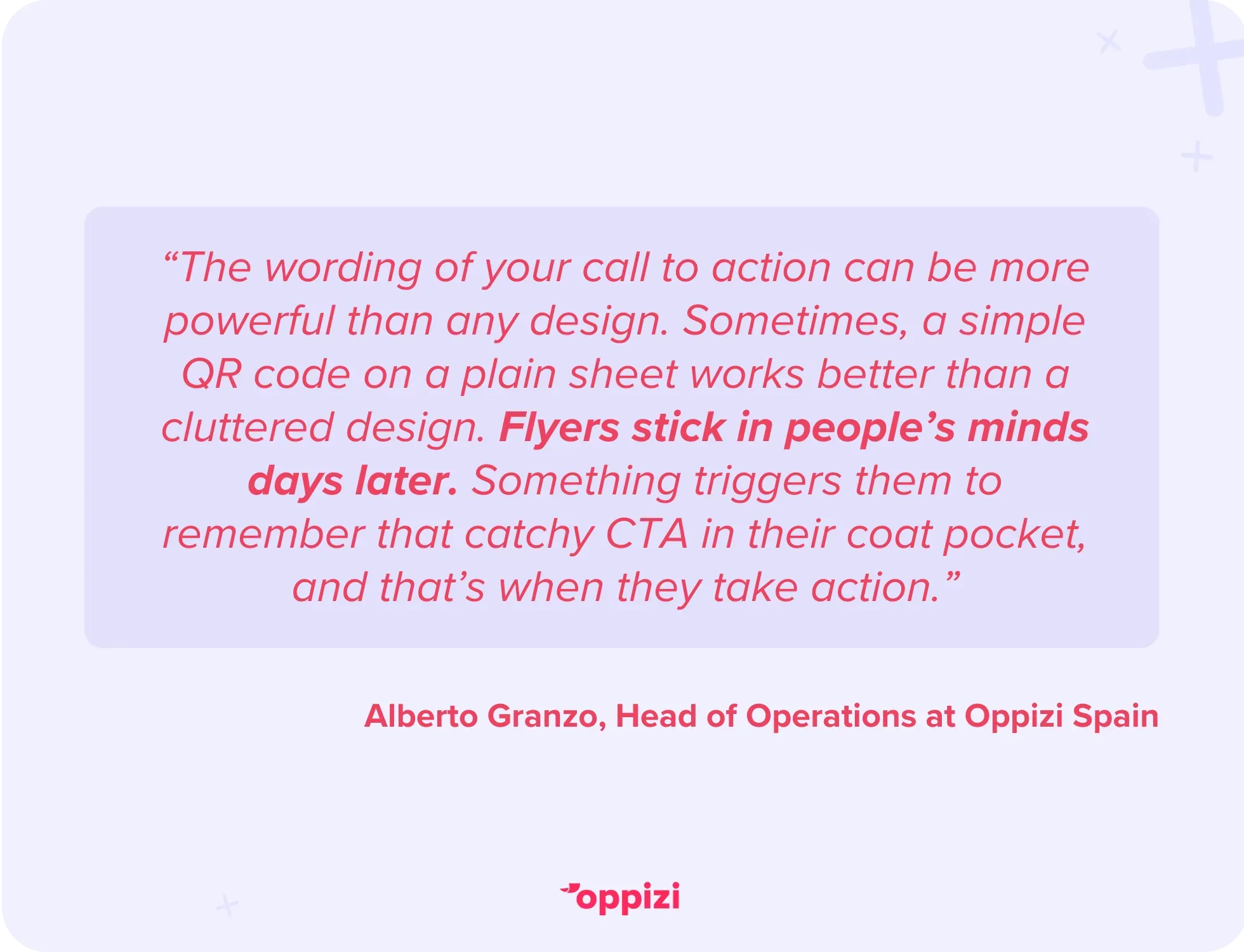
These kinds of tests not only sharpen your campaign performance but also build a playbook of what messaging, visuals, and timing resonate most with your audience.
Real-world examples of offline A/B testing
Here are some practical ideas that different industries can use to apply offline A/B testing:
- Retail chains: Test different end-cap displays in matched stores. The version that drives higher sales per customer gets rolled out chain-wide.
- Restaurants: Distribute two flyer designs across neighborhoods with similar demographics; track redemption rates to see which creative resonates.
- Healthcare providers: Compare signage wording (“check-in here” vs. “please register”) to see which reduces waiting times.
- Banks: Test branch layouts. Does a self-service kiosk reduce teller queue times?
These experiments may sound simple, but the ROI impact can be substantial when scaled.
How Oppizi makes offline A/B testing scalable
Oppizi’s platform is designed to help solve the pain points associated with offline A/B testing. Here’s how:
- Smart segmentation & randomization: Assigns stores, locations, or flyer batches into clean test/control groups, ensuring balanced comparisons.
- Data consolidation: Syncs redemption data, QR scans, POS inputs, and footfall into one dashboard for easy analysis.
- Real-time dashboards: Track performance, confidence intervals, and ROI as campaigns run, meaning you don’t have to wait weeks for reports.
- Scalable rollouts: Once a test proves effective, Oppizi helps you replicate the winning strategy across entire regions or chains.
- Omnichannel reach: From flyer distribution and door hangers to direct mail, Oppizi gives you controlled distribution channels that make offline experiments measurable.
In short, Oppizi takes the messiness out of offline testing and gives you the rigor you’d expect from digital.
Conclusion
Offline A/B testing may not seem as straightforward as digital, but it’s just as powerful. With clear hypotheses, smart randomization, and reliable measurement, you can turn your stores, branches, or campaigns into environments for continuous experimentation and improvement.
And you don’t have to do it alone. With Oppizi, you can execute and analyze offline experiments with ease, delivering real, scalable insights.
Ready to put your offline campaigns to the test? Start a campaign with Oppizi today and transform guesswork into data-driven growth.