Last updated November 11, 2026
Summary
- EDDM is a USPS direct mail program that delivers to every address on the carrier routes you choose, with no mailing list
- The USPS EDDM tool filters routes by age, income, and household size, but it can't pick individual households, which is what addressed mail is for
- EDDM Retail postage is $0.260 per piece, and Oppizi EDDM runs about $0.45 all-in versus $0.54 to $0.65 for addressed mail with data included
- UK-measured JICMAIL data shows addressed mail earns the higher response rate while unaddressed mail often earns the higher return
- Use EDDM to cover a place, addressed mail to reach a person, and both together to turn neighborhood reach into customers
Last updated: November 2026
EDDM is a type of direct mail. Every Door Direct Mail is a USPS program that delivers the same piece to every address on the carrier routes you choose, with no mailing list. When people set "direct mail" against EDDM, they usually mean addressed direct mail: a piece printed with a named recipient's address and sent to a list you pick.
Both end up in the same mailbox. What changes is who you're paying to reach, and that's the decision this guide helps you make. In short: EDDM reaches a place, addressed mail reaches a person. Pick the one that matches what your campaign actually knows about its audience.
What is Every Door Direct Mail?
Every Door Direct Mail (EDDM) is a USPS saturation mail program that delivers your piece to every address on the carrier routes you select. You don't need names or a list. Pieces carry a simplified address such as "Postal Customer" or "Residential Customer." USPS puts one in every mailbox on the route. For a walkthrough of routes, targeting, and the USPS tool, see how EDDM works step by step.
A few things define how EDDM works in practice:
- You choose routes rather than people. You pick carrier routes, and every address you select on a route gets the piece.
- The piece has to be a flat. It must exceed 6.125 inches high, 11.5 inches long, or 0.25 inch thick (any one of the three), and weigh no more than 3.3 ounces. Our EDDM size requirements guide covers the formats that qualify.
- EDDM Retail has volume limits. You can send at least 200 and up to 5,000 pieces per ZIP Code per day, with no permit, and drop them at the Post Office with PS Form 3587. The full rule set lives in our USPS EDDM requirements guide.
- It's US-only. EDDM is a USPS product, so it doesn't exist outside the United States. Other countries have their own unaddressed mail services under different names and rules.
How does EDDM targeting work?
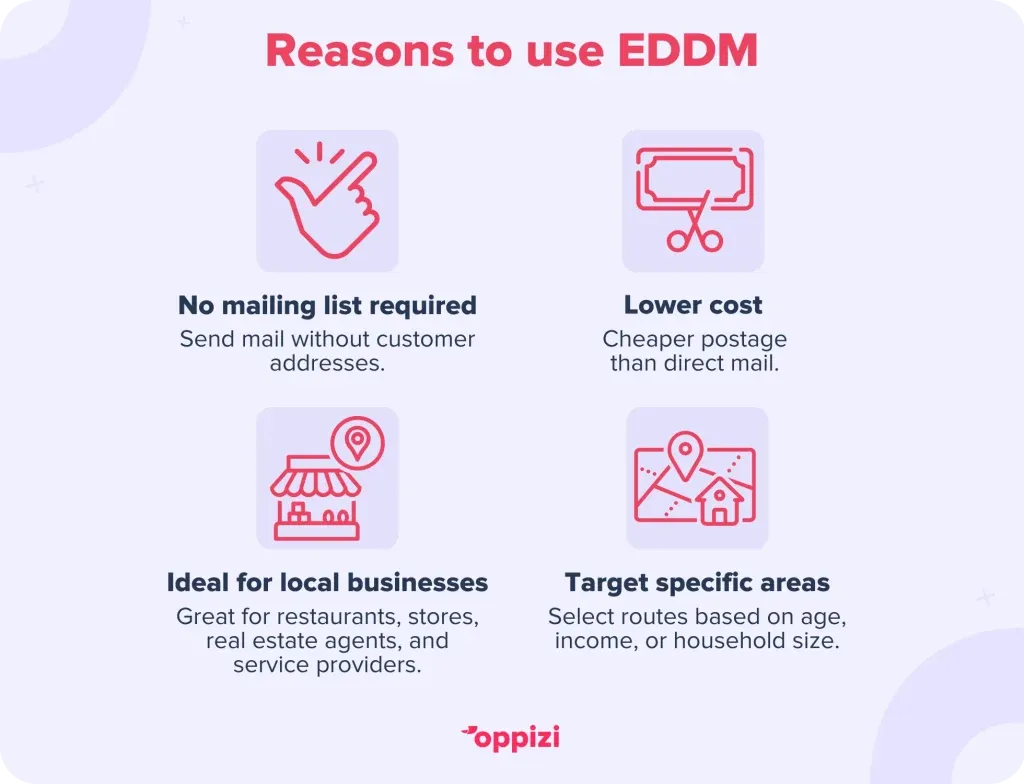
EDDM targets neighborhoods, not people: you choose which carrier routes to mail, and USPS delivers to the addresses on them. The USPS EDDM online tool lets you filter routes by age, income, and household size, using U.S. Census Bureau data, so you can favor routes that lean toward your audience.
Two more choices narrow it down. You can mail residential addresses only or every address on the route, and you can search the tool by address, city, or ZIP Code to find the routes around your location.
What you can't do is pick individual households. The demographic filters describe a route as a whole, so a route that skews toward higher incomes still includes every household on it, whatever its income or age. If household-level precision matters to your campaign, that's the job of addressed direct mail.
What counts as addressed direct mail?
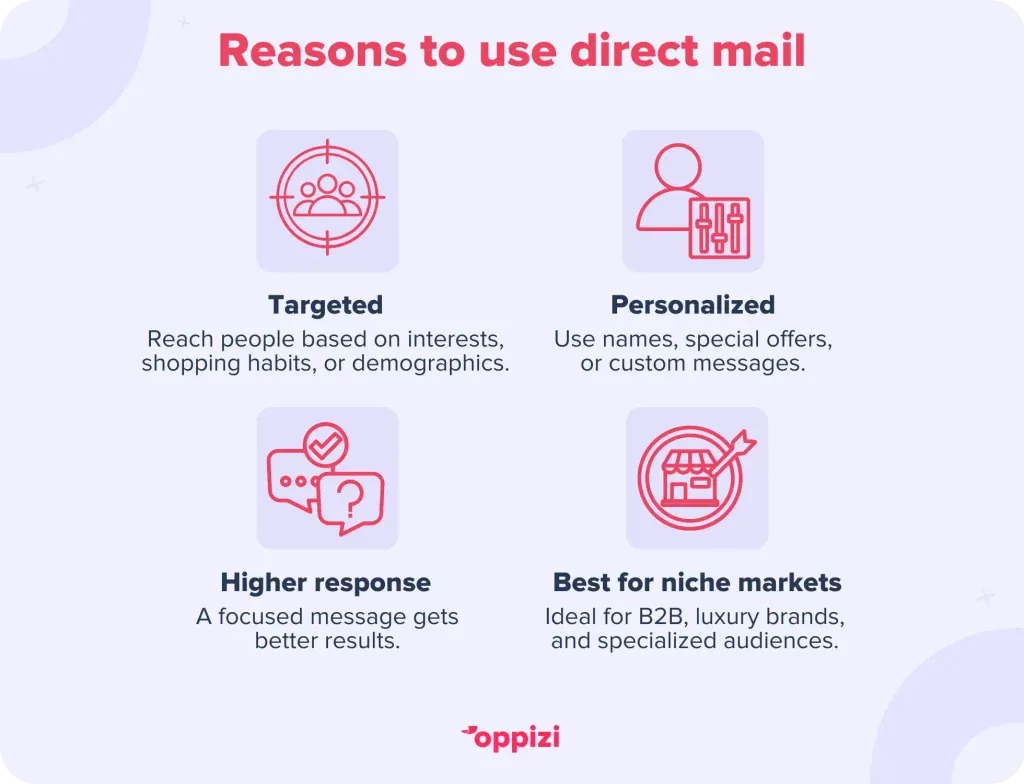
Addressed direct mail is any mailpiece sent to a specific, named recipient at a known address. You decide who gets it, either from your own customer data or from a mailing list built around the profile you want to reach.
Because every piece has a name on it, every piece can be different. Variable data printing lets you change the name, the offer, the image, or a unique promo code from one piece to the next. Formats are more flexible too: postcards, letters, self-mailers, and catalogs all work.
The trade-off is that the list becomes part of the job. A list needs address verification and upkeep, and your reach tops out at the number of qualified names you have. If you have 10,000 good prospects, that's your campaign until you add more data.
When you compare addressed mail providers, check what the per-piece price actually covers, starting with whether the list data is included and whether there's a platform fee on top. Addressed direct mail through Oppizi runs $0.54 to $0.65 per piece with data included and no monthly platform fee.
How is EDDM different from addressed direct mail?
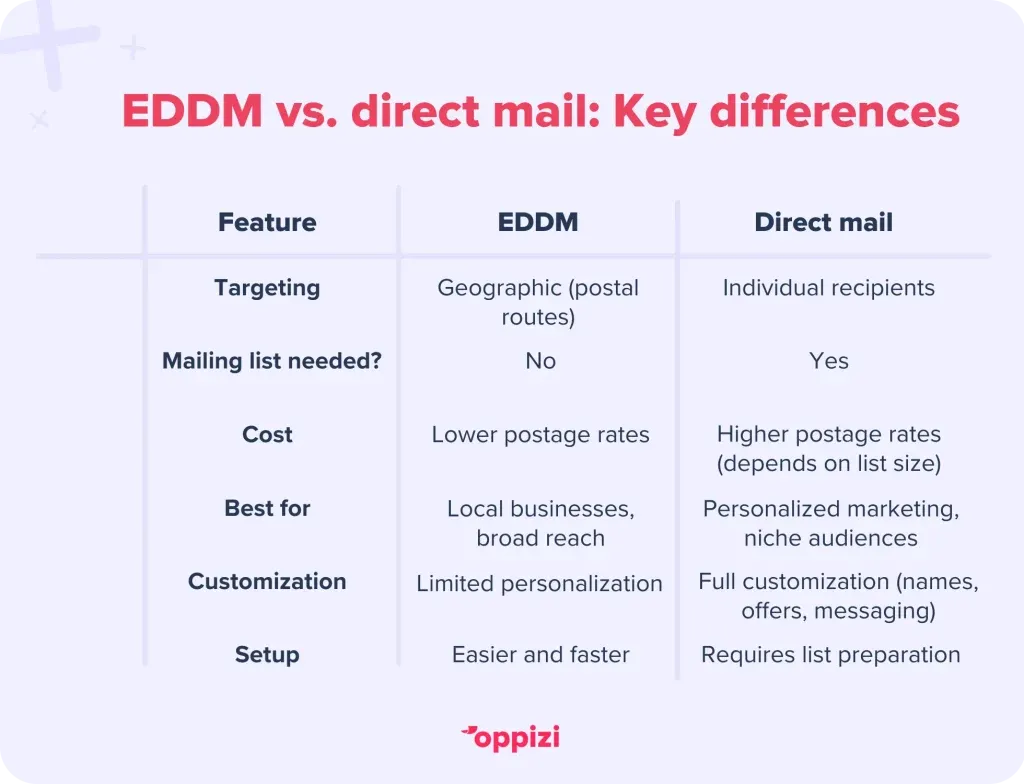
EDDM and addressed direct mail differ on three things: who the piece is addressed to, how you target, and what you pay per piece. Everything else follows from those.
- Who it's addressed to. EDDM goes to a route, addressed to "Postal Customer." Addressed mail goes to a named person.
- How you target. EDDM targets geography, using route-level data to choose neighborhoods. Addressed mail targets households, using whatever attributes your list carries.
- What it costs. EDDM Retail postage is $0.260 per piece on the USPS price list effective July 12, 2026, and commercial saturation flats entered at the delivery unit with a permit run $0.258. With printing and distribution included, an Oppizi EDDM campaign runs about $0.45 per piece all-in. Addressed direct mail through Oppizi runs $0.54 to $0.65 per piece with data included, so the list is part of the price rather than a separate purchase. Neither carries a monthly platform fee.
Here's how the two compare side by side:
| EDDM | Addressed direct mail | |
|---|---|---|
| Addressed to | "Postal Customer" or "Residential Customer" | A named recipient |
| How you target | Carrier routes, filtered by age, income, and household size data | Individual households, by whatever your list carries |
| Mailing list needed | No | Yes, your own data or a built list |
| Personalization | None, every piece is identical | Name, offer, image, and promo code can change per piece |
| Mailpiece format | Flats only: over 6.125 in high, 11.5 in long, or 0.25 in thick; max 15 x 12 x 0.75 in and 3.3 oz | Postcards, letters, self-mailers, and catalogs |
| USPS postage | $0.260 per piece (EDDM Retail), $0.258 for commercial saturation flats with a permit | Depends on format and mail class |
| Price through Oppizi | About $0.45 per piece all-in | $0.54 to $0.65 per piece, data included |
| Permit and paperwork | None for EDDM Retail; PS Form 3587 at the Post Office | Handled by Oppizi when you mail through the platform |
| Volume | 200 to 5,000 pieces per ZIP Code per day (EDDM Retail) | No per-ZIP daily cap |
Cheaper per piece isn't automatically cheaper per customer. If most of a route will never buy from you, EDDM's lower price buys a lot of wasted mailboxes, and the number that matters is your customer acquisition cost. For EDDM budgets in detail, our EDDM cost breakdown and EDDM cost calculator do the math.
When should you use EDDM?
Use EDDM when your offer works for almost everyone in an area and you don't have, or don't need, a list of who lives there. It's the faster, lower-cost way to cover a neighborhood.
It fits best when:
- Your customers are defined by where they live. Restaurants, home services, gyms, real estate agents, and local retail serve a radius, and EDDM covers that radius door to door.
- You're opening something. A new location, a grand opening, or a seasonal promotion needs the whole neighborhood to hear about it at once.
- You're entering a market with no customer data. EDDM lets you launch before you've built a list, and the people who respond start building it for you.
- Your offer is broad. A pizza deal or a free first class appeals to most households, so paying to target individuals adds cost without adding much precision.
When should you use addressed direct mail instead?
Use addressed direct mail when you know who you want to reach and the right message depends on who they are. It costs more per piece, and that extra spend buys precision.
It fits best when:
- Your buyer fits a narrow profile. Financial services, B2B offers, and premium products sell to a narrow slice of any neighborhood. Mailing the whole route pays for doors that were never going to answer.
- You're talking to people you already know. Lapsed customers, past inquirers, and people who abandoned a purchase are easier to win back by name, with an offer based on what they did.
- The offer is personal. A personalized mail piece with a name, a tailored offer, and a unique code gives the recipient a reason to act that a generic piece can't.
- You need to know exactly who responded. Unique codes per recipient tie a response back to a household, which makes testing offers and audiences much cleaner.
Which one should you pick for your campaign?
Pick based on what you know about your audience and what the campaign needs to prove. This table maps the most common situations to a starting point.
| Your situation | Start with | Why |
|---|---|---|
| New location, need the neighborhood to know | EDDM | Covers every door in the trade area with no list |
| Broad offer that suits most households | EDDM | Lowest cost per piece for wide local reach |
| No customer data in a new market | EDDM | Launches without a list and helps build one |
| Narrow buyer profile (income, business type, or life stage) | Addressed direct mail | Pays only for households that fit |
| Winning back lapsed or past customers | Addressed direct mail | Names, history, and tailored offers |
| Testing offers and need clean attribution | Addressed direct mail | Unique codes per recipient |
| Launching in a market and converting interest | Both | EDDM for reach, addressed mail for follow-up |
If you're still torn, ask one question: does knowing someone's name change what you'd say to them? If the answer is no, EDDM is usually the better buy. If the answer is yes, the name is worth paying for.
What response and return should you expect from each?
Addressed mail usually earns the higher response rate, and unaddressed mail often earns the higher return on spend. The JICMAIL Response Rate Tracker, which measured 4,939 UK campaigns through matchback and tracking codes rather than by survey, puts cold addressed mail at a 1.0% average response rate and door drops (the UK's unaddressed equivalent of EDDM) at 0.3%. These are UK-measured figures, and there's no US equivalent of the tracker.
Return tells a different story. On the same UK-measured data, cold addressed mail returns 2.1 times the campaign cost in revenue, and door drops return 4.0 times the campaign cost in revenue. For cold addressed mail, return rises with scale, reaching 2.7 times the campaign cost in revenue above 100,000 pieces.
So neither channel wins on every measure. Addressed mail gets more people per thousand to act, and unaddressed mail gets more revenue per dollar when the offer is broad enough. Whichever you run, track EDDM responses with offer codes, landing pages, or call tracking numbers so you can compare your own results against these benchmarks.
Can you run EDDM and addressed direct mail together?
Yes, and for many campaigns that's the strongest setup, because each channel covers what the other can't. EDDM builds reach in a geography, and addressed mail turns the people who raised their hand into customers.
Three common ways to layer them:
- Reach, then convert. Saturate a trade area with EDDM, collect sign-ups or inquiries from the people who respond, then follow up with addressed mail personalized to what they asked about.
- Enter a market, then nurture. Use EDDM to introduce a new location, then mail your growing customer list with offers that bring them back.
- Split by audience. Run EDDM for a broad seasonal promotion, and send addressed mail with a better offer to your best existing customers.
How does Oppizi handle EDDM and addressed direct mail?
Oppizi runs both from one platform, along with package inserts and flyering, so you can plan, launch, and track every offline channel in one place. EDDM and addressed direct mail sit side by side in Oppizi OS, with campaign tracking and attribution built in, so the results from a route-based drop and a named mailing land in the same reporting.
Pricing stays simple: about $0.45 per piece all-in for EDDM, $0.54 to $0.65 per piece for addressed direct mail with data included, and no monthly platform fee. Oppizi has distributed more than 306 million pieces globally since 2014, across over 12 countries.
Ready to put the right piece in the right mailbox? Plan your first EDDM or addressed direct mail campaign with Oppizi.
Frequently asked questions
- Is EDDM considered direct mail?
Yes. EDDM is a form of direct mail, delivered by USPS to every address on the carrier routes you choose. What sets it apart is that it's unaddressed: pieces go to "Postal Customer" rather than a named person. When people compare EDDM with direct mail, they usually mean addressed direct mail sent to a specific list.
- Is EDDM cheaper than addressed direct mail?
Per piece, yes. EDDM Retail postage is $0.260 per piece, and an Oppizi EDDM campaign runs about $0.45 per piece all-in. Addressed direct mail through Oppizi runs $0.54 to $0.65 per piece with data included. Per customer, it depends on your offer: EDDM also pays to reach households that were never likely to buy.
- Do I need a mailing list for EDDM?
No. EDDM doesn't use a mailing list. You select carrier routes, and USPS delivers to every address on them, using a simplified address such as "Postal Customer." The EDDM tool shows age, income, and household size data per route to help you choose, but you can't pick individual households within a route.
- Can I target specific households with EDDM?
No. EDDM delivers to every address on a route, so you target neighborhoods rather than people. You can choose routes whose age, income, or household size data fits your audience, and you can select residential addresses only. If you need to reach specific named households, addressed direct mail is the channel built for that.
- Which gets a better response, EDDM or addressed direct mail?
Addressed mail usually gets the higher response rate. UK-measured JICMAIL data puts cold addressed mail at 1.0% and unaddressed door drops at 0.3%. Unaddressed mail often wins on return, though: door drops return 4.0 times the campaign cost in revenue, against 2.1 times for cold addressed mail, on the same data.
- Can I use EDDM outside the United States?
No. EDDM is a USPS program and only exists in the United States. Other countries run their own unaddressed mail services with different names, rules, and pricing, set by each national postal operator. If you're planning campaigns in more than one country, check what the local postal operator offers before you design the piece.