Last updated July 28, 2026
Nowadays, connecting with customers through their mobile phones is no longer optional—it’s essential. With mobile usage steadily increasing, businesses must decide the best approach to engage their audience effectively.Should you invest in a mobile app or a mobile website? Each option offers unique advantages and disadvantages that can shape your marketing strategy and impact the user experience.
Ultimately, your decision should align with your specific goals, budget, and the type of content you intend to deliver. To help you make the right decision, let’s break down the key differences, pros, and cons of each option.
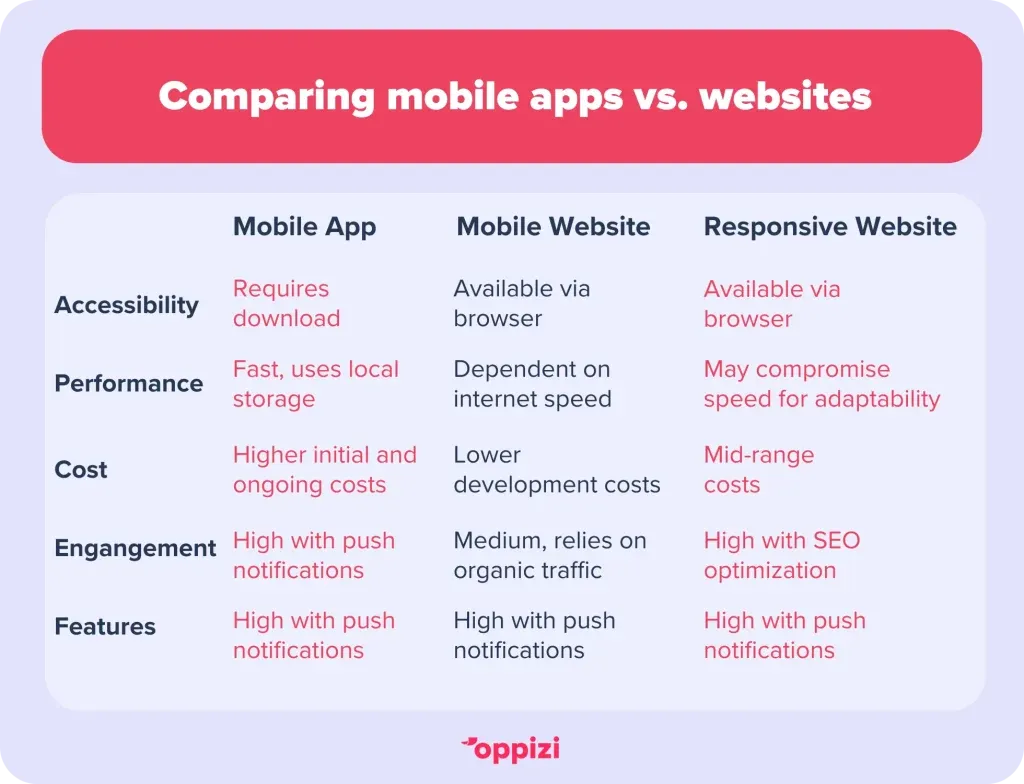
Mobile app vs mobile website vs responsive website
Let’s take a look at the differences between mobile apps, mobile websites, and responsive websites to be clear about what they all do.
- A mobile app is a software application made specifically for mobile devices like smartphones or tablets. Unlike websites, apps need to be downloaded and installed. Some are designed for specific platforms, such as Android or iOS, while others work on multiple different platforms.
- A mobile website is a site specifically designed for smaller screens, making them easier to use on mobiles and tablets. Typically, they have certain text sizes, images, and buttons that allow for clear and simple user interaction.
- A responsive website is a single website designed to adapt automatically to the screen size and resolution of any device. In other words, they’re websites that change in appearance depending on the device you access them from, be it a desktop, tablet, or smartphone.
Advantages of a mobile website
When you access a website on your mobile phone, the browser automatically redirects you to the mobile version, provided the company has one. If the website is responsive, it will adjust its layout based on the device you’re using.
But why not rely solely on a responsive website? Because having a mobile website comes with a number of advantages. Let’s explore them.
Broad compatibility
One significant advantage of mobile websites is their compatibility. They are built to support multiple devices and platforms, ensuring that users can access the information they need regardless of their device brand or type. This adaptability is particularly valuable for users with different devices.
Faster development and marketing
Mobile websites are faster to develop and market than mobile apps. Since they are accessed through the internet rather than app stores, they can be created and launched quickly, whereas apps must wait for approval from app stores before going live.

Wider reach and shareability
The broad compatibility of mobile websites allows them to reach a wide audience, regardless of device type. This is advantageous for promoting a business and expanding its reach. Additionally, mobile websites are more shareable, as their links can be easily distributed across various platforms.
Unlike mobile websites, apps lack sharing capabilities. Website links can be easily emailed, texted, or shared on social media platforms like Instagram and Facebook.
Easier support and maintenance
Mobile websites are easier to support and maintain than apps. Upgrading a website is typically less expensive since you only need to manage a single version. In contrast, apps require users to download each update, which can be costly and inconvenient.
With mobile websites, you can update content or design by making a single edit, and the changes automatically apply across all devices. This approach saves both time and money.
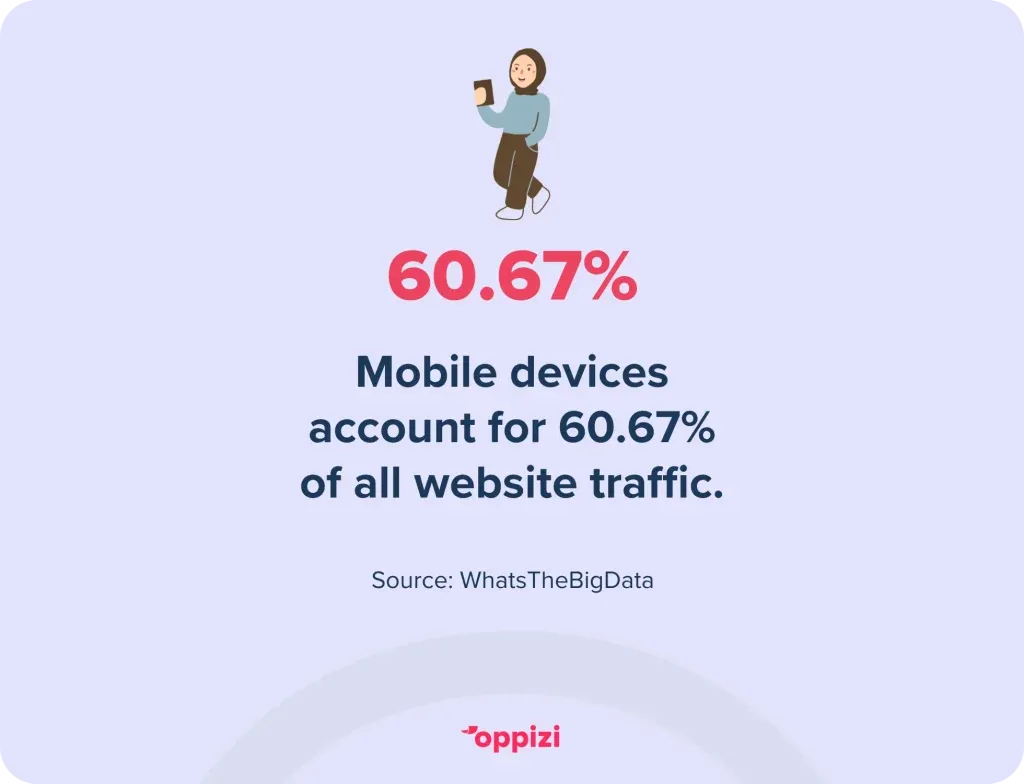
What’s more, as of 2024, 60.67% of website traffic comes from mobile devices.
Disadvantages of websites
While mobile websites are designed for various devices, they cannot leverage smartphone features as effectively as apps. Features like cameras, GPS, and phone dialing may not be fully accessible, even when viewed on smartphones.
Limited offline access
Another issue is that mobile websites do not offer offline access. Even with a streamlined design, their functionality is limited without an internet connection. A poor connection can lead to slow loading times or failure to load entirely, which can be inconvenient for tasks like quickly accessing banking sites for transactions.
Lack of app store presence
Websites are not available in app stores, which means users may be unaware of their existence. App marketplaces provide greater exposure and help expand your audience. With an app listed in an app store, you can advertise it, compare it to similar apps, categorize it, and even receive rankings against other apps with comparable functionality.
Design challenges on smaller screens
While mobile websites adjust to the device's screen size, they often struggle to display all information effectively on smaller screens, leading to design distortions. Text may be condensed, and some content may be omitted entirely. Designing a mobile website that consistently responds well without requiring users to pinch, rotate, or zoom can be challenging.
Advantages of a mobile app
A mobile app is a software application designed to run on mobile devices like phones, tablets, or smartwatches. Typically downloaded from app stores like the App Store (iOS) or Google Play, apps can function without internet access or use minimal data. They are optimized for small screens and offer highly interactive experiences.
Customization and personalization
Mobile apps offer greater options for customization and personalization. Users can adjust the app’s interface and features to their preferences, including personalizing the types of notifications they receive.
Offline capability
One of the main advantages of mobile apps is their offline capability. Since apps are downloaded directly to your device, they don’t rely heavily on a strong internet connection to function well.
Many apps also allow users to download specific features and data, making them especially useful for interactive tasks. This offline access means you can use the app anywhere, regardless of your internet connection.
Important Information accessibility
Mobile apps also enable users to download important information. For example, the AllTrails app lets you download trail routes for offline use while hiking.
Engaging push notifications
Mobile apps can send push notifications, which are effective for keeping users engaged with your content. Personalized notifications enhance app engagement by catering to users’ interests. This benefits users by providing important reminders, such as due payments or tasks, while also helping app creators boost user interaction through effective notification strategies.
Interactivity as a key feature
Many mobile apps are interactive, allowing users to engage with content through games, visualizations, and more. This interactivity captures users’ attention and serves as an effective educational tool.
Most apps incorporate some level of interactivity, but highly interactive games perform significantly better on apps than on mobile websites. By enhancing user engagement, interactivity can increase the time users spend on the app and make it more appealing and productive.
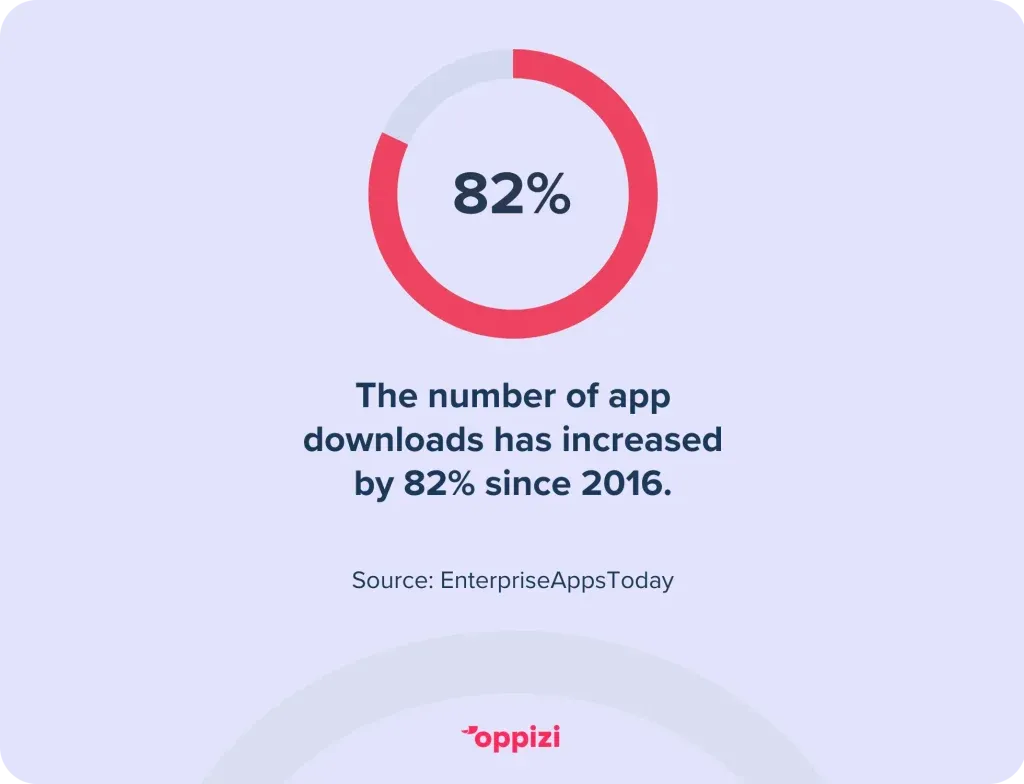
To put their popularity into perspective, app downloads have surged by 82% since 2016.
Overcoming the challenges of mobile apps
Mobile apps come with several notable disadvantages, primarily revolving around costs and user experience. Developing and maintaining an app is expensive, particularly when ensuring compatibility across iOS and Android platforms. Regular updates and bug monitoring add to the maintenance costs, with users needing to download updates to ensure functionality and security.
To address these challenges, businesses must invest in robust customer support to resolve issues and encourage retention, as users are more forgiving of websites than apps that fail to meet expectations. Check out our complete guide on the advantages and disadvantages of mobile apps to learn more.
Which is better for your business?
User preferences and engagement
Mobile user feedback shows that apps are generally more popular. Users value the customization options and interactivity that apps offer. Since apps are designed specifically for smartphones, content is always easy to read, unlike on websites.
Offline access and content delivery
Mobile apps can generate more engagement and interest in your content due to their interactive nature and features like notifications. They are an excellent choice for delivering content that needs to be accessed offline or on mobile devices.
Content type considerations
The type of content you develop influences whether an app or a mobile website is best for you. For instance, banking companies are increasingly prioritizing apps. Banking apps are successful because they are interactive, fast, and practical, enabling users to easily transfer money and check account balances from their smartphones.
Cost-effectiveness for text-based content
If your content is primarily text-based—like journal entries, how-to articles, or reviews—a mobile website is an excellent choice. Since these types of content require few interactive features, you can save time and money by opting for a mobile website instead of an app.
Budget considerations
If you have a low budget and are creating content that doesn’t require interaction or functionality, a mobile website may be the best choice. Conversely, if you have a higher budget, are developing interactive content, and need to provide functional usability for users, a mobile app is likely the better option.
Combining the online with the offline
Before choosing between an app and a website, consider your content goals, the type of content you are developing, and your budget. This will help you make an informed decision.
To maximize your marketing efforts, we suggest combining the strengths of both mobile apps and websites with a powerful offline strategy. At Oppizi, we specialize in amplifying your reach through tailored offline marketing solutions.
Whether you’re developing an app or optimizing your website, we can help you create a strategy that keeps you ahead of the competition.
Ready to boost your visibility and complete your marketing mix? Create an offline campaign with Oppizi today!