Last updated July 28, 2026
Franchising is one of the fastest ways to scale a business. With over 800,000 franchise establishments in the U.S. alone (representing more than 10% of all businesses), it’s clear this model isn’t slowing down.
But here’s the challenge: how do you market a brand that needs to feel consistent nationwide, but also personal in every local community?
For franchisors, the priority is protecting the brand and driving growth. For franchisees, it’s about winning customers in their neighborhood. When these two forces drift apart, the result is wasted ad spend, mixed messages, and missed opportunities.
That’s where smart franchise marketing strategies come in. Let’s break down the essentials that keep your brand strong while helping every location succeed.
What is franchise marketing?
Franchise marketing is the set of strategies and activities used to grow and sustain a franchise business. It has two main sides:
- Franchise development marketing – This focuses on selling the franchise opportunity itself. The goal is to attract new franchisees and investors who want to buy into the business model. Tactics here often include advertising on franchise directories, hosting discovery days, or running targeted digital campaigns aimed at entrepreneurs.
- Franchisee consumer marketing – This is all about driving customer sales for individual franchise locations. Think local SEO, direct mail campaigns, paid social ads, and community events—anything that helps franchise owners bring more people through their doors or onto their websites.
A strong franchise marketing strategy blends both approaches. On one hand, it builds national brand awareness and shows potential investors why the franchise is a solid business opportunity. On the other, it provides localized marketing support that drives foot traffic, phone calls, and online orders for each franchisee.
This combined approach strengthens business development and sales by creating a steady pipeline of potential franchise buyers and helping existing locations grow revenue. In other words, franchise marketing is about growing the network and the customers at the same time.

The 5 core strategies of effective franchise marketing
1. Balance control with local flexibility
Franchisors must maintain brand consistency, while franchisees need the freedom to market effectively in their community. The sweet spot is a hybrid system:
- HQ provides brand guidelines, templates, approved assets, and national campaigns.
- Franchisees adapt messaging for local events, demographics, or promotions.
This avoids brand dilution while ensuring ads resonate with real customers in the local area.
2. Prioritize local SEO
Many customers start their journey online. To stand out, each franchise location should:
- Claim and optimize its Google Business Profile.
- Use local keywords (“pizza delivery in Austin” vs. “pizza delivery”).
- Encourage and respond to reviews.
A Statista study found that 44.5% of businesses consider customer experience a key differentiator, and showing up in search with accurate, trusted information is part of that experience. If you’re marketing a wellness centre, for example, the real difference between you and a competitor might simply be how easily local customers can find you when they search.
3. Invest in digital marketing (and track it)
National campaigns build recognition, while targeted digital ads convert locally. A strong franchise digital marketing plan should include:
- SEO & content – blogs, guides, and location pages that rank.
- Paid ads (PPC) – Google Ads for local intent, retargeting campaigns.
- Social media – national storytelling paired with local engagement.
- Email marketing – corporate for big announcements, franchisees for local offers.
Digital tools like Google Analytics, CRM dashboards, and marketing automation help track ROI and guide both franchisors and franchisees on what’s working.
4. Don’t forget offline marketing
Many communities still respond strongly to traditional marketing. Franchises can use tactics like:
- Direct mail with coupons or store details.
- Flyers for grand openings or local events.
- Sponsorships of youth sports or community activities.
- In-store promotions and signage.
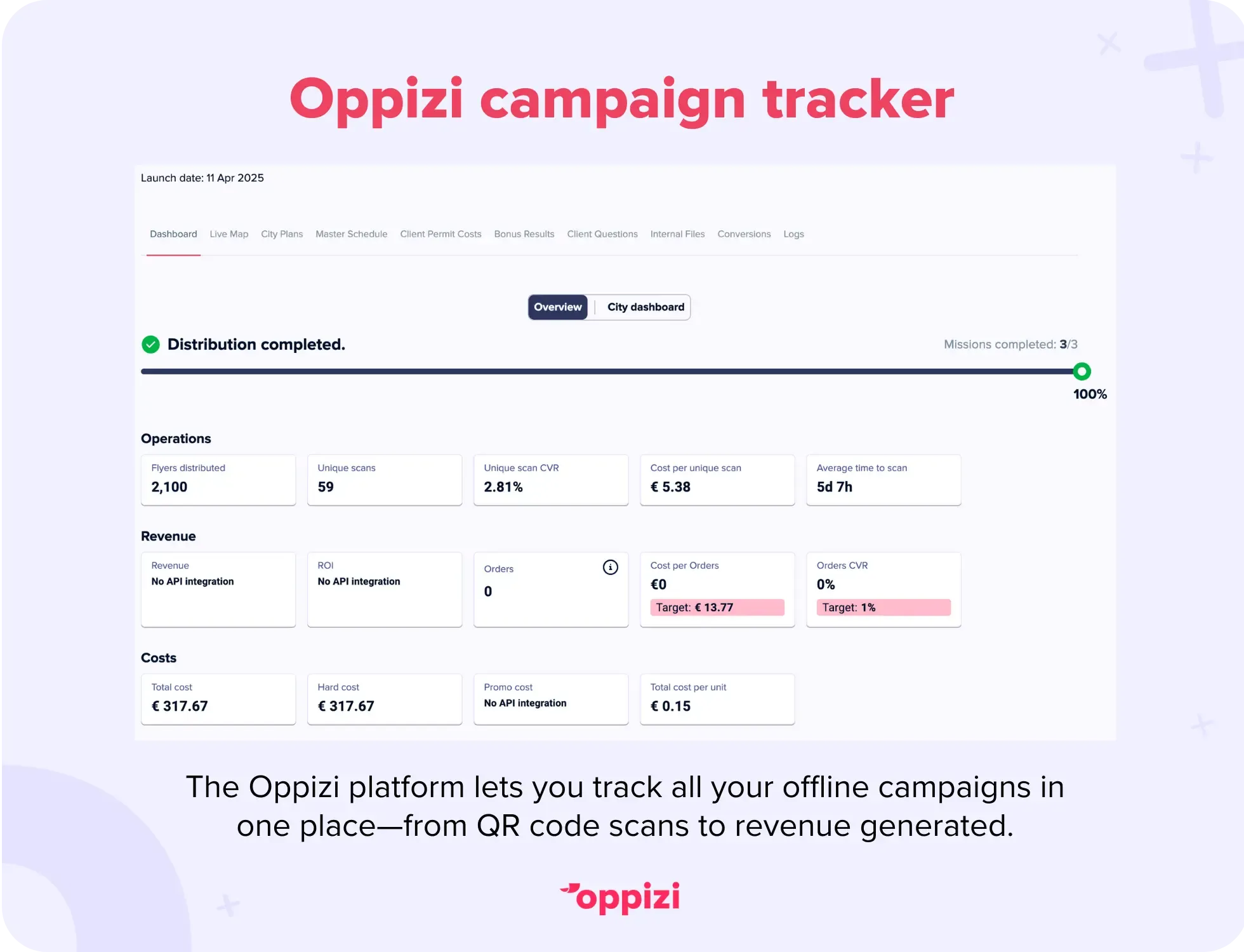
When combined with digital efforts, these campaigns create multiple touchpoints that reinforce the brand. And, what most people don’t realize is that, thanks to platforms like Oppizi, offline marketing is now as trackable as digital. With Oppizi’s campaign tracker, you can see exactly how your flyers or mailers are performing and make data-driven decisions. Take a look:
5. Measure what matters
Like with all marketing, it’s important to track your efforts to find out what works and what doesn’t. Both HQ and local operators should track KPIs such as:
- Website traffic (national + local).
- Franchise lead volume.
- Store visits, calls, or online orders.
- Customer reviews and ratings.
- Cost per lead and conversion rates.
Regular reporting helps identify what’s working and where budgets need adjusting.
Step-by-step guide: How to set up a franchise marketing strategy
Step 1: Define your goals
Decide whether your focus is franchise lead generation, local customer growth, or both. From there, set SMART goals with clear strategies for achieving them.
Step 2: Know your audience
Define who you’re speaking to. Build simple profiles for both franchisees (e.g., their challenges, motivations, and decision factors) and local customers (e.g., demographics, buying habits, and pain points). This helps you tailor messaging that resonates with each group.
Step 3: Build a brand playbook
Create a clear guide that documents your logos, colors, tone of voice, and brand rules. Include examples of how messaging should sound across digital and offline channels. A playbook keeps your brand consistent across all locations, no matter who is running the local marketing.
Step 4: Get the basics right online
Make sure each location is visible and credible online. Optimize Google Business Profiles with correct info, photos, and posts. Create local landing pages that rank for “near me” searches. Encourage franchisees to actively manage and respond to reviews as this builds trust and drives foot traffic.
Step 5: Choose your channels
Select the right marketing mix. Use digital tactics like SEO, PPC ads, social media, and email to drive leads, while supporting them with offline strategies like direct mail, community sponsorships, and events. The best approach blends online reach with local, on-the-ground visibility.
Step 6: Equip franchisees
Make marketing easy for franchise owners by giving them the tools they need. Provide ready-to-use templates, campaign kits, social posts, content calendars, and simplified marketing guides. This empowers franchisees to stay on-brand without needing expert-level skills.
Step 7: Track performance
Focus on a few key metrics that align with your goals, such as cost per lead (CPL), review ratings, or in-store foot traffic. Monitor them regularly and share insights with franchisees so they understand what’s working and where to improve.
Step 8: Test, learn, repeat
Treat marketing like an ongoing experiment. Start small, measure results, and double down on the strategies that deliver. Once a campaign proves successful, scale it across more locations for consistent growth.

Franchise marketing framework
Think of franchise marketing as a layered system:
- National brand marketing → Awareness campaigns, PR, paid ads.
- Local franchise marketing → SEO, community engagement, social, direct mail.
- Technology backbone → CRM, automation, analytics, review monitoring.
- Collaboration & support → Dashboards, franchisee training, co-op ad budgets.
When these layers work together, the customer experience feels consistent whether someone walks into your franchise in Boston or San Diego.
How Oppizi helps with local offline campaigns for franchisees
Oppizi makes it simple for franchise brands to run consistent, measurable offline campaigns at scale. Whether it’s flyer distribution, direct mail, or door hangers, Oppizi handles the logistics, from printing to delivery, ensuring every franchisee stays on-brand while targeting their specific local audience.
With advanced tracking technology, you get full visibility into campaign performance, so franchisees can focus on connecting with their community while you keep control of brand standards and ROI.
For example, Chipotle partnered with Oppizi to support its franchisees in Paris and Lyon. Using a dual-channel flyer strategy, they distributed 10,000 flyers hand-to-hand and 19,000 door-to-door, each featuring a “buy one, get one free” offer. This led to over 550 in-store purchases in just 4 weeks—a clear demonstration of how localized offline campaigns for franchisees can drive measurable growth.
Conclusion
Franchise marketing is about building a bridge: keeping your brand identity consistent while giving local operators the tools and freedom to connect authentically with their community. The strongest systems combine structure, support, and smart tracking, helping franchises grow nationally while thriving on a local level.
Offline marketing is often the missing piece in that puzzle. It brings your brand off the screen and into people’s hands, creating real-world touchpoints that drive trust, awareness, and foot traffic. When done well, campaigns like flyers, direct mail, and local sponsorships don’t just boost sales; they give franchisees a powerful way to show up in their neighborhoods and win loyal customers.
Want to give your franchisees a proven, trackable way to reach more customers where they live and shop? Partner with Oppizi to launch your next offline campaign today!