Last updated July 28, 2026
There’s one channel that remains the top contender for B2B communication: email marketing. When done right, it’s incredibly effective at nurturing leads, building relationships, and driving conversions. And, with billions of active email users worldwide, targeted B2B email campaigns are not only advantageous but essential for reaching key decision-makers.
By providing relevant information, demonstrating expertise, and showcasing solutions, emails in B2B marketing are a key strategy for driving conversions and building long-term business relationships.
In this guide, we’ll break down everything you need to know about B2B email marketing, from what it is to how to build a winning strategy, best practices to follow, and mistakes to avoid.
What is B2B email marketing?
B2B (business-to-business) email marketing involves sending targeted email campaigns from one business to another. The goal? To educate, engage, and convert business prospects into leads or customers.
Unlike B2C emails, which tend to be more emotionally driven, B2B emails are often more informative and value-driven. You’re talking directly to decision-makers - people who are looking for ROI, efficiency, and long-term solutions to their problems. That means your content needs to be smart, relevant, and strategic.
By segmenting your audience, personalizing content, and analyzing campaign performance, you can ultimately drive higher conversion rates and build stronger business relationships.
Why B2B email marketing works
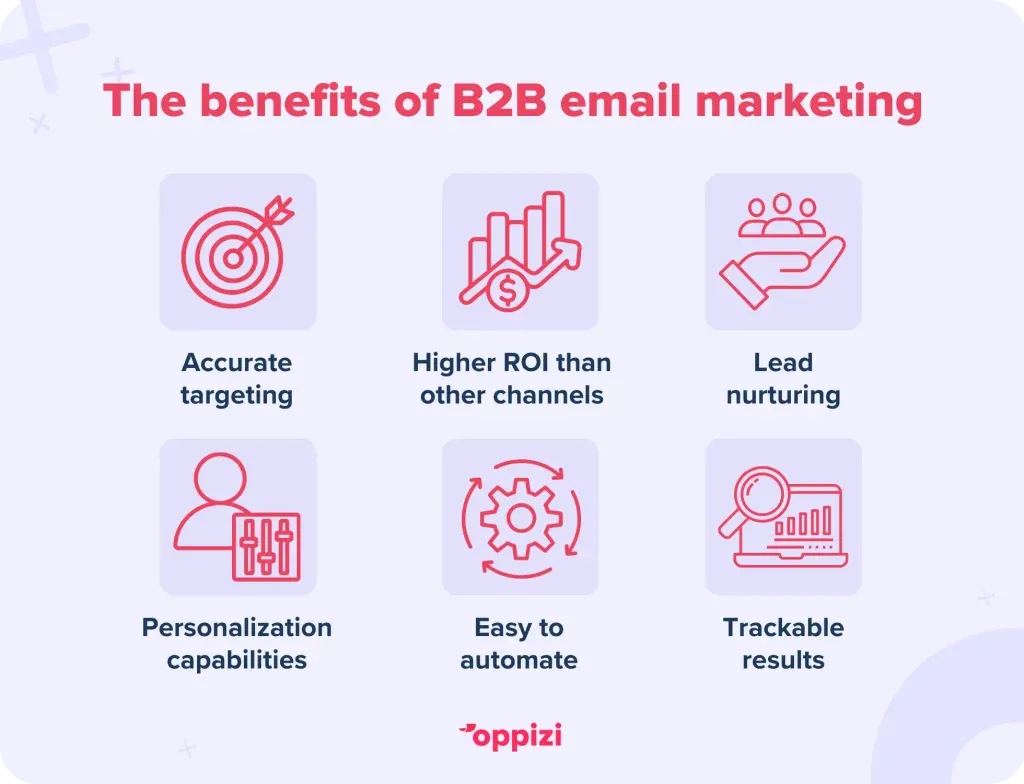
Let’s take a look at some of the key benefits of having a strong B2B email marketing strategy:
- Better targeting: Deliver tailored messages to specific audience segments for more effective, relevant communication.
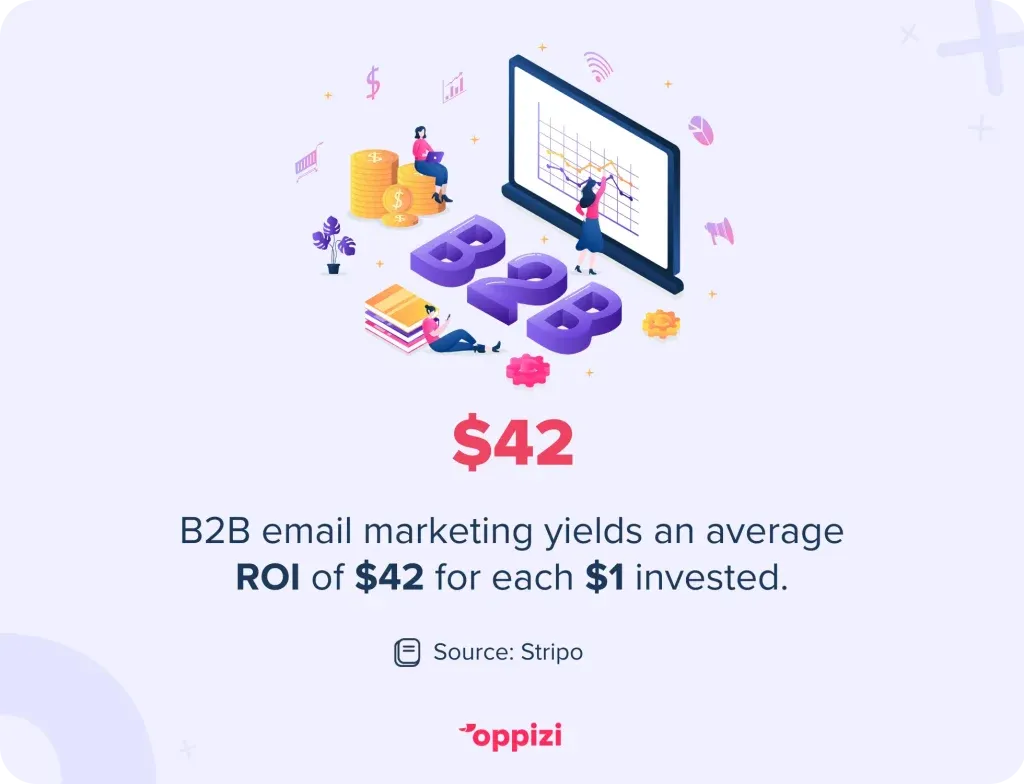
- Cost-effectiveness: Achieve a high return on investment (ROI) with relatively low expenditure compared to other marketing channels. According to Stripo, the average ROI for B2B email marketing is $42 for every $1 spent.
- Lead nurturing: Maintain regular contact with leads to keep them engaged and move them through the sales funnel.
- Personalization: Tailor content to address the unique needs and challenges of each recipient, considering their stage in the customer lifecycle journey.
- Automation: Streamline workflows to ensure consistent communication through automated email sequences and triggers.
- Measurable results: Track and analyze campaign performance easily to refine strategies and improve outcomes.
How to use B2B email marketing effectively
B2B email marketing isn't about sending generic promos to your entire database. It’s about delivering the right message to the right person at the right time. Here's how to do it well:
Define your audience segments
Don’t treat your audience as one giant list. Segment by industry, job title, company size, or buying stage. For example, an onboarding email for a small SaaS startup should differ from a sales pitch to a national enterprise.
Set clear goals for each campaign
Your email should have one clear purpose - whether that’s generating leads, driving demo signups, or promoting a new feature.
Build a lead-nurture funnel
B2B sales cycles can be much longer than B2C sales cycles. Use email to guide leads through the funnel: from awareness (e.g. helpful blog content) to consideration (e.g. product comparisons) to decision (e.g. case studies and testimonials).
Proven B2B email marketing strategies
Here are six tactics to help you get the most from your B2B email marketing:
1. Leverage marketing automation
Use email automation tools to trigger messages based on user behavior. For example, if a lead signs up for a webinar, follow up with a tailored email series that includes the webinar replay, relevant case studies, and a clear next step.
Studies show that B2B companies using marketing automation to nurture prospects see a 451% increase in qualified leads.
2. Use strong CTAs and subject lines
Your subject line is your first impression, so make it count. Keep it short, attention-grabbing, and clear about the content inside.
You should also be specific with your CTA. Examples include: “Book Your Free Demo” or “Download the Full Case Study.”
3. Provide value-first content
Instead of constantly promoting products, focus on providing valuable insights. Share industry trends, data-backed reports, or actionable advice. When your emails offer genuine help rather than just sales pitches, recipients are more inclined to engage.
4. Time it right
The best time to send a B2B email? Mid-week mornings tend to perform best. Research shows that sending B2B emails on Tuesdays and Thursdays between 9-11 am achieves higher engagement rates.
5. Test and optimize regularly
Make sure you test everything from subject lines, send times, layouts, and CTAs. Even small tweaks can deliver big results over time.
6. Adapt content to the funnel stage
Not every lead is ready to buy, and your email content should reflect that. Tailor your messaging based on where your lead is in the sales funnel.
Use CRM data and behavior tracking to adjust your message based on lead stage, industry, or interaction history.
Best practices for B2B email marketing success
To ensure your B2B email marketing campaigns are effective, it's crucial to implement these best practices.
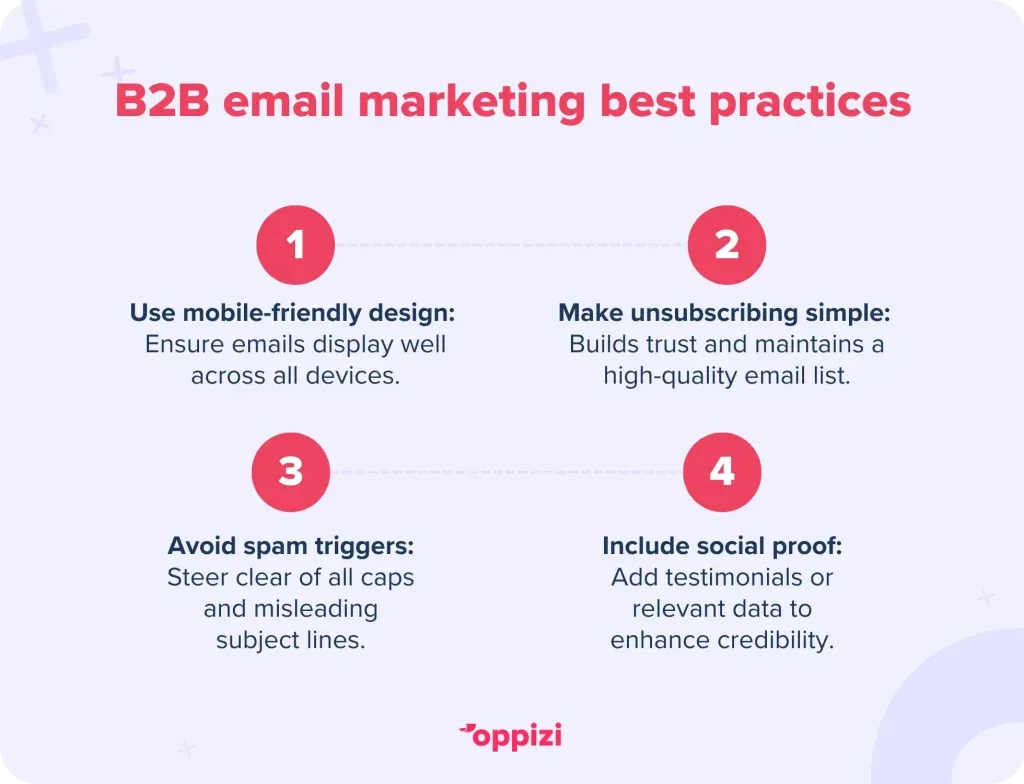
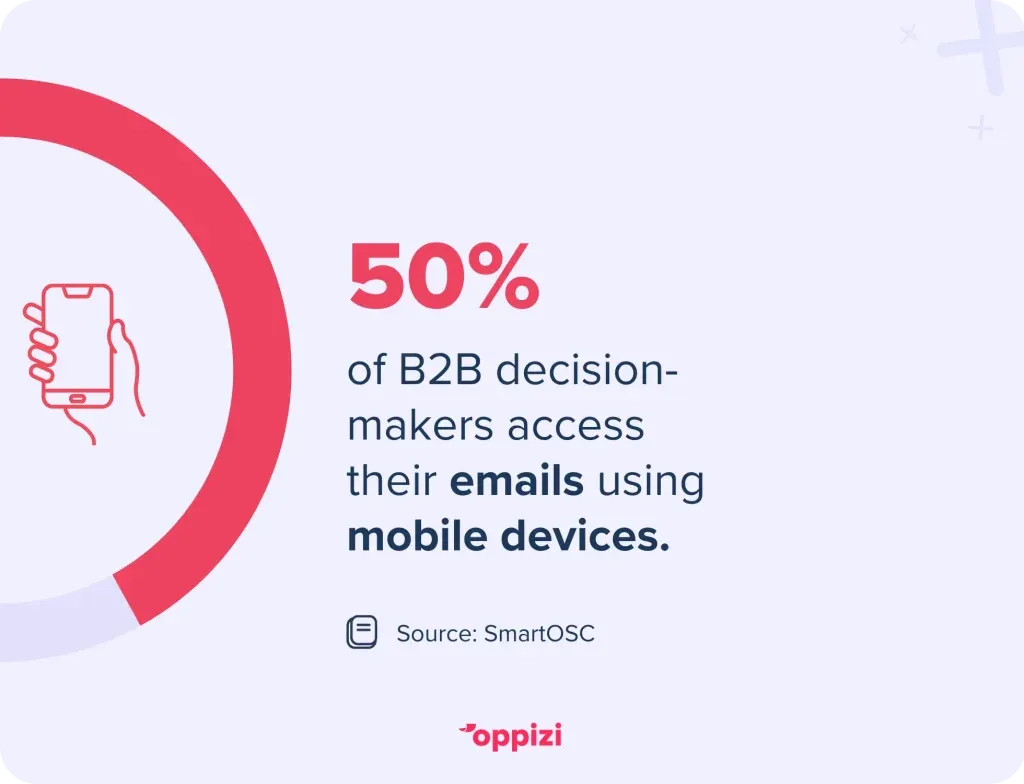
- Use a mobile-friendly design: Over 50% of B2B decision-makers check their emails via mobile.
- Make unsubscribing easy: It builds trust and keeps your list clean.
- Avoid spam triggers: Don’t use all caps, too many exclamation marks, or misleading subject lines.
- Include social proof: Case studies, testimonials, or stats can help build credibility.
Keep it concise: B2B readers are busy, so say what you need to say clearly.
Common B2B email marketing mistakes to avoid
Even experienced B2B marketers can fall into certain email marketing traps. Try to avoid these common mistakes to ensure you get the most out of your email campaign:
Overloading emails with information
If your email is too long, chances are it won’t be read. Stick to one idea per email and link to further information.
Sending irrelevant content
Generic messages = deleted messages. Personalization and segmentation are essential to ensure you reach your audience with relevant content.
Neglecting the subject line
Even if you have great content inside your email, a bad subject line means it won’t even get opened. Think carefully about your subject line to draw your leads in.
Forgetting to A/B test
If you’re not testing, you’re just guessing what works. Continuous optimization is how you build high-performing campaigns.
Failing to track KPIs
Open rates, CTRs, bounce rates, and unsubscribes - all of these metrics tell a story about how well your campaign is doing. Use them to adjust your messaging, timing, and content.
FAQs about B2B email marketing
1. What is the difference between B2C and B2B email marketing?
Business-to-consumer (B2C) email marketing focuses on individual consumers, using emotional appeals and short-term offers. In contrast, business-to-business (B2B) email marketing targets businesses and professionals, emphasizing informational content, value, ROI, expertise, and problem-solving. B2B sales cycles are typically longer and involve multiple decision-makers.
2. How effective is B2B email marketing?
B2B email marketing can be very effective when done right. It is a leading marketing channel for B2B marketers, with 87% ranking it among their top choices, according to the Content Marketing Institute. It allows businesses to nurture leads, educate prospects, and build trust over time. With the right strategy, B2B email can drive high engagement, generate qualified leads, and support long-term sales growth.
3. Is cold email marketing still effective in B2B?
Yes, cold email marketing can be effective for B2B when it’s personalized, targeted, and valuable. Focus on relevant content and avoid tactics that could detect your email as spam.
4. How do I B2B email marketing measure success?
Track open rates, click-through rates, conversion rates, and unsubscribe rates. Look for engagement trends over time.
Final thoughts
B2B email marketing is still one of the most effective ways for businesses to connect directly with their ideal audience. But something that can make it even more powerful? Following up from email campaigns with tangible offline marketing strategies like direct mail.
This multi-channel approach helps your brand cut through the noise, reinforce key messages, and reach decision-makers at multiple touchpoints - online and off.
Want to make sure you stand out from the competition? Start your offline marketing campaign with Oppizi today and put your message directly into the hands of your ideal customers.