Last updated July 28, 2026
It’s hard to try to have a conversation in a room where everyone’s shouting, scrolling, and switching topics every 10 seconds. But that’s pretty much the online landscape we’re all trying to market in.
Welcome to the attention economy, where attention, not information, is scarce. It’s the modern battleground for brands, content creators, and platforms. If you're pouring resources into content or ad spend and still seeing declining engagement, you're not alone. The rules of the game have changed. And if you’re not thinking strategically about attention, you’re already behind.
Let’s break down what the attention economy means, how it’s reshaping marketing, and how to thrive in it.
What is the attention economy?
Nowadays, thanks to the nature of the competitive online ad space, consumer attention is a scarce and valuable resource, giving rise to what is known as the attention economy. This concept was famously articulated by Nobel Prize-winning economist Herbert A. Simon, who famously wrote, “A wealth of information creates a poverty of attention.”
In other words, the more content we see, the less we pay attention, highlighting that gaining attention has become more valuable than ever.
Every scroll, swipe, or click equals a moment of focus. And every brand, platform, and creator is fighting for those precious seconds of your audience’s time.
Why attention has become so scarce
Today’s consumers are bombarded with content, from TikTok and Instagram reels to banner ads and YouTube pre-rolls. Consider this:
- 91% of consumers in the UK feel they see too many adverts on social media
- Humans now have an average attention span of just 8.25 seconds.
- On average, users spend just 54 seconds on a web page before bouncing.
In this landscape, even the best content struggles to make an impact.
Attention is not just about getting noticed
A common misconception is that attention = impressions or views. But that’s just the first layer.
There are actually three levels of attention to consider:
In the attention economy, true value lies in moving people from fleeting awareness to sustained engagement.
The hidden cost of competing for attention
In the race for visibility, many brands are falling into a trap: spending more to get less.
- Digital ad spend reached $667.6 billion globally in 2023, yet average click-through rates on display ads hover around 0.35%.
- Social platforms prioritize virality over genuine value, effectively limiting organic reach, which means brands need paid promotion for visibility.
- Even high-quality content can get buried if it doesn’t stop the scroll in the first few seconds.
The result? Oversaturation, consumer fatigue, and declining ROI on traditional digital tactics.
How to win in the attention economy
So, how do you rise above the digital noise? Here are six strategies that help you thrive in the attention economy.
1. Shift from reach to resonance
Don’t chase numbers. Chase meaning. Micro-targeted, high-value content that deeply resonates with a specific audience can consistently outperform broad, generic campaigns.
Try this: Use empathy-driven messaging that mirrors your audience’s language, problems, and aspirations.
2. Design for skimmability
People don’t read - they scan. Your UX and content layout need to accommodate users.
Use:
- Bullet points
- Bold headlines
- Short paragraphs
- Visual cues (arrows, emojis, illustrations)
UX and content are partners in performance.
3. Create ‘stop-the-scroll’ moments
The first 3 seconds matter most - on video, email subject lines, even flyer headlines. Lead with emotion, urgency, or curiosity.
Example: Instead of “5 Tips for Better Design,” try something like “Why 90% of Your Design Budget Is Wasted.”
4. Layer offline and experiential touchpoints
With so much of our time spent looking at screens, physical experiences stand out. This is why brands are turning to experiential marketing, offline advertising, and even tactics like QR-coded flyers or pop-up installations.
Physical media commands attention in a way digital often can't, because it isn't competing on the same noisy battlefield.
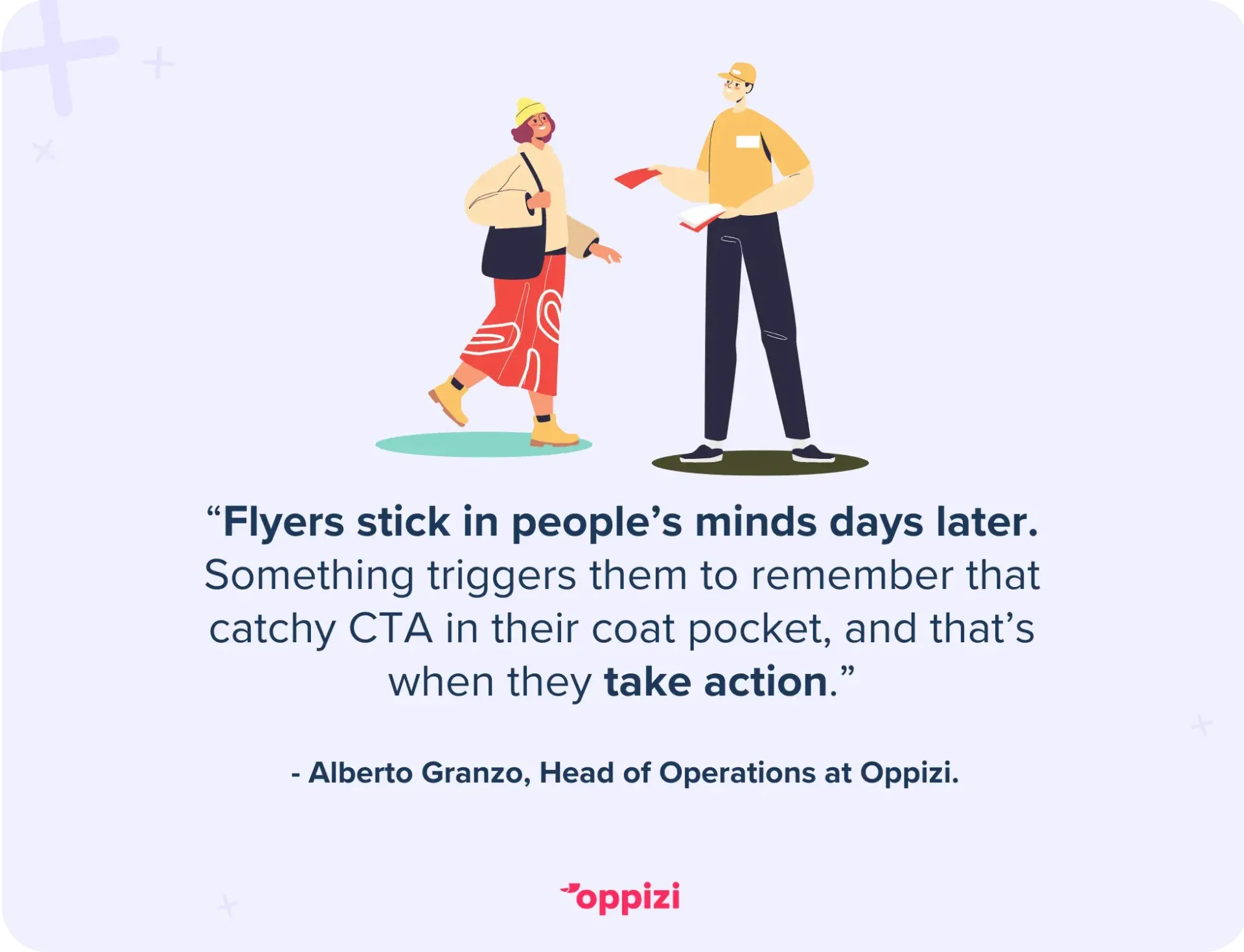
In fact, according to Alberto Granzo, Head of Operations at Oppizi, “Flyers stick in people’s minds days later. Something triggers them to remember that catchy CTA in their coat pocket, and that’s when they take action.”
5. Turn passive viewers into active participants
Interactive content like polls, quizzes, AR filters, and co-creation opportunities pulls users from passive to participatory.
People remember what they engage with, not what they scroll past.
6. Invest in brand trust, not just traffic
The goal isn’t just attention - it’s attention with intent. That only happens when you build long-term trust. Be consistent, be human, and be relevant.
Rethinking metrics in the attention economy
We’ve been trained to worship impressions, clicks, and views. But in this new era, you need to optimize for quality of attention:
- Dwell time
- Scroll depth
- Engagement rate
- Retention or repeat visits
- Brand mentions or shares
You shouldn't just focus on “did they see it?” but “did it matter to them?”
Why this matters for your marketing strategy
If you’re a brand manager, startup founder, or UX designer wondering why your audience engagement has dropped despite great creatives, the answer likely lies here:
You're competing in an economy where attention is expensive and fragmented.
By understanding the attention economy, you can:
- Build smarter content funnels
- Refine your messaging
- Reduce wasted spend
- Deliver more meaningful user experiences
The future of the attention economy
As AI generates more content faster than ever, saturation will only increase. But so will the value of trust, creativity, and emotional intelligence.
Winning won't mean producing more, but rather producing with purpose.
The next challenge? Creating context-aware content, personalization without intrusion, and human-centered storytelling that earns attention.
Final thoughts
In today’s attention economy, digital noise is the norm, and attention is the exception. Brands that rely solely on online channels are finding it harder than ever to reach their ideal audience. But here’s the good news: standing out doesn’t always mean shouting louder. It means showing up differently.
That’s where Oppizi comes in. We help brands break out of the digital echo chamber with targeted offline marketing campaigns that are designed to generate real-world engagement. From flyering in strategic locations to direct mail that gets noticed, Oppizi provides a way to reach consumers where digital advertising can’t.
Want to win in the attention economy? Let’s start with a campaign that people can’t scroll past. Set up an offline marketing campaign with Oppizi today!