Last updated July 28, 2026
When it comes to the marketing industry, digital marketing gets most of the attention. But under the radar, offline channels like direct mail and flyering are still driving some of the highest trust, engagement, and ROI.
For marketers, small business owners, and entrepreneurs, that’s a big deal. And the stats show that direct mail, print ads, and in-person experiences aren’t fading away. They’re working better than many people realize.
If you’re deciding where to spend your budget, these numbers show exactly how offline marketing performs, who responds to it, and why it’s still a smart choice in 2025.
Key statistics that demonstrate the benefits of offline marketing
Building trust and credibility
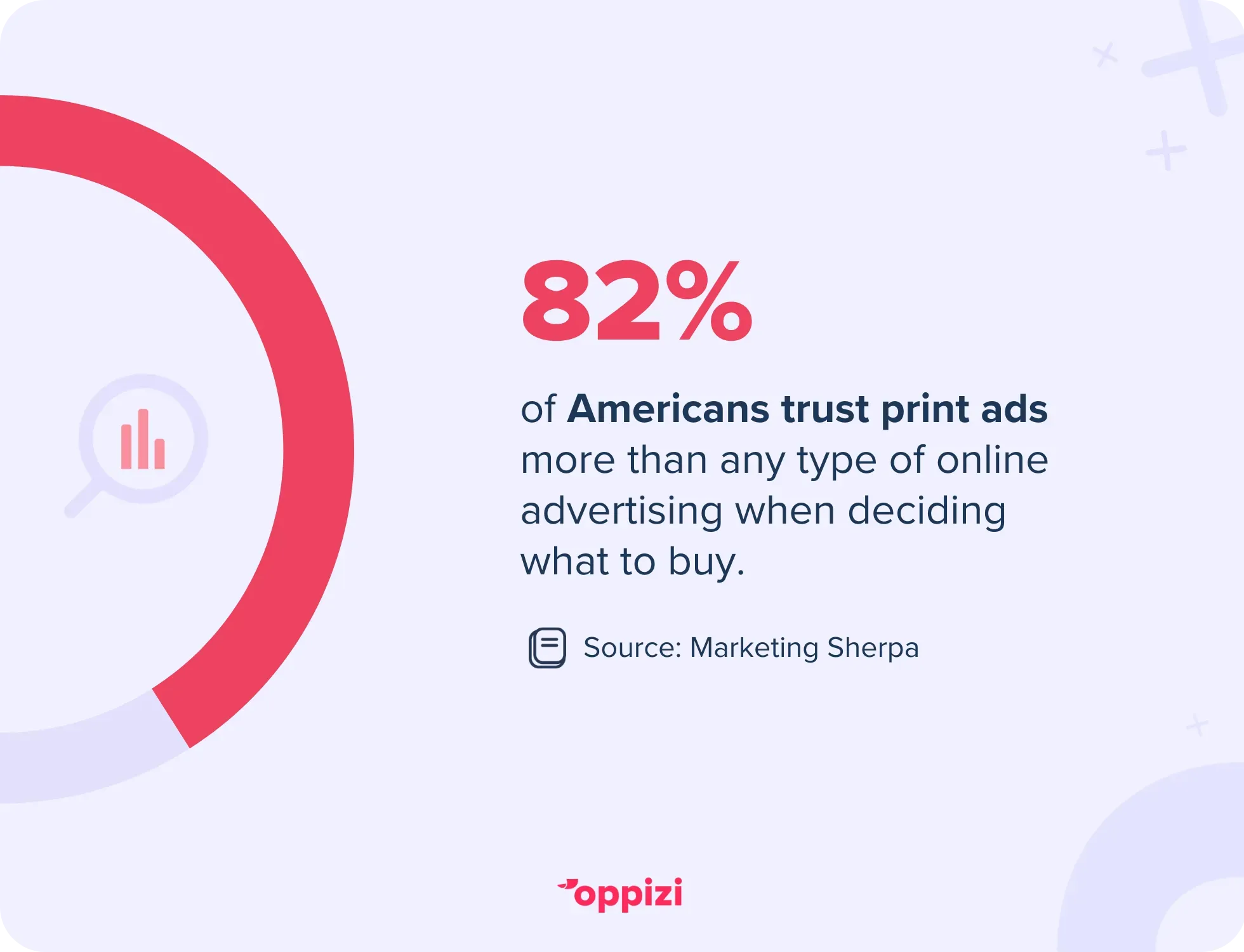
1. 82% of American consumers trust print ads (newspaper/magazine) when making purchase decisions – more than any form of online advertising
(Source: Marketing Sherpa).
Trust is one of the hardest things to earn in marketing. Print still carries a sense of credibility that digital often struggles to match. For a business trying to win over skeptical customers, print ads can feel more authentic.
2. 76% of Americans trust direct mail (postcards, flyers, etc.) for purchase decisions – again, higher than digital ads
(Source: Marketing Sherpa).
Direct mail feels personal and intentional. In a world full of crowded inboxes and noisy social feeds, a well-designed piece of mail can stand out and feel more genuine.
3. 71% of consumers say print catalogs and magazines feel more authentic than digital campaigns, and 65% look forward to receiving catalogs
(Source: eMarketer).
When people look forward to your marketing, you already have their attention. That anticipation makes them more open to buying.
4. 71% of Baby Boomers say mail feels more personal than digital communication
(Source: USPS Delivers).
Sending physical mail shows effort and care. It can make customers feel valued in a way digital often doesn’t.
Boosting marketing investment and ROI
5. U.S. marketers spent over $39 billion on direct mail in 2023, making it the 5th-largest advertising channel in the country
(Source: Winterberry Group).
Budgets show where confidence is. This level of spending proves direct mail is still a strong revenue driver.
6. 83% of marketers say direct mail helps them achieve their marketing objectives
(Source: USPS Delivers).
It’s not just about sending mail. It’s about results. Most marketers using direct mail see it working for their goals.
7. 85% of marketers consider direct mail a strategic channel in their mix
(Source: USPS Delivers).
When something becomes “strategic,” it means it’s essential, not experimental. That’s how direct mail is viewed today.
8. 61% of marketers have recently increased their direct mail budgets – a 12% rise from the year before
(Source: WhatTheyThink).
Budgets don’t go up without a reason. This growth shows strong returns and growing demand for physical marketing.
9. 54% of marketers plan to increase direct mail spending, outpacing planned increases for email or paid social
(Source: WhatTheyThink).
Direct mail isn’t just keeping up with digital channels. It’s pulling ahead in growth, showing a shift in how brands want to connect with people.
Increasing engagement and influencing audience behavior
10. 72% of consumers engage with postal mail at least once a week
(Source: WhatTheyThink).
This means your message has a better chance of being seen. Mail often gets full attention in a quiet moment, without the distractions of a screen.
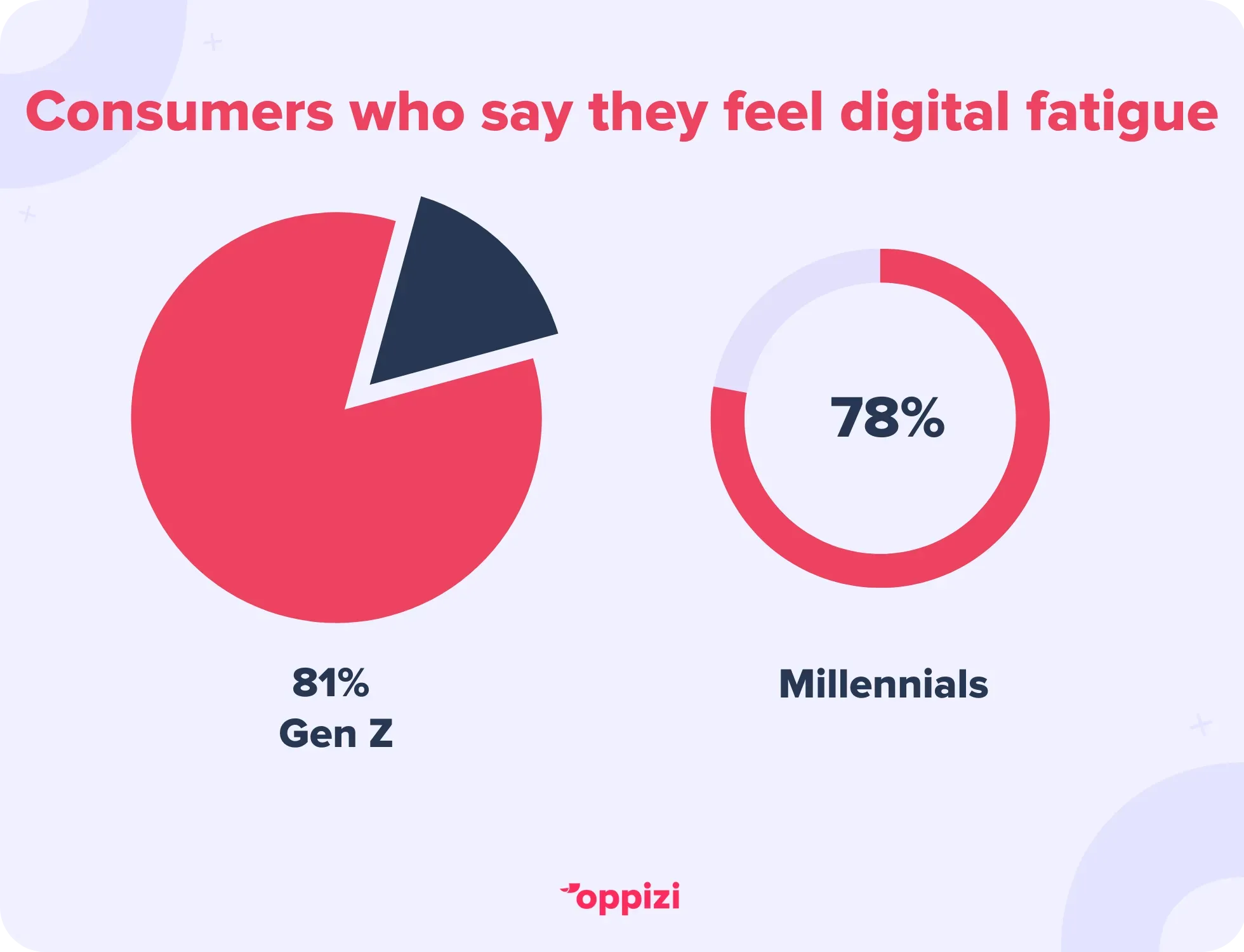
11. 81% of Gen Z adults and 78% of Millennials often want to take a break from digital devices
(Source: eMarketer).
This screen fatigue creates a chance for offline marketing. When people want less screen time, physical media feels fresh and welcome.
12. 88% of consumers say physical store experiences are easier to remember when brands make an effort to engage them
(Source: eMarketer).
Memorable experiences often lead to loyalty. Offline moments can stay in someone’s mind long after an online ad fades.
13. 71% of consumers say visiting a brand’s physical store makes them feel more connected and loyal
(Source: eMarketer).
True loyalty builds through real-world experiences. Physical spaces let people see, touch, and feel a brand in ways digital can’t match.
14. 74% of Gen Z and Millennial shoppers are more likely to buy from brands with unique unboxing experiences
(Source: eMarketer).
For younger shoppers, packaging matters. A creative unboxing can turn a one-time buyer into a repeat customer.
Improving response rates and targeting
15. UK addressed direct-mail campaigns to existing customers average a 7.2% response rate and deliver about £9 ROI for every £1 spent
(Source: JICMAIL).
That’s an impressive return. It proves the value of strengthening relationships with customers you already have.
16. UK addressed prospect mail campaigns average a 0.9% response rate and about £3.20 ROI per £1 spent
(Source: JICMAIL).
Even with new audiences, direct mail can generate strong returns. It works for both retention and acquisition.
17. UK unaddressed door-drop campaigns average a 0.5% response rate and about £2.90 ROI per £1 spent
(Source: JICMAIL).
Leaflet drops can still bring in results, even without personalization.
18. Targeted direct mail gets 2.5× higher response rates and 37% higher ROI than non-targeted campaigns
(Source: JICMAIL).
Good targeting works offline just like it does online. Combined with the feel of print, it can be even more effective.
Boosting memory, recall, and emotional impact
19. 75% of people remember receiving a specific direct-mail piece
(Source: WhatTheyThink).
High recall means your message stays with people. That makes it more likely to influence their buying decisions later.
20. Adding the recipient’s name to a mail piece can boost response rates by up to 135%
(Source: USPS Delivers).
Personalization isn’t just polite. It can dramatically increase conversions.
21. Physical ads create stronger emotional reactions and longer-lasting memories than digital ads
(Source: USPS OIG).
Print doesn’t just get noticed; it moves people. That’s why Uber chose Oppizi to win new customers fast. In a data-driven campaign, our trained brand ambassadors delivered 3 million flyers straight into the hands of potential riders. The result? Flyers became Uber’s most powerful customer-acquisition channel.

“People don’t realize how sophisticated the logistics can be,” explains Alberto Granzo, Head of Operations at Oppizi. “An offline campaign is alive; it’s happening in real time on the street. From printing to brand ambassador pick-ups, shift management, and live monitoring, everything moves like a fast-changing spider web. Every part has to work together.”
22. One week after seeing them, consumers remembered physical ads faster and more confidently than digital ads
(Source: USPS OIG).
This means your brand stays in their mind well after the ad arrives.
23. Brain scans show more activity in value-processing areas when people view print ads compared to digital
(Source: USPS OIG).
The brain assigns more value to print. That can make your offers feel more appealing.
Generational insights
24. 57% of Baby Boomers would be “very disappointed” if they stopped receiving mail. That’s compared to 45% of Gen X, 41% of Millennials, and 37% of Gen Z
(Source: USPS Delivers).
For older audiences, mail is a trusted habit. Skipping it could mean missing an important connection.
25. 93% of Millennials read mail from local businesses, compared to 86% who read similar emails
(Source: USPS Delivers).
Even digital-first generations engage more with physical messages from local brands.
26. 97% of Millennials read their monthly bills or statements in print, compared to 95% by email
(Source: USPS Delivers).
When information matters, print still wins for trust.
27. 90% of Millennials read mailed catalogs, compared to 70% who read digital ones
(Source: USPS Delivers).
Catalogs give people a focused, distraction-free way to browse — something rare online.

FAQ: making sense of offline marketing in 2025
1. How do I measure the ROI of an offline marketing campaign?
Offline campaigns don’t have built-in analytics like online ads, but you can still track results. Use unique promo codes, dedicated phone numbers, or campaign-specific landing pages. At Oppizi, tracking is built into every campaign so you can see responses, conversions, and ROI all in one place.
2. Is offline marketing only effective for certain industries?
Not at all. The stats show strong results in retail, hospitality, services, nonprofits, and more. Any business that needs trust, memorability, and targeted reach can benefit, especially when offline and digital work together.
3. How do I know which offline channel is best for my audience?
It depends on your audience and goals. Direct mail and catalogs work well for repeat purchases and higher-value products. Flyers are great for driving local foot traffic. Oppizi helps you match the right channel to your audience profile.
Final thoughts
Offline marketing isn’t old-fashioned. It’s a high-impact channel that delivers measurable results. Keep these key takeaways in mind the next time you’re considering new marketing strategies:
- Trust is offline marketing’s superpower. Print and direct mail consistently beat digital ads in credibility.
- ROI and engagement stay strong. Targeted campaigns and tactile experiences get higher response rates, better recall, and deeper customer connections.
- Offline works across generations. From Baby Boomers who value personal mail to Millennials who read catalogs, the appeal is broad and lasting.
With Oppizi, you can launch and manage a campaign as easily as running a digital ad. Start a fully-managed offline campaign in minutes, all managed from one simple, user-friendly dashboard.