Last updated July 23, 2026
Direct marketing is a focused, efficient way for businesses to stand out and make meaningful connections, and it remains one of the most powerful strategies for businesses who want to speak directly to their target audiences.
Unlike traditional mass advertising, direct marketing is highly personalized, focusing on delivering tailored messages directly to potential customers. This approach allows businesses to reach people who are more likely to respond, creating a clear pathway for engagement and conversion.
Whether it’s through direct mail, email, or digital channels, direct marketing enables companies to build stronger customer relationships, measure results more effectively, and drive sales. Read on to discover the pros and cons of direct marketing, the various channels available, and how to create a direct marketing campaign for your business.
What is direct marketing?
Direct marketing is a form of advertising that speaks directly to potential customers rather than using a third party or middleman, such as mass media. It aims to create a personal relationship with consumers through tailored messaging, taking into account their buying behavior and preferences.
In order for direct marketing to be successful, businesses require a well-executed strategy based on careful planning and precise execution. This includes understanding your target audience’s needs and aligning these insights with your broader marketing strategy.
Direct marketing has come a long way over the years, evolving from traditional mail and flyer advertising to incorporating digital channels such as email, telemarketing, and social media. Offline marketing channels (direct mail, flyers, etc.) can be enhanced using modern platforms like Oppizi to track and optimize distribution.
The advantages of direct marketing
Let’s look at some of the key advantages of direct marketing for businesses.
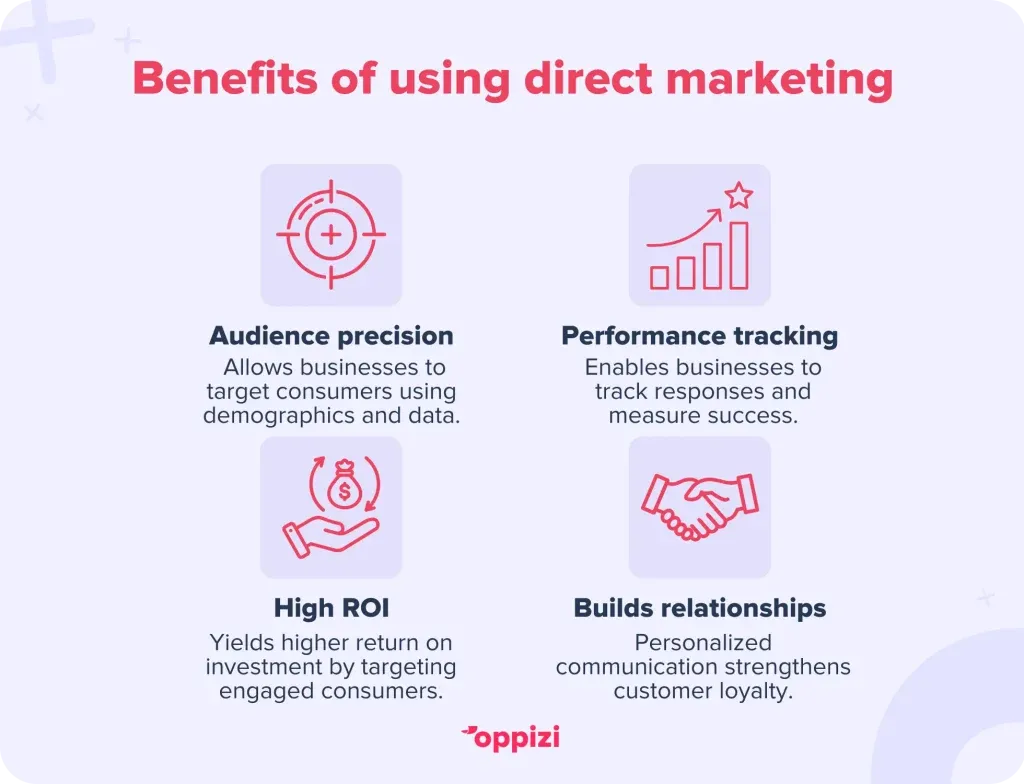
Audience precision
When it comes to direct marketing, precision is key. The capacity to specifically reach out to consumers based on multiple factors (demographic, purchase history, etc.) allows businesses to deliver more accurate messaging and even personalize marketing material to boost engagement levels.
Performance tracking
Tracking performance metrics such as response rates or conversion rates can be difficult when it comes to traditional advertising methods like TV ads or billboards. However, with direct marketing techniques, it’s much easier to measure performance.
While a TV commercial is the same for everyone, direct marketing channels allow businesses to include unique identifiers to track responses. This data can then be analyzed using various tools to determine the success rate of a campaign and to test different strategies.

High return on investment
Campaigns involving effective direct marketing methods yield a higher return on investment (ROI) compared to those that don’t. This makes sense, considering direct marketing enables you to target individuals who have shown interest in your product or exhibit characteristics associated with your target audience.
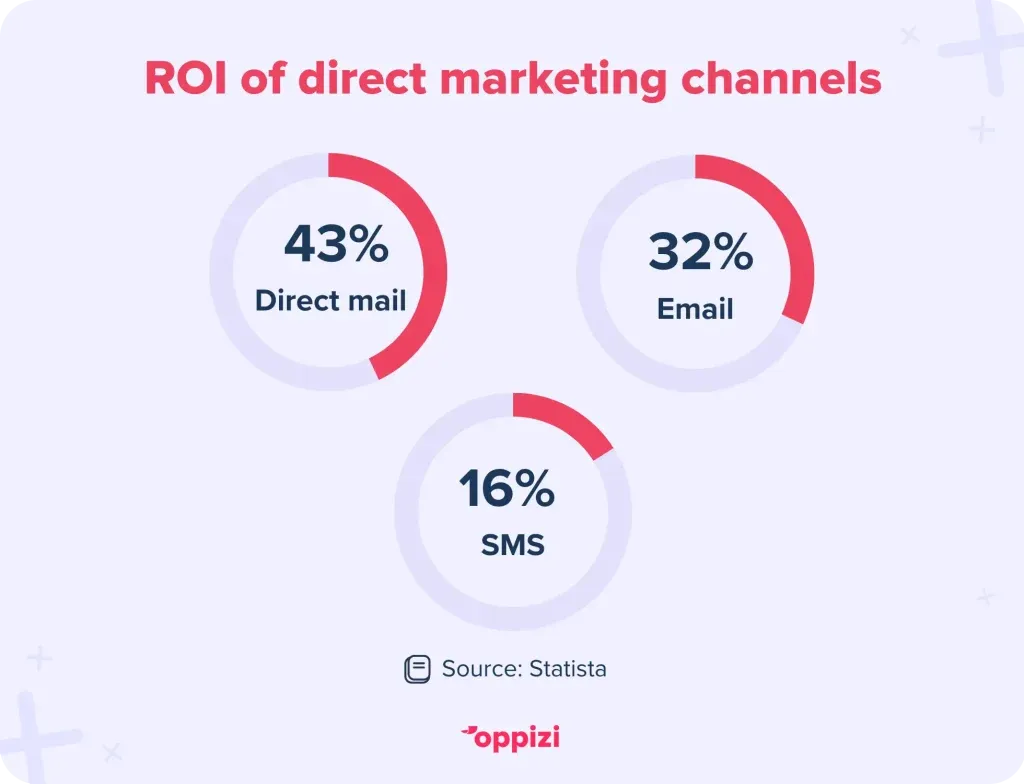
This leads to higher response rates and higher ROI. For example, 2022 data from Statista showed ROI figures for direct marketing techniques to be:
- Direct mail – 43%
- Email – 32%
- SMS – 16%
Building customer relationships
Direct communication with consumers helps build stronger, longer-lasting relationships while also attracting new ones to grow your customer base.
When implemented correctly, tailored messaging and one-on-one communication help to generate an emotional connection between the brand and consumer, strengthening loyalty over time.
The disadvantages of direct marketing
Risk of negative perception
One of the greatest strengths of direct marketing is its ability to speak directly to the customer. However, this can also be a risk if not executed properly. Poorly handled messaging can feel intrusive or irrelevant, damaging customer trust. To mitigate this risk, businesses should strive for well-targeted communication and, whenever possible, obtain consumer consent before sending direct marketing materials.

Data management hurdles
The success of a direct marketing campaign relies on accurate customer data. However, managing large volumes of data, from collection and maintenance to analysis, poses significant challenges.
Moreover, consumer concerns over data privacy are on the rise. Businesses must implement responsible data management practices to ensure the security of customer information. According to Salesforce, 83% of consumers worry about sharing their data online, and 72% would stop purchasing from a company or using a service if they had privacy concerns.
Limited scope
Unlike mass media channels such as TV and print advertising, which can reach a broad audience, direct marketing has a more constrained scope. For example, flyer distribution may be restricted in certain localities, making it less effective for businesses aiming for widespread coverage.
Comparing popular direct marketing channels
Three of the most common direct marketing channels are:
- Email marketing
- Direct mail
- Telemarketing
Each channel has its own strengths and limitations, making them more suitable for different types of campaigns.
Email marketing
Email marketing is a cost-effective way to drive sales and nurture customer relationships. It allows businesses to send personalized messages to individuals who have shown interest in their products or made previous purchases.
This channel is highly scalable, with numerous platforms available to help manage email lists, optimize delivery times, and personalize content. When used effectively, email marketing ensures targeted outreach while maintaining affordability.
Direct mail
Direct mail campaigns use tangible marketing materials such as flyers, postcards, catalogs, and letters to reach customers directly. A well-executed direct mail piece, whether offering a discount, a free trial, or exclusive access, should have a strong incentive to prompt action.
Unlike digital ads, which are easy to scroll past, physical mail demands engagement. Recipients must handle and decide what to do with it, often resulting in higher conversion rates than purely digital alternatives.
Telemarketing
Telemarketing connects businesses with potential customers via phone calls, providing instant feedback that can refine marketing efforts. This approach is particularly useful when launching new products or services, as it offers real-time insights into customer reactions.
However, unsolicited calls can feel intrusive, potentially leading to negative brand perception. To minimize this risk, businesses should ensure compliance with privacy regulations and adopt a respectful, customer-focused approach.
Optimizing your direct marketing strategy
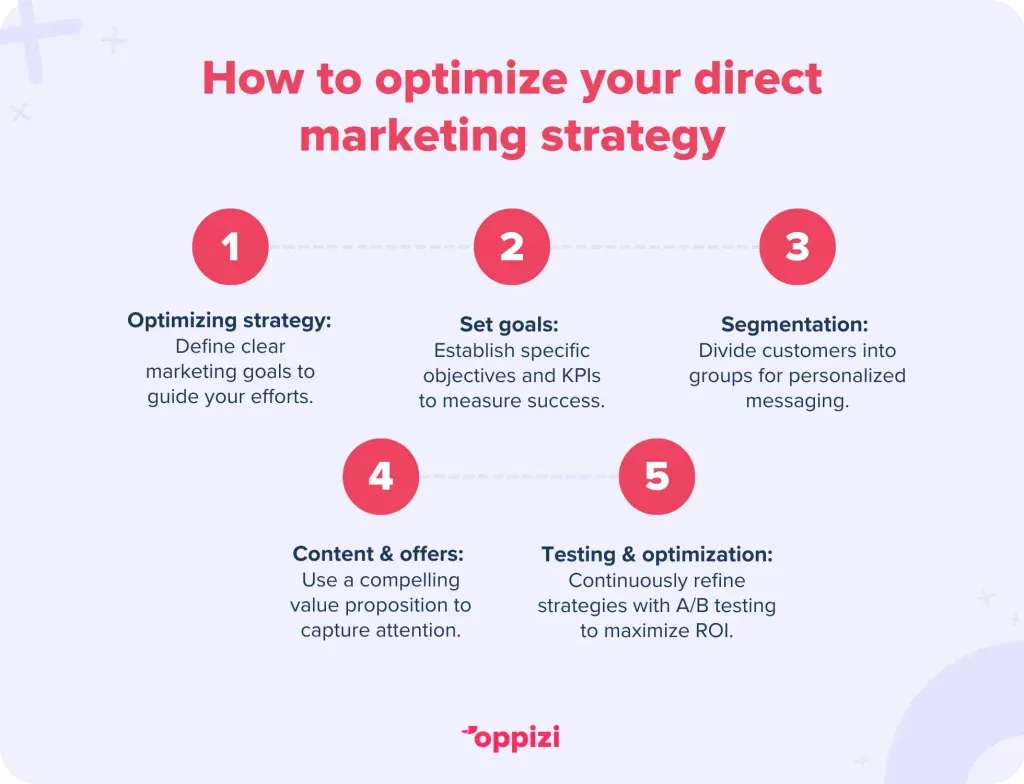
With so many channels and strategies available, incorporating direct marketing can feel overwhelming. However, the starting point should always be to define your specific marketing goals.
Set marketing goals
What do you want to achieve with this direct marketing campaign - brand awareness, customer engagement, conversions? And how does it align with your broader marketing objectives?
Without well-defined goals and key performance indicators (KPIs), future decision-making lacks direction, and measuring success becomes impossible.
Consumer segmentation and targeting
Once your goals are set, you should analyze your existing customer data and identify what additional insights you need to improve audience segmentation.
A data-driven approach allows you to divide customers into distinct groups based on demographics, behaviors, or purchasing habits, enabling more personalized and effective messaging that boosts conversions.
Marketing content and offers
No matter how well-targeted your campaign is, it won’t succeed without a compelling value proposition. Even the most sophisticated data-driven strategies will fall flat if the content fails to capture attention.
Many direct marketing strategies revolve around special offers and promotions to drive engagement and conversions.
Testing and optimization
Don’t expect to get everything right the first time. Like any business strategy, direct marketing requires ongoing testing and refinement to maximize ROI.
Beyond segmenting your audience based on consumer behavior, consider running A/B tests with different cohorts to identify the most effective messaging, offers, and delivery methods. Continuous optimization is key to long-term success.
Frequently asked questions about direct marketing
What are the main types of direct marketing?
Some of the most common types of direct marketing include email marketing, direct mail, telemarketing, and SMS marketing.
How can businesses measure the success of direct marketing campaigns?
Businesses can track key metrics such as response rates, conversion rates, ROI, and customer engagement levels to measure the success of their direct marketing campaigns. A/B testing can also help refine marketing efforts.
How can businesses avoid negative perceptions with direct marketing?
Companies should ensure that messages are relevant, personalized, and sent with customer consent. Compliance with privacy laws and clear opt-out options also help maintain a positive reputation.
What is a real-life example of direct marketing?
A real-life example of direct marketing is Amazon’s personalized email recommendations. Based on a customer’s browsing and purchase history, Amazon sends out tailored product suggestions via email, increasing engagement and conversion rates.
What is the difference between direct selling and direct marketing?
Direct selling involves face-to-face interactions where a salesperson sells products directly to customers, such as door-to-door sales. Direct marketing, on the other hand, uses channels like email, direct mail, and telemarketing to promote products without a physical salesperson.
Try out direct marketing for your business
A well-executed direct marketing campaign offers numerous advantages, including precise audience targeting, enhanced performance tracking, improved ROI, and stronger customer relationships.
However, it’s important to consider the potential challenges, such as managing consumer perceptions, handling large volumes of data, and the limitations of targeting specific audiences. With Oppizi’s offline marketing solutions, you can bridge the gap between physical marketing and digital tracking, ensuring your message reaches the right people at the right time.
Discover how to revitalize your marketing efforts with Oppizi and create a campaign today!