Last updated August 28, 2026
Think about the last big purchase you made. Maybe you needed a new phone or an appliance for your home. You probably did some research online. After checking out a few options, you finally made your choice.
That process you went through? That's inbound marketing in action.
With consumers today inundated with information online, conventional outbound marketing tactics are less effective. Businesses that utilize inbound marketing create meaningful connections that guide leads naturally from awareness to conversion.
Understanding how this funnel works is crucial for businesses looking to optimize their marketing efforts and drive sustainable growth. In this guide, we’ll break down each stage of the inbound marketing funnel and share actionable strategies to help you turn prospects into loyal customers.
What is an inbound marketing funnel?
An inbound marketing funnel represents the stages a potential customer moves through before making a purchase. Unlike the traditional sales funnel, which often emphasizes pushing products onto consumers, the inbound funnel aligns closely with the buyer's journey, addressing their needs at each stage.
Inbound marketing is particularly important for B2B companies. Studies have shown that decision makers in businesses would prefer to get company information via a series of articles rather than advertisements.
Whether for B2C or B2B, the goal is simple: attract, engage, and convert more leads. This is achieved by tailoring content for each stage of the buying process.
The importance of an inbound marketing funnel
A well-structured inbound marketing funnel is a must for businesses that want to build a sustainable customer acquisition strategy. Unlike costly and intrusive advertising methods, inbound marketing nurtures potential customers by delivering relevant and high-value content at the right time.
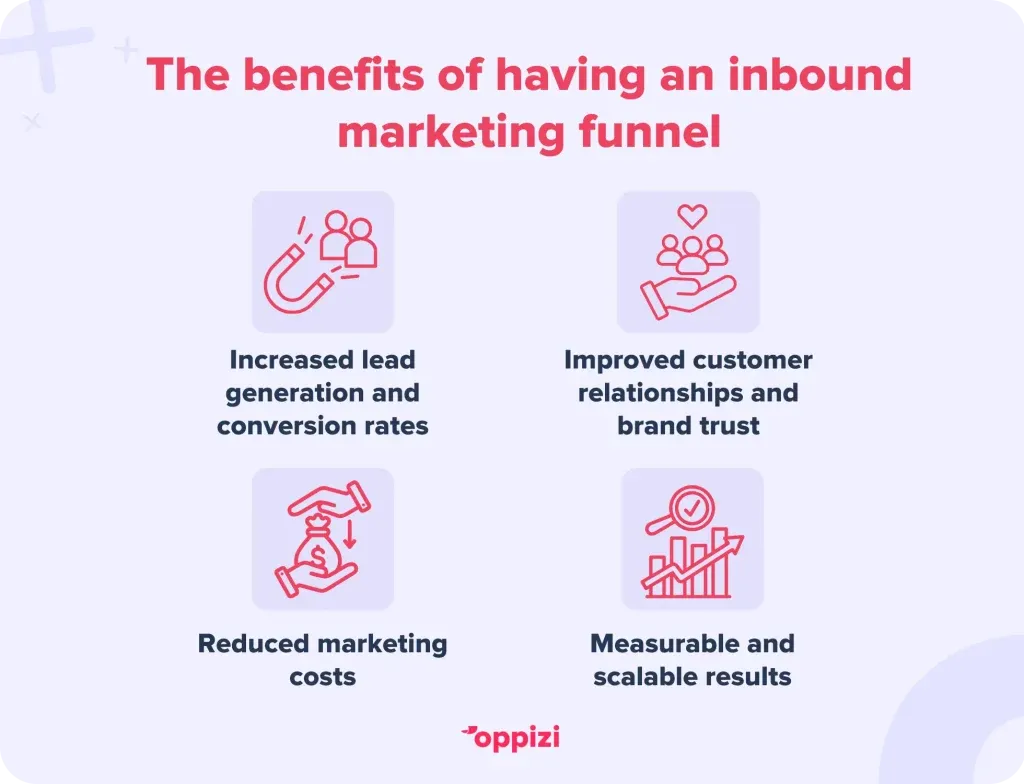
Here are some of the benefits of having a strong inbound marketing funnel:
Increase lead generation and conversion rates
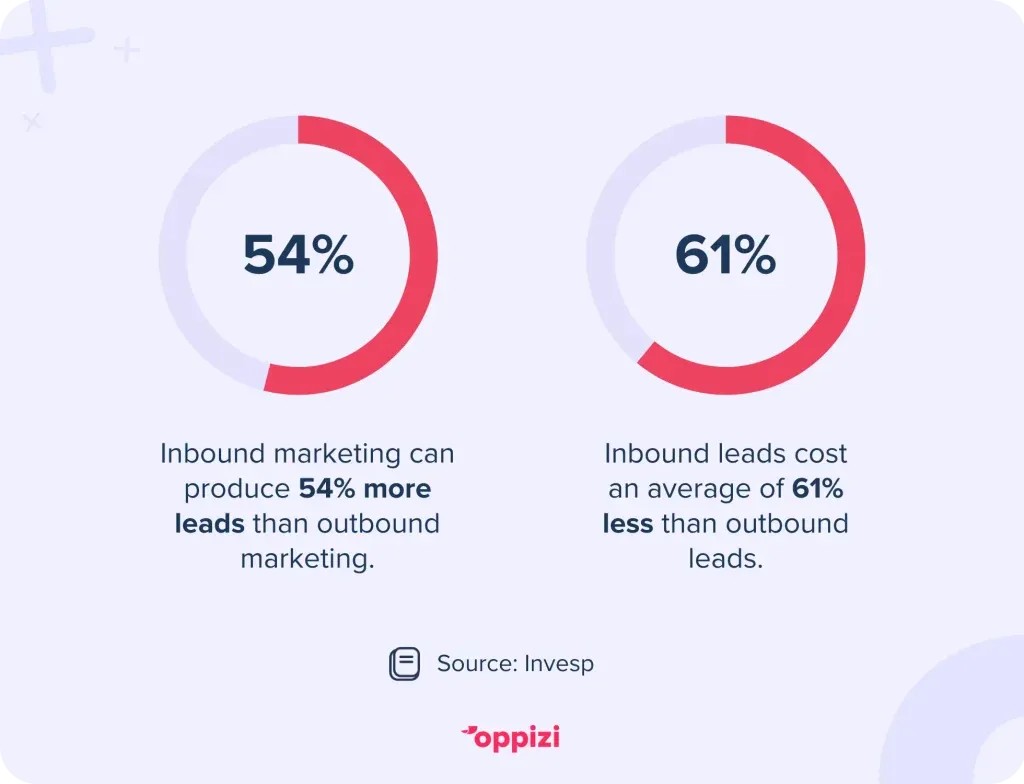
By guiding potential customers through a well-planned journey, businesses can capture more qualified leads and nurture them at each stage toward conversion. Studies have shown that inbound marketing can produce 54% more leads than outbound marketing. Instead of reaching a broader audience who may not be interested in your product or service, inbound marketing focuses on attracting those who are genuinely interested in what you offer.
Improve customer relationships and brand trust
Providing useful content, addressing customer pain points, and engaging authentically with your audience builds trust and credibility in your brand. Customers who see you as a valuable resource rather than just another company trying to sell to them are more likely to stay engaged and become advocates for your brand.
Reduce marketing costs compared to outbound methods
Traditional outbound marketing, such as cold calling and TV commercials, often requires a significant budget without guaranteed results. Inbound marketing, on the other hand, leverages organic methods like content marketing, SEO, and social media, which have a higher return on investment (ROI) over time.
Provide measurable and scalable results over time
Inbound marketing strategies can be continuously optimized based on real-time analytics. Businesses can track key performance indicators (KPIs) such as website traffic, lead conversion rates, and customer engagement to refine their approach. Furthermore, as your content library grows, inbound marketing efforts become more effective and require less effort to maintain.
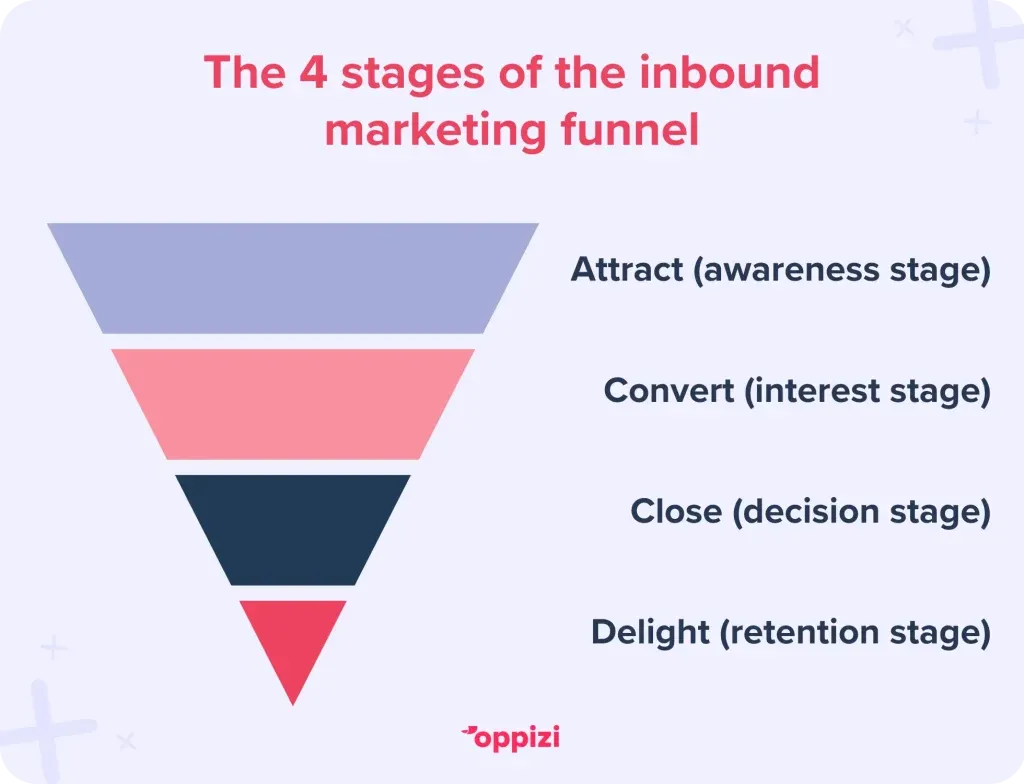
The four stages of the inbound marketing funnel
1. Attract (awareness stage)
Objective:
Draw in people who may not know your brand by providing valuable content that addresses their interests or pain points.
Strategies:
- Optimize your website and content for search engines (SEO).
- Publish blog posts, infographics, and educational videos.
- Leverage social media platforms to distribute content.
- Use pay-per-click (PPC) advertising aimed at your target audience to increase reach.
2. Convert (interest stage)
Objective:
Transform website visitors into leads by encouraging them to share their contact information at the mid-funnel stage.
Strategies:
- Offer lead-magnet content like eBooks, whitepapers, and webinars.
- Design high-converting landing pages with persuasive calls-to-action (CTAs).
- Implement interactive content such as quizzes and assessments.
- Use exit-intent pop-ups to capture leads before they leave.
3. Close (decision stage)
Objective:
Guide your leads toward making a purchase decision.
Strategies:
- Personalize email marketing campaigns with tailored recommendations according to their needs.
- Provide case studies, product demos, and customer testimonials to reinforce brand trust.
- Offer limited-time discounts and incentives.
- Use live support or chatbots to answer last-minute objections or queries.

4. Delight (retention stage)
Objective:
Ensure customers are satisfied, turning them into repeat buyers and brand advocates. With 65% of a company’s business coming from existing customers, it’s essential to invest in retention strategies.
Strategies:
- Provide exceptional customer support through various channels.
- Send personalized follow-up emails and exclusive loyalty rewards.
- Engage with customers on social media and encourage user-generated content.
- Conduct surveys to gather feedback and improve future interactions.
Implementing the inbound marketing funnel
To effectively implement the inbound marketing funnel, businesses should follow these key steps:
1. Understand your audience
Outline detailed buyer personas so that you can tailor content and strategies. Understanding your audience ensures that your messaging resonates with their specific pain points.
2. Create high-quality content
Your content should be educational, engaging, and optimized for different formats, whether it's blogs, videos, or social media posts. Content marketing, which costs 62% less than outbound marketing while generating over three times as many leads, remains one of the most effective strategies for attracting and retaining customers.
3. Utilize marketing automation
Automation tools like HubSpot, Marketo, and Mailchimp help streamline email campaigns, lead nurturing, and data analytics, making the funnel more efficient. Companies that automate their lead nurturing cycle see a 10+% increase in revenue within 6 to 9 months.
4. Measure and optimize
Regularly analyze key performance indicators (KPIs) such as website traffic, lead conversion rates, and customer acquisition costs. Data-driven decisions can refine the funnel for better results.
Conclusion
Understanding and implementing the stages of the inbound marketing funnel can significantly enhance your ability to attract, convert, close, and delight customers. By focusing on providing value and building authentic relationships, businesses can achieve sustainable growth and loyal customers.
But inbound marketing doesn't have to be limited to digital channels. Combining your online efforts with offline marketing strategies can maximize your reach. With Oppizi’s offline solutions like direct mail and flyering, you can create a well-rounded marketing approach that drives results.
Want to start an offline marketing campaign? Partner with Oppizi today and take your business to the next level!
Frequently asked questions
- How long does it take to see results from inbound marketing?
Results can vary from business to business, but many see improvements within 6 to 9 months of consistent inbound marketing efforts.
- Is inbound marketing suitable for all industries?
Yes, inbound marketing is a method that can be tailored to fit various industries by adapting content and strategies to target audiences.
- How does inbound marketing differ from outbound marketing?
Inbound marketing concentrates on attracting customers by sharing valuable content and addressing customers' particular pain points at each stage of the marketing funnel, while outbound marketing relies on paid ads, cold outreach, and direct promotion.
- Can small businesses benefit from inbound marketing?
Absolutely. Inbound marketing is cost-effective and allows small businesses to compete with larger companies by building trust in their brand and establishing a relationship with their audience.
- What metrics should I track in inbound marketing?
To measure the success of your inbound marketing efforts, you should track metrics like web traffic, lead conversion rates, email open rates, customer acquisition cost, and customer lifetime value.