Last updated July 28, 2026
Let’s be honest: just having a great product or service isn’t enough anymore. If your audience doesn’t know you exist or doesn’t understand why you matter, growth stagnates. That’s where demand generation comes in. Unlike lead generation, which aims to capture existing interest, demand generation is all about creating that interest in the first place. It gets your brand on the radar and builds long-term engagement.
But how do you create a demand generation strategy that actually drives results?
This guide walks you through every step so you can build a strategy that fuels awareness, consideration, and trust at every stage of the buyer journey.
What is demand generation?
Demand generation is a data-driven marketing approach centered on building brand recognition and cultivating prospective customers at each stage of their purchasing journey. This strategy integrates content marketing, advertising, and various other tactics to generate demand and consistently supply the initial phase of the sales funnel with qualified leads.
Unlike quick-hit tactics, demand generation is a long game, but when done right, it's a game-changer.
Steps to building a powerful demand generation strategy
Step 1: Define clear goals and KPIs
Every strong marketing strategy starts with clear objectives. Make sure the goals you choose are SMART (specifc, measurable, achievable, relevant, time-bound). Start by asking yourself:
- Do you want to build brand awareness?
- Generate marketing-qualified leads?
- Increase engagement or demo requests?
Now, choose the KPIs that best align with your goal. For example:
- Website traffic – to track visibility
- Conversion rates – to measure how well your messaging performs
- Social engagement – to gauge audience interaction
- Cost-per-acquisition (CPA) – to understand efficiency
- Marketing Qualified Leads (MQLs) – to measure lead quality
Avoid getting caught up in vanity metrics. High numbers look nice on paper, but they don’t always reflect success. For instance, a million impressions mean very little if no one is converting. Prioritize metrics that show real business impact.
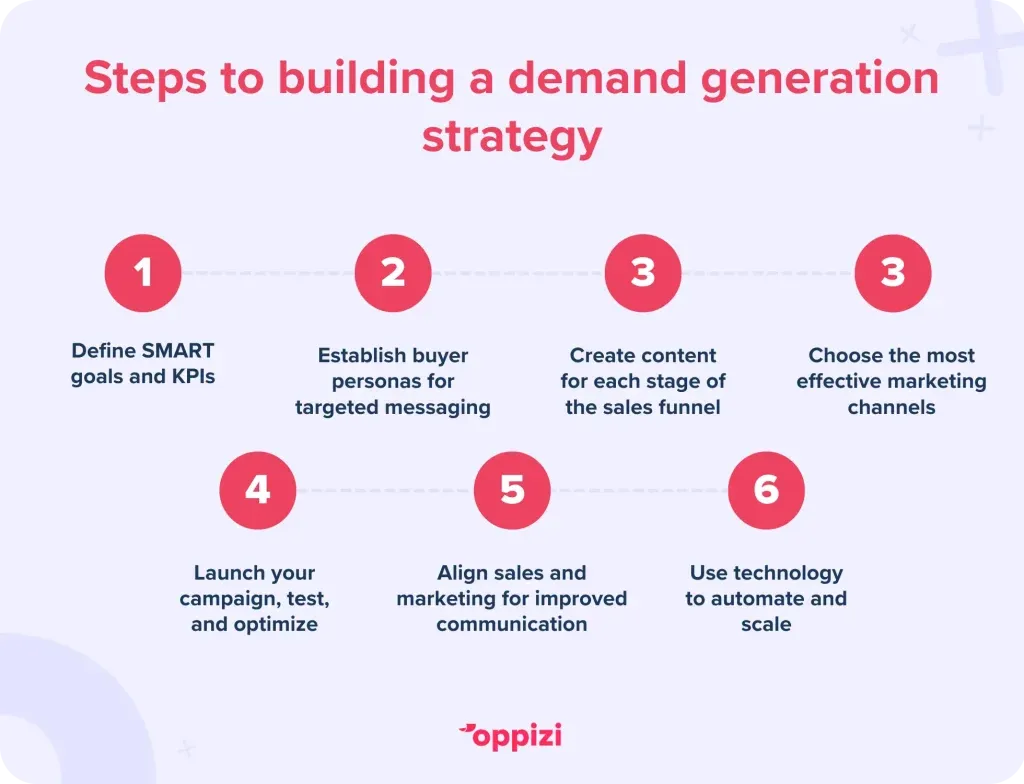
Step 2: Build deep buyer personas
If you don’t understand your audience, your messaging will fall flat. In fact, research has shown that companies that use buyer personas see 73% higher conversion rates on average. Take the time to build detailed buyer personas based on:
- Demographics (age, job title, location)
- Pain points
- Buying motivations
- Preferred content channels
- Offline behaviors
To create effective content and campaigns, prioritize understanding your audience's true interests. Instead of making assumptions, gather insights through customer interviews, data analysis, and sales team feedback.
Step 3: Create targeted, full-funnel content
Now that you understand your audience and have clear goals, the next step is to align your content with the different stages of the buyer journey. This ensures you're delivering the right message at the right time, which guides potential customers from first touch to final decision.
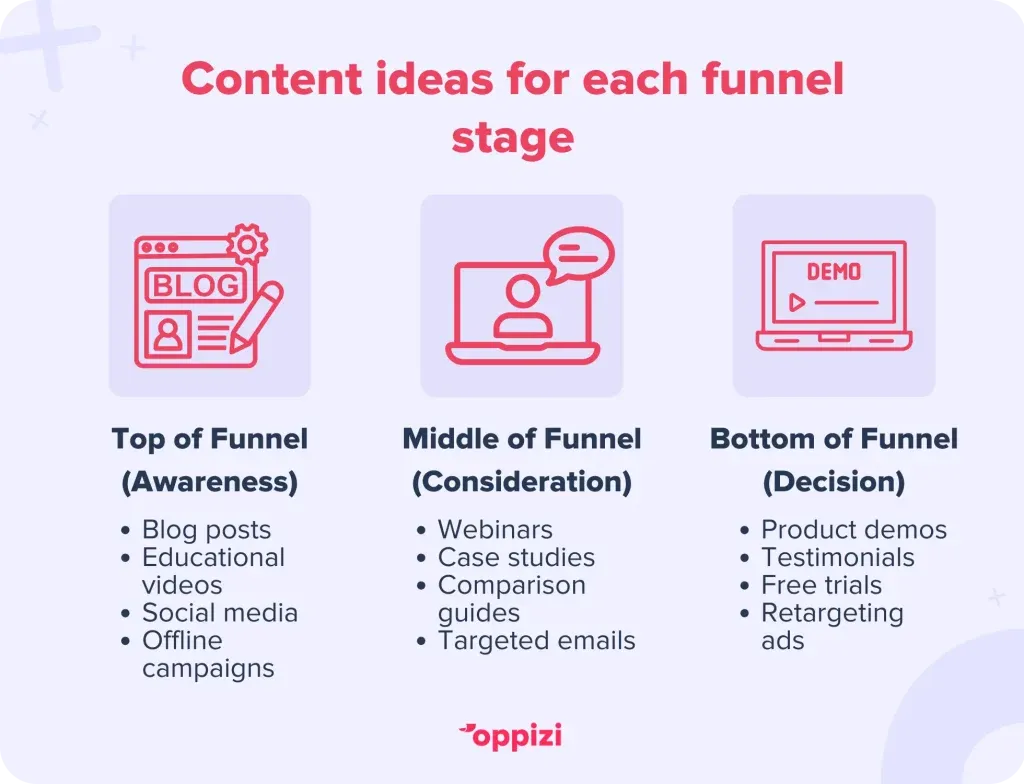
Top of Funnel (awareness stage)
This initial stage of the demand generation process focuses on introducing your brand to a new audience. Potential customers at this point might not be aware of their need, so the objective is to educate, inspire, or entertain them. Avoid aggressive sales tactics and concentrate on making a positive first impression.
Content ideas:
- Blog posts: SEO-friendly articles that answer common questions
- Educational videos: “How-to” content, explainer videos, thought leadership
- Social media: Engaging posts to introduce your brand and build trust
- Offline flyers & activations: Brand ambassadors, events, and flyer distribution campaigns to generate awareness in key locations
Middle of Funnel (consideration stage)
At the mid-funnel stage, your audience is aware of what they need and is actively looking for solutions. Your content should help them evaluate their options and move closer to choosing you.
Content ideas:
- Webinars: In-depth sessions to showcase expertise and value
- Case studies: Real-world examples that build credibility
- Comparison guides: Show how your offer stacks up against competitors
- Targeted email sequences: Nurture leads with personalized, relevant content
Bottom of Funnel (decision stage)
Now your prospects are ready to act but need a final nudge. Content at this stage should eliminate any hesitation and make it easy to say yes.
Content ideas:
- Product demos: Let them experience the value firsthand
- Testimonials: Social proof from happy customers
- Free trials: Low-risk ways to try your product or service
- Limited-time offers or retargeting ads: Create urgency and help you stay top-of-mind
Ensure your content features prominent calls to action and is optimized for both online and offline interactions. To guarantee trackability, consider incorporating UTM parameters and QR codes into your physical materials.
Step 4: Choose the right channels (online and offline)
While digital channels frequently take centre stage, integrating offline methods into your overall strategy can still yield significant results. 95% of marketers said they would recommend combining offline and online marketing strategies to enhance campaign performance.
Here’s a channel mix to consider:
- SEO & paid ads: For intent-based capture
- Social media & influencer collabs: For top-of-funnel awareness
- Email marketing: For nurture campaigns
- Offline marketing (such as direct mail, flyers, and events): For geographic or hyper-targeted activations
Offline marketing is particularly powerful for local campaigns or reaching audiences who are experiencing online ad fatigue.
Step 5: Launch, test, and refine
A great campaign is rarely perfect on the first try - it's built through testing, learning, and improving. Begin with a focused approach, implement changes quickly and repeatedly, and find ways to continuously improve your methods.
Here’s how to approach your rollout:
- Pilot campaigns: Run smaller tests with clear hypotheses
- Measure impact: Use tracking tools and attribution models
- Gather feedback: From both customers and internal teams
- Refine: Adjust messaging, visuals, and offers based on performance
Regularly analyze your sales funnel to pinpoint lead drop-off points. Fixing a weak middle-of-funnel nurture flow might yield more ROI than pouring more money into the top of the funnel.
Step 6: Align sales and marketing
Demand generation shouldn’t sit solely within the marketing department. To truly succeed, sales and marketing should work together as a unified team from day one. 57% of marketers said they needed to prioritize improving the alignment between their sales and marketing teams for better demand generation.
- Agree on definitions: Make sure both teams are aligned on what qualifies as a lead, a marketing-qualified lead (MQL), and a sales-qualified lead (SQL). Misalignment here leads to wasted effort and missed opportunities.
- Share content and messaging plans: Keep sales in the loop on campaign themes, offers, and content calendars. Their frontline experience can help craft stronger messaging, and they’ll be better equipped to reinforce your campaigns in conversations with prospects.
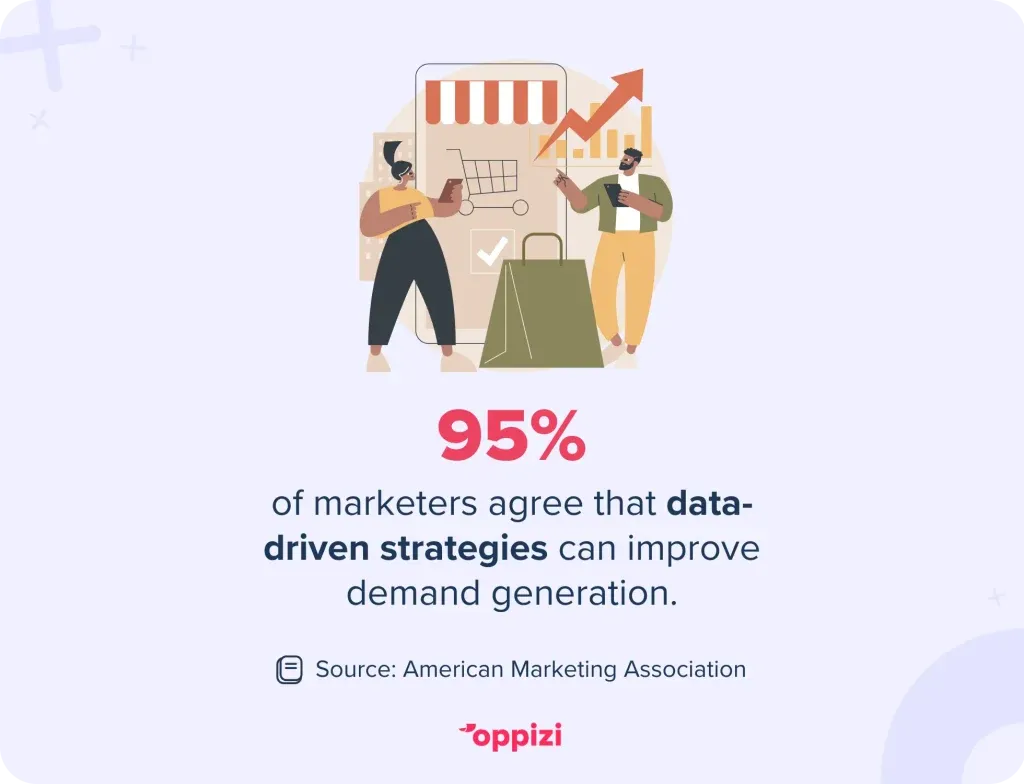
- Use CRM feedback loops: Tap into CRM data and sales team feedback to understand which types of leads convert best, where drop-offs occur, and how to fine-tune targeting over time. 95% of marketers agree that data-driven strategies can improve demand generation.
Marketing efforts generate demand, but it’s sales that will convert it. You need both teams pulling in the same direction and working towards your shared goal.
Step 7: Use tech to automate and scale
You can’t manually nurture thousands of potential leads. Thankfully, marketing automation and CRM tools can help.
Use marketing and sales tools to work smarter:
- Automation platforms (like HubSpot, Marketo, or ActiveCampaign):Automate email sequences, lead nurturing, segmentation, and customer journeys at scale.
- Analytics tools (like Google Analytics or Looker Studio): Get insights into campaign performance, user behavior, and ROI across touchpoints.
- Lead scoring tools: Prioritize follow-ups by ranking leads based on engagement, fit, and likelihood to convert.
- Oppizi’s dashboard: Track the performance of offline campaigns in real time, so you can optimize flyer campaigns, direct mail, and more.
Leverage technology for scalability in demand generation, but ensure automation enhances, not replaces, genuine human connection. Streamline processes with automation while maintaining authentic and personalized messaging.
The benefits of an effective demand generation strategy
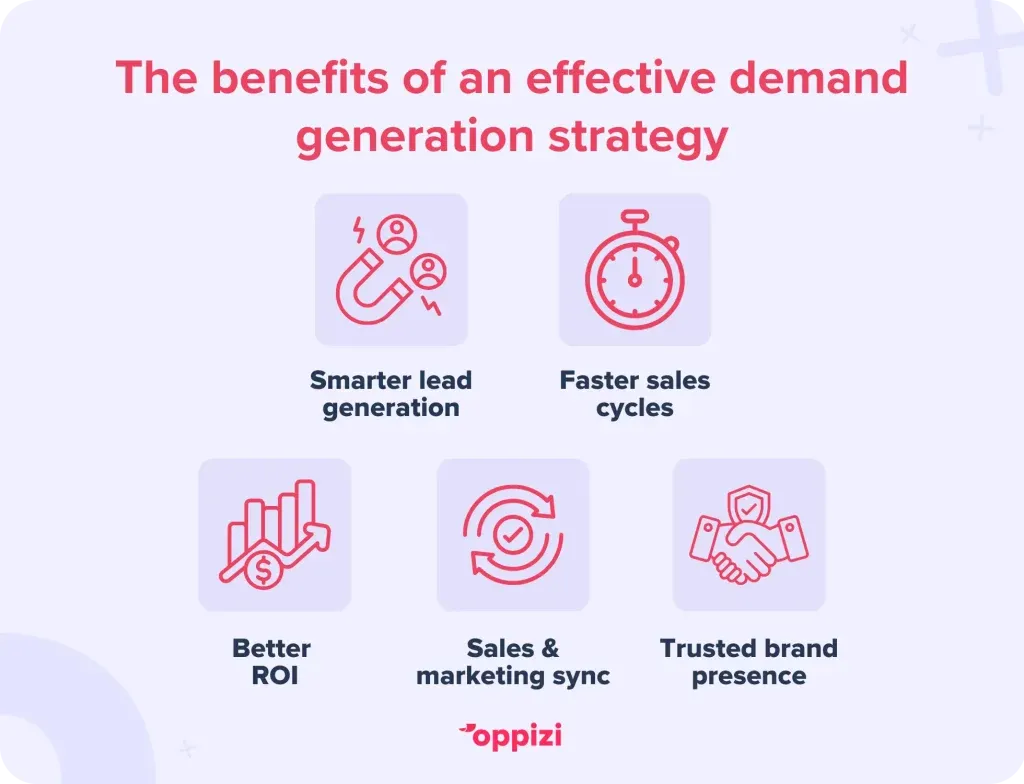
Here’s how a successful demand generation strategy pays off:
Consistent lead flow
A well-structured strategy ensures you’re not just generating leads, but attracting the right ones. These are people who are genuinely interested in what you offer and are more likely to convert.
Shorter sales cycles
When leads are nurtured with relevant, targeted content at each stage of the buyer journey, they arrive at sales conversations more informed and ready to make a decision.
Higher ROI on marketing spend
To enhance campaign performance, align your content, messaging, and channels with specific goals and KPIs. This enables real-time optimization, reducing wasted resources and maximizing impact.
Stronger sales and marketing alignment
Demand generation fosters sales and marketing alignment, which leads to enhanced communication and a more unified customer journey.
Brand authority and trust
By consistently delivering value through your content and campaigns, you position your brand as a trusted resource.
Effective demand generation is not about isolated, attention-grabbing campaigns. Instead, it focuses on creating a consistent and replicable system that drives long-term business expansion.
FAQs about demand generation
1. What’s the difference between demand generation and lead generation?
Demand generation aims to build brand awareness and cultivate interest early in the customer journey, while lead generation concentrates on acquiring contact information after the initial interest has been created.
2. How long does it take to see results from a demand generation strategy?
It typically takes 3-6 months to see results, especially when it comes to content-driven strategies. Long-term consistency is key with demand generation.
3. Is offline marketing really still effective for demand generation?
Absolutely. Offline marketing creates memorable touchpoints that digital ads can’t match - especially when integrated with digital campaigns.
4. How do I track offline marketing ROI?
Incorporate QR codes, trackable URLs, or promo codes on offline marketing materials to monitor their performance by location. Oppizi uses dashboards for real-time analytics of these metrics.
5. What’s the best content for top-of-funnel demand gen?
Content focused on education, such as blog posts, explainer videos, and awareness-stage flyers, yields the best results. Prioritize delivering value rather than direct sales tactics.
Final thoughts
Demand generation is the fuel your business needs to grow. A well-executed strategy combines the right messaging, content, channels, and metrics to attract attention, build trust, and drive action.
And here’s the game-changer: offline marketing can be a powerful part of that journey.
If you’re looking to create real-world connections that complement your digital efforts, Oppizi makes it easy to launch personalized, trackable campaigns in just minutes.
Ready to supercharge your demand generation strategy? Launch an offline campaign with Oppizi and make your business grow.